Chapter 2: Acids, Bases and Salts
๐Ÿ‡ฎ๐Ÿ‡ณ National Curriculum Standard โ–พ
๐Ÿ› Vidyoric Certified โ€ข Dr. Ananya Sharma
๐Ÿ”ฅ 0 days
โšก 0 Sparks +
Chapter 2: Acids, Bases and Salts

Visual Overview: The Ionic Architecture of Acids, Bases & Salts

STEP 1: VIDEO LESSON ๐Ÿ“ค Uploaded HTML5 Video

๐Ÿ“‘ Interactive Chapter Bookmarks

0 chapters

๐ŸŽ™๏ธ Synchronized Transcript

๐Ÿ”
# Video Lecture Production Script โ€” Step 1: Visual Overview: The Ionic Architecture of Acids, Bases & Salts

- **Step Order**: Step 1 of 13 (Stage 1: Foundations & Chemical Reactivity)
- **Step Type**: `video` (Video Lecture)
- **Deck**: CBSE Class 10 Science Chapter 2: Acids, Bases and Salts
- **Presenter**: Dr. Ananya Sharma, Senior NCERT Chemistry Faculty
- **Production Duration**: ~5 Minutes 30 Seconds (~730 Words Spoken Dialogue)
- **Format**: Dynamic Classroom Studio with 4K Lab Cutaways, 3D Molecular Hydronium Models, and KaTeX Formula Overlays

---

## ? Production Scenes & Cue Breakdown

### Scene 1: From Sensory Clues to Proton Precision (0:00 โ€“ 1:00)
- **Visual Setup**: Wide studio shot. Dr. Ananya Sharma stands with a sliced lemon on one side and a bar of olive oil soap on the other. Behind her, a dark slate display shows glowing $H^+$ and $OH^-$ ions in water.
- **Presenter Dialogue**:
> *"Hello, young scholars! Welcome back to Vidyoric. I am Dr. Ananya Sharma, and today, we enter the ionic realm of **Class 10 Science Chapter 2 โ€” Acids, Bases and Salts**.*
>
> *Since antiquity, humans classified matter through taste and touch: acids tasted sour like lemons and unripe tamarind; bases tasted bitter and felt slippery like soap. But in a modern chemistry laboratory, tasting chemicals is strictly forbidden.*
>
> *How do we identify them with precision? Through **indicators**โ€”chemical dyes and olfactory essences that shift their color or odor in response to hydrogen and hydroxide ions."*
- **On-Screen Display (OSD)**:
- Header: `CHAPTER 2: ACIDS, BASES AND SALTS`
- Subtitle: `Proton Donors, Hydroxide Receptors & The Ionic Architecture`
- Indicator Types: `Natural (Litmus, Turmeric)` โ€ข `Synthetic (Methyl Orange, Phenolphthalein)` โ€ข `Olfactory (Onion, Vanilla)`

---

### Scene 2: Acid-Base Indicators & Gas Evolution (1:00 โ€“ 2:15)
- **Visual Setup**: Close-up laboratory cutaways:
1. Blue litmus turns red in dilute $HCl$; red litmus turns blue in $NaOH$.
2. Phenolphthalein shifts to brilliant magenta pink in alkali.
3. Zinc granules in $H_2SO_4$ bubble furiously with hydrogen gas.
- **Presenter Dialogue**:
> *"Watch what happens when zinc granules are dropped into dilute sulphuric acid:*
> *$$Zn(s) + H_2SO_4(aq) \longrightarrow ZnSO_4(aq) + H_2(g) \uparrow$$*
> *Effervescent bubbles rise through the delivery tube into soapy water. When a lighted splinter approaches the bubbleโ€”POP! That sharp acoustic pop is the definitive forensic test for hydrogen gas.*
>
> *And when acids meet metal carbonates, like marble chips in $HCl$, they liberate carbon dioxide:*
> *$$CaCO_3(s) + 2HCl(aq) \longrightarrow CaCl_2(aq) + H_2O(l) + CO_2(g) \uparrow$$*
> *Passing this $CO_2$ through limewater turns it milky white! But beware of this classic board trap: passing excess $CO_2$ dissolves the white precipitate, forming soluble calcium hydrogen carbonate and turning the liquid crystal clear again!"*
- **On-Screen Display (OSD)**:
- Chemical Equations:
$$Ca(OH)_2(aq) + CO_2(g) \longrightarrow CaCO_3(s)\downarrow \text{ (Milky White)} + H_2O(l)$$
$$CaCO_3(s) + H_2O(l) + CO_2(g) \longrightarrow Ca(HCO_3)_2(aq) \text{ (Soluble & Clear)}$$
- Pop Test Alert: `Hโ‚‚ Gas burns with an unmistakable "POP" sound!`

---

### Scene 3: The Hydronium Paradigm & Electrical Conduction (2:15 โ€“ 3:30)
- **Visual Setup**: 3D molecular simulation showing anhydrous $HCl$ gas hitting dry blue litmus paper (no reaction). Then liquid water is introducedโ€”water molecules surround $HCl$, pulling the proton to form $H_3O^+$, and the litmus turns scarlet red.
- **Presenter Dialogue**:
> *"Here is a profound question examiners love to test: Why does dry $HCl$ gas fail to turn dry blue litmus paper red?*
>
> *Because an isolated proton cannot exist alone! It requires the dipolar pull of water molecules.*
> *When $HCl$ dissolves in water, the hydrogen ion bonds with a water molecule to forge the **Hydronium Ion ($H_3O^+$)**:*
> *$$HCl + H_2O \longrightarrow H_3O^+ + Cl^-$$*
> *Without free ions, there is no acidity, and no electrical conduction! A solution of glucose or alcohol contains hydrogen atoms, but because they do not ionize in water, they cannot conduct electricity and cannot light up a bulb."*
- **On-Screen Display (OSD)**:
- Hydronium Formation:
$$H^+ + H_2O \rightleftharpoons H_3O^+ \quad [\text{Hydronium Ion}]$$
- Conductivity Comparison:
- Dilute $HCl$ / $H_2SO_4$: `Dissociates into Ions` โž” `Conducts Current (Bulb Glows)`
- Glucose / Alcohol: `No Free Ions` โž” `Non-Conducting (Bulb Dark)`

---

### Scene 4: Sรธrensen's Logarithmic pH Scale & Daily Life (3:30 โ€“ 4:45)
- **Visual Setup**: Universal indicator color spectrum ribbon unrolls across the screen: Red (0) to Green (7) to Violet (14). Split cutaways show acid rain eroding the Taj Mahal and gastric acid in the human stomach.
- **Presenter Dialogue**:
> *"In 1909, Danish biochemist Sรธren Sรธrensen devised the **pH Scale**, where 'p' stands for *potenz*โ€”the German word for power.*
> *The pH scale measures hydronium concentration logarithmically from 0 to 14.*
> *A pH below 7 is acidic; a pH of 7 is neutral; a pH above 7 is alkaline.*
>
> *Notice that every single unit drop represents a tenfold leap in proton concentration!*
> *In everyday life, pH governs our biology: our blood is locked in a narrow band between 7.35 and 7.45; tooth enamel dissolves when mouth bacteria lower the pH below 5.5; and when acid rain falls below pH 5.6, it corrodes the marble of the Taj Mahal in a phenomenon known as 'marble cancer'."*
- **On-Screen Display (OSD)**:
- Universal pH Palette:
- $\text{pH} < 7$: Acidic (Red, Orange, Yellow)
- $\text{pH} = 7$: Neutral (Emerald Green)
- $\text{pH} > 7$: Basic (Blue, Indigo, Violet)
- Biological Thresholds:
- Tooth Decay: $\text{pH} < 5.5$ (Enamel Dissolution)
- Acid Rain: $\text{pH} < 5.6$ (Aquatic & Marble Damage)
- Blood Homeostasis: $\text{pH } 7.36 - 7.42$

---

### Scene 5: Roadmap of Salts & Transition to Step 2 (4:45 โ€“ 5:30)
- **Visual Setup**: Studio shot. Dr. Sharma points to the Chlor-Alkali industrial model and the roadmap menu.
- **Presenter Dialogue**:
> *"In the second half of this chapter, we explore how simple rock salt ($NaCl$) powers an industrial revolution through the **Chlor-Alkali process**, yielding caustic soda, chlorine gas, bleaching powder, baking soda, washing soda, and Plaster of Paris.*
>
> *Open **Step 2: Concept Notes**, test the indicator reactions, and let's master Acids, Bases, and Salts together!"*
- **On-Screen Display (OSD)**:
- Checklist:
- [x] Olfactory, natural & synthetic indicators
- [x] Hydrogen "pop" test & Limewater $CO_2$ clearing trap
- [x] Hydronium $H_3O^+$ requirement for acidity
- [x] pH scale logarithmic power & biological thresholds
- Action Button: `Proceed to Step 2: Concept Notes โž”`
STEP 2 โ€ข CONCEPT NOTES โฑ๏ธ 8 min read
๐Ÿ“Œ 0 Notes

1. Physical Perception vs Chemical Precision

In everyday life, we encounter acids and bases through sensory perception: lemons taste sour due to citric acid, vinegar is tangy due to acetic acid, while soap feels slippery and tastes bitter due to alkaline sodium hydroxide. However, tasting laboratory chemicals is perilous. Chemistry relies on indicators โ€” substances that change color or odor in acidic and basic media.

=============================================================================
                      INDICATOR CLASSIFICATION TREE
=============================================================================
                                     โ”‚
     โ”Œโ”€โ”€โ”€โ”€โ”€โ”€โ”€โ”€โ”€โ”€โ”€โ”€โ”€โ”€โ”€โ”€โ”€โ”€โ”€โ”€โ”€โ”€โ”€โ”€โ”€โ”€โ”€โ”€โ”€โ”€โ”€โ”ผโ”€โ”€โ”€โ”€โ”€โ”€โ”€โ”€โ”€โ”€โ”€โ”€โ”€โ”€โ”€โ”€โ”€โ”€โ”€โ”€โ”€โ”€โ”€โ”€โ”€โ”€โ”€โ”€โ”€โ”€โ”€โ”
     โ–ผ                               โ–ผ                               โ–ผ
[NATURAL INDICATORS]       [SYNTHETIC INDICATORS]        [OLFACTORY INDICATORS]
  โ”œโ”€ Litmus (Lichens)        โ”œโ”€ Phenolphthalein            โ”œโ”€ Vanilla Extract
  โ”‚   Acid: Crimson Red      โ”‚   Acid: Colourless          โ”‚   Acid: Scent Intact
  โ”‚   Base: Deep Blue        โ”‚   Base: Vivid Pink          โ”‚   Base: Scent Banished
  โ”œโ”€ Turmeric Paste          โ””โ”€ Methyl Orange              โ”œโ”€ Onion Extract
  โ”‚   Acid: Bright Yellow        Acid: Scarlet Red         โ”‚   Acid: Pungent Scent
  โ”‚   Base: Reddish-Brown        Base: Golden Yellow       โ”‚   Base: Scent Destroyed
  โ””โ”€ Red Cabbage Juice                                     โ””โ”€ Clove Oil
      Acid: Crimson/Red                                        Acid: Retained
      Base: Green/Yellow                                       Base: Disappears
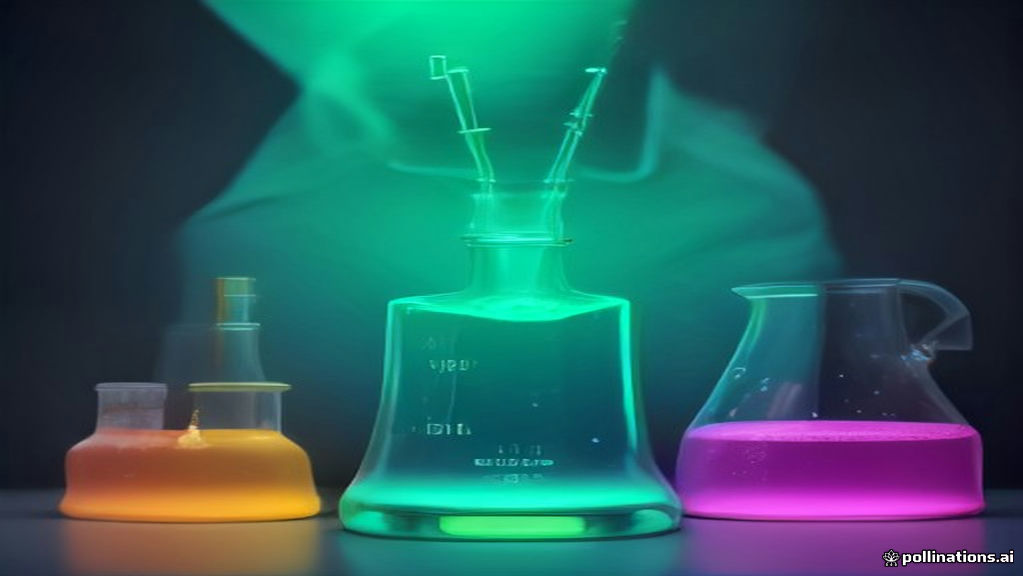
Figure 2.1: The Indicators Spectrum

A. Natural Indicators

  • Litmus: A purple dye extracted from lichens (a symbiotic association of fungus and algae). In acidic solutions ($pH < 7$), blue litmus paper shifts to red. In basic solutions ($pH > 7$), red litmus paper shifts to blue.
  • Turmeric: Contains the natural pigment curcumin. It remains yellow in neutral or acidic conditions, but develops an intense reddish-brown stain in basic media (as seen when soap touches a yellow curry stain on clothes). When rinsed with copious water, it turns yellow again.

B. Synthetic Indicators

  • Phenolphthalein: An organic dye that exists as a colourless lactone in acid, but ionises in basic solutions to form a resonant pink quinoid dianion. Acidic: Colourless; Basic: Intense Pink/Magenta.
  • Methyl Orange: An azo dye. Acidic: Red/Pinkish-red; Basic: Golden Yellow.

C. Olfactory Indicators

Olfactory indicators alter their scent depending on whether they are added to an acid or base. In basic medium, the alkaline $OH^-$ ions react with the volatile aromatic aldehydes and esters, banishing their aroma. In acidic medium, their aroma persists.
๐Ÿ“
Comprehensive High-Yield Mathematical Relations & Theorems

Complete step-by-step derivations, step traps, and LaTeX formula sheet breakdowns...

๐Ÿ”’

End of Free Notes Preview

Unlock the complete deck to access full LaTeX formula breakdowns, interactive diagrams, exam traps, and personal margin highlights!

๐Ÿ”‘ Sign In / Register Free
STEP 3 โ€ข CONCEPT NOTES โฑ๏ธ 8 min read
๐Ÿ“Œ 0 Notes

2. Chemical Reactivity & Gas Testing Protocols

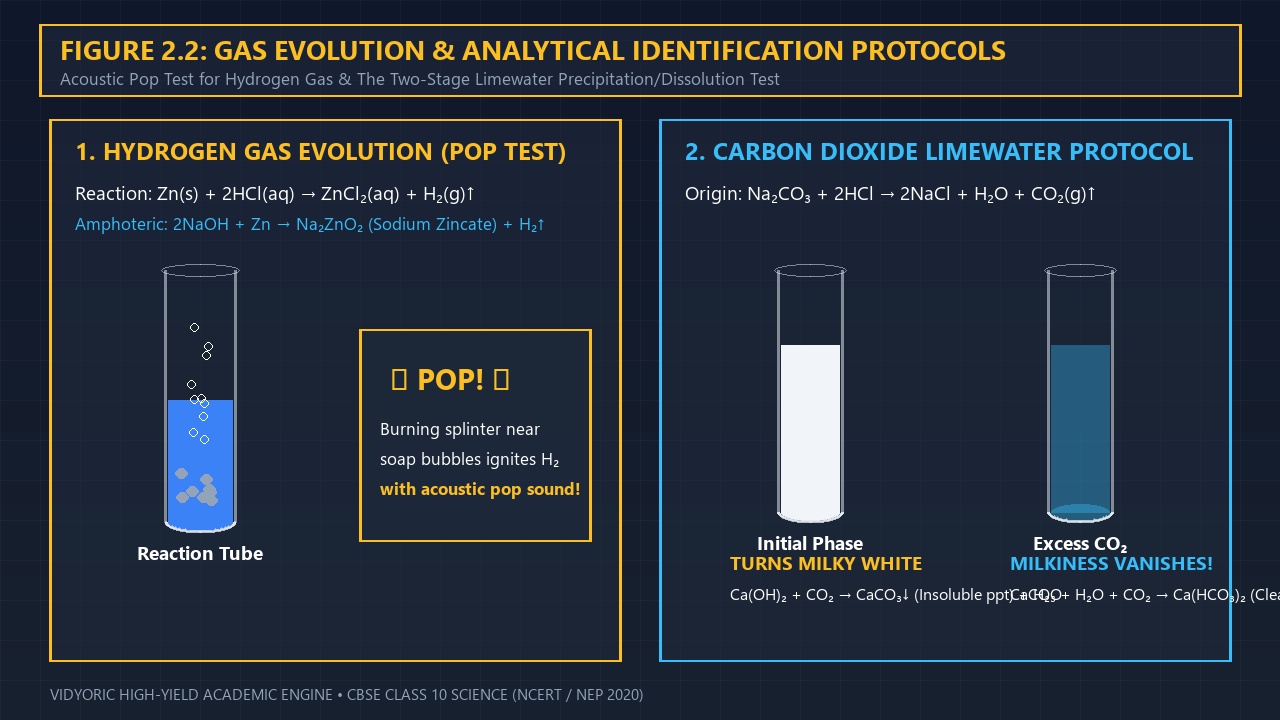
When acids react with metals or carbonates, characteristic gases are liberated. Identifying these gases through standardized analytical tests is a cornerstone of secondary chemistry.

=============================================================================
                     GAS EVOLUTION DIAGNOSTIC PROTOCOL
=============================================================================
                                      โ”‚
     โ”Œโ”€โ”€โ”€โ”€โ”€โ”€โ”€โ”€โ”€โ”€โ”€โ”€โ”€โ”€โ”€โ”€โ”€โ”€โ”€โ”€โ”€โ”€โ”€โ”€โ”€โ”€โ”€โ”€โ”€โ”€โ”€โ”€โ”ดโ”€โ”€โ”€โ”€โ”€โ”€โ”€โ”€โ”€โ”€โ”€โ”€โ”€โ”€โ”€โ”€โ”€โ”€โ”€โ”€โ”€โ”€โ”€โ”€โ”€โ”€โ”€โ”€โ”€โ”€โ”€โ”€โ”
     โ–ผ                                                                 โ–ผ
[HYDROGEN GAS: Hโ‚‚โ†‘]                                         [CARBON DIOXIDE: COโ‚‚โ†‘]
  โ”œโ”€ Origin: Active Metal + Acid                               โ”œโ”€ Origin: Metal Carbonate + Acid
  โ”‚   Zn(s) + 2HCl(aq) โ†’ ZnClโ‚‚(aq) + Hโ‚‚โ†‘                       โ”‚   Naโ‚‚COโ‚ƒ + 2HCl โ†’ 2NaCl + Hโ‚‚O + COโ‚‚โ†‘
  โ”œโ”€ Amphoteric Alkali Reaction:                               โ”œโ”€ Confirmatory Limewater Test:
  โ”‚   2NaOH + Zn โ†’ Naโ‚‚ZnOโ‚‚ + Hโ‚‚โ†‘                               โ”‚   Ca(OH)โ‚‚(aq) + COโ‚‚ โ†’ CaCOโ‚ƒโ†“ (Milky) + Hโ‚‚O
  โ””โ”€ Acoustic Detection:                                       โ””โ”€ Excess COโ‚‚ Trap:
      Brought near burning candle                              โ”‚   CaCOโ‚ƒ + Hโ‚‚O + COโ‚‚ โ†’ Ca(HCOโ‚ƒ)โ‚‚(aq)
      Bursts with characteristic acoustic "POP" sound!         โ””โ”€ Result: Milkiness VANISHES completely!

Figure 2.2: Gas Evolution and Identification

A. Reaction of Acids with Metals

$$\text{Acid} + \text{Metal} \rightarrow \text{Salt} + H_2(g) \uparrow$$
  • Granulated zinc reacts with dilute sulphuric acid:
$$Zn(s) + H_2SO_4(aq) \rightarrow ZnSO_4(aq) + H_2(g) \uparrow$$
  • Granulated zinc also reacts with hot, concentrated sodium hydroxide:
$$2NaOH(aq) + Zn(s) \xrightarrow{\Delta} Na_2ZnO_2(aq) \text{ (Sodium zincate)} + H_2(g) \uparrow$$
  • Acoustic Pop Test: Hydrogen bubbles passed through soap solution rise as soap bubbles. When a burning candle is brought near, the bubble bursts with a characteristic acoustic pop sound.

B. Reaction with Carbonates & Hydrogen Carbonates

$$\text{Metal Carbonate} + \text{Acid} \rightarrow \text{Salt} + H_2O(l) + CO_2(g) \uparrow$$
  • Sodium carbonate with hydrochloric acid:
$$Na_2CO_3(s) + 2HCl(aq) \rightarrow 2NaCl(aq) + H_2O(l) + CO_2(g) \uparrow$$
  • Sodium hydrogen carbonate with hydrochloric acid:
$$NaHCO_3(s) + HCl(aq) \rightarrow NaCl(aq) + H_2O(l) + CO_2(g) \uparrow$$

C. The Two-Stage Limewater Test

  1. Initial Clouding: $CO_2$ passed through clear lime water turns it milky white due to insoluble calcium carbonate:
$$Ca(OH)_2(aq) + CO_2(g) \rightarrow CaCO_3(s) \downarrow \text{ (white precipitate)} + H_2O(l)$$
  1. Clearing with Excess $CO_2$: Passing excess $CO_2$ converts the insoluble precipitate into soluble calcium hydrogen carbonate:
$$CaCO_3(s) + H_2O(l) + CO_2(g) \rightarrow Ca(HCO_3)_2(aq) \text{ (soluble, transparent)}$$
๐Ÿ“
Comprehensive High-Yield Mathematical Relations & Theorems

Complete step-by-step derivations, step traps, and LaTeX formula sheet breakdowns...

๐Ÿ”’

End of Free Notes Preview

Unlock the complete deck to access full LaTeX formula breakdowns, interactive diagrams, exam traps, and personal margin highlights!

๐Ÿ”‘ Sign In / Register Free
STEP 4 โ€ข CONCEPT NOTES โฑ๏ธ 8 min read
๐Ÿ“Œ 0 Notes

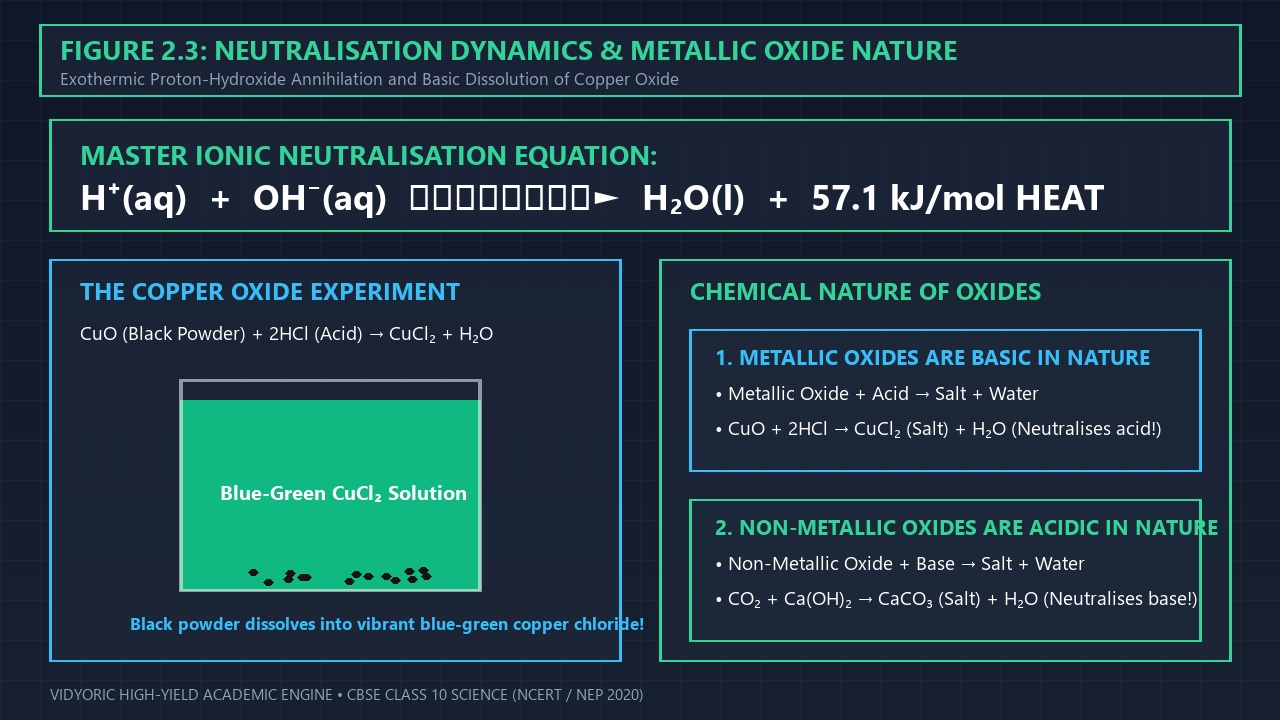
3. Neutralisation Dynamics & The Chemical Nature of Oxides

When an acid encounters a base, their chemical properties cancel each other out in an exothermic process termed neutralisation.

=============================================================================
                    OXIDE CHEMISTRY & NEUTRALISATION LAWS
=============================================================================
                                      โ”‚
     โ”Œโ”€โ”€โ”€โ”€โ”€โ”€โ”€โ”€โ”€โ”€โ”€โ”€โ”€โ”€โ”€โ”€โ”€โ”€โ”€โ”€โ”€โ”€โ”€โ”€โ”€โ”€โ”€โ”€โ”€โ”€โ”€โ”€โ”ดโ”€โ”€โ”€โ”€โ”€โ”€โ”€โ”€โ”€โ”€โ”€โ”€โ”€โ”€โ”€โ”€โ”€โ”€โ”€โ”€โ”€โ”€โ”€โ”€โ”€โ”€โ”€โ”€โ”€โ”€โ”€โ”€โ”
     โ–ผ                                                                 โ–ผ
[METALLIC OXIDES: BASIC NATURE]                             [NON-METALLIC OXIDES: ACIDIC NATURE]
  โ”œโ”€ React with Acids to form Salt + Water                     โ”œโ”€ React with Bases to form Salt + Water
  โ”‚   CuO(s) + 2HCl(aq) โ†’ CuClโ‚‚(aq) + Hโ‚‚O                      โ”‚   COโ‚‚(g) + Ca(OH)โ‚‚(aq) โ†’ CaCOโ‚ƒ(s) + Hโ‚‚O
  โ”œโ”€ Colour Transformation:                                    โ”œโ”€ Mechanism:
  โ”‚   Black CuO powder dissolves into                          โ”‚   Non-metal oxide acts like an acid,
  โ”‚   Blue-Green Copper(II) Chloride solution                  โ”‚   neutralizing the alkaline hydroxide.
  โ””โ”€ Core Deduction: Metallic Oxides = Basic                   โ””โ”€ Core Deduction: Non-Metallic Oxides = Acidic

Figure 2.3: Neutralisation and Oxide Nature

A. The Master Ionic Equation of Neutralisation

At the molecular level, neutralisation is the fusion of aqueous hydrogen ions ($H^+$) and aqueous hydroxide ions ($OH^-$) to synthesize neutral water:

$$H^+(aq) + OH^-(aq) \rightarrow H_2O(l) \quad (\Delta H = -57.1 \text{ kJ/mol})$$

B. Metallic Oxides are Basic

Because metallic oxides react with acids to yield a salt and water, they behave as chemical bases:

$$\text{Metal Oxide} + \text{Acid} \rightarrow \text{Salt} + \text{Water}$$
  • The Copper Oxide Experiment: Black copper(II) oxide powder stirred into dilute hydrochloric acid dissolves to form a vibrant blue-green solution:
$$CuO(s) \text{ (Black)} + 2HCl(aq) \rightarrow CuCl_2(aq) \text{ (Blue-Green)} + H_2O(l)$$

C. Non-Metallic Oxides are Acidic

Non-metallic oxides react with bases to yield salt and water, proving their acidic character:

$$\text{Non-Metal Oxide} + \text{Base} \rightarrow \text{Salt} + \text{Water}$$
  • Carbon dioxide reacting with calcium hydroxide:
$$CO_2(g) + Ca(OH)_2(aq) \rightarrow CaCO_3(s) + H_2O(l)$$
  • Sulphur dioxide reacting with sodium hydroxide:
$$SO_2(g) + 2NaOH(aq) \rightarrow Na_2SO_3(aq) + H_2O(l)$$
๐Ÿ“
Comprehensive High-Yield Mathematical Relations & Theorems

Complete step-by-step derivations, step traps, and LaTeX formula sheet breakdowns...

๐Ÿ”’

End of Free Notes Preview

Unlock the complete deck to access full LaTeX formula breakdowns, interactive diagrams, exam traps, and personal margin highlights!

๐Ÿ”‘ Sign In / Register Free
STEP 5 โ€ข CONCEPT NOTES โฑ๏ธ 8 min read
๐Ÿ“Œ 0 Notes

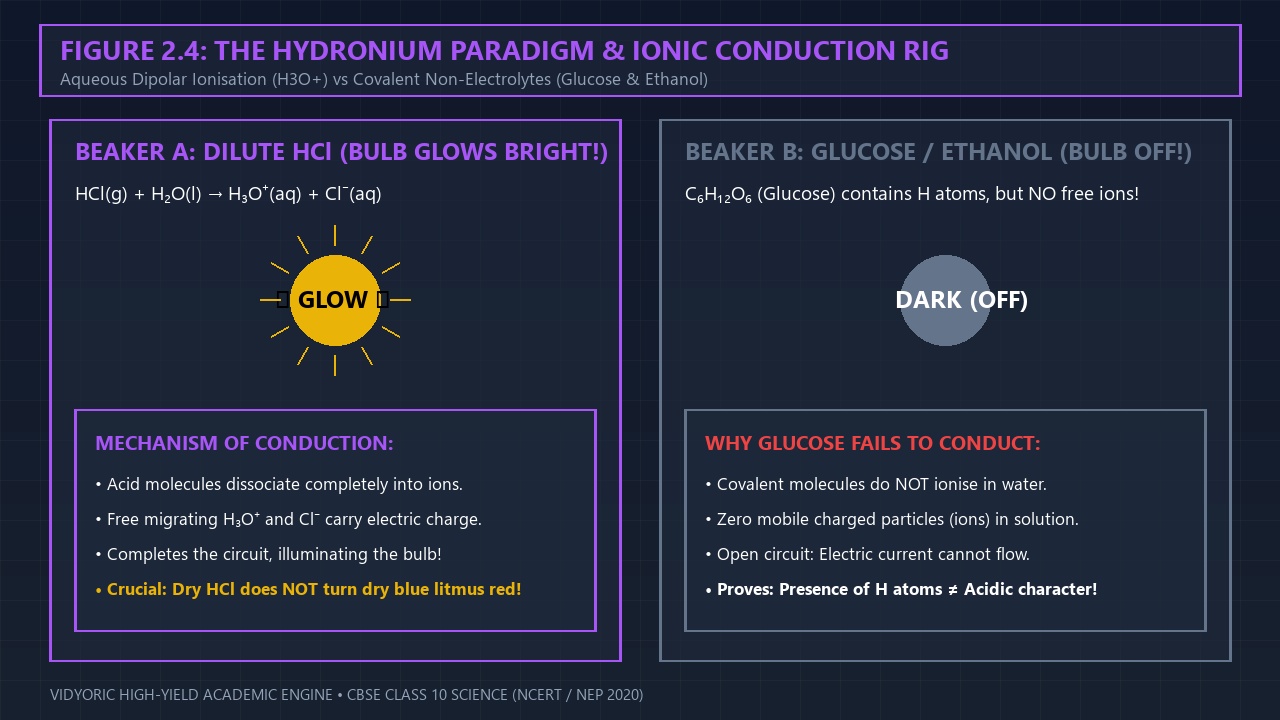
4. The Hydronium Paradigm & The Requirement of Water

Why do acids exhibit acidic behaviour exclusively in aqueous solutions? What occurs at the submicroscopic molecular level?

=============================================================================
                  THE WATER DISSOCIATION & CONDUCTION RIG
=============================================================================
                                     โ”‚
     โ”Œโ”€โ”€โ”€โ”€โ”€โ”€โ”€โ”€โ”€โ”€โ”€โ”€โ”€โ”€โ”€โ”€โ”€โ”€โ”€โ”€โ”€โ”€โ”€โ”€โ”€โ”€โ”€โ”€โ”€โ”€โ”€โ”ดโ”€โ”€โ”€โ”€โ”€โ”€โ”€โ”€โ”€โ”€โ”€โ”€โ”€โ”€โ”€โ”€โ”€โ”€โ”€โ”€โ”€โ”€โ”€โ”€โ”€โ”€โ”€โ”€โ”€โ”€โ”€โ”
     โ–ผ                                                               โ–ผ
[BEAKER A: DILUTE HCl (AQUEOUS)]                            [BEAKER B: GLUCOSE / ETHANOL]
  โ”œโ”€ Dissociation:                                            โ”œโ”€ State:
  โ”‚   HCl + Hโ‚‚O โ†’ Hโ‚ƒOโบ(aq) + Clโป(aq)                          โ”‚   Cโ‚†Hโ‚โ‚‚Oโ‚† remains intact covalent molecules
  โ”œโ”€ Mobile Charge Carriers:                                  โ”œโ”€ Ions Released:
  โ”‚   Hydronium cations & chloride anions migrate             โ”‚   ZERO ions produced in water
  โ””โ”€ Electrical Circuit:                                      โ””โ”€ Electrical Circuit:
      BULB GLOWS BRIGHTLY!                                        BULB REMAINS COMPLETELY DARK!

Figure 2.4: The Hydronium Paradigm & Conductivity

A. The Hydronium Ion ($H_3O^+$)

A bare hydrogen ion ($H^+$) is a naked proton with an extremely high charge-to-radius ratio. It cannot exist independently in aqueous solution. It immediately forms a coordinate bond with a lone pair on a polar water molecule:

$$HCl(g) + H_2O(l) \rightarrow H_3O^+(aq) + Cl^-(aq)$$

B. Dry $HCl$ Gas vs Moist Litmus Paper

  • When dry $HCl$ gas is tested with dry blue litmus paper, there is NO color change.
  • When dry $HCl$ gas touches moist blue litmus paper, it turns red immediately.
  • Deduction: Water is mandatory for ionisation. Without polar water molecules to solvate and stabilize the proton, covalent $H-Cl$ bonds do not dissociate.

C. Electrical Conductivity in Solution

  • Electrolytes: Aqueous solutions of $HCl, H_2SO_4, HNO_3, NaOH$ contain mobile ions that migrate towards electrodes, closing the electrical circuit and illuminating the bulb.
  • Non-Electrolytes: Glucose ($C_6H_{12}O_6$) and ethyl alcohol ($C_2H_5OH$) contain hydrogen atoms, but their covalent bonds do not ionise in water. No ions are produced, so the bulb remains off.

D. The Strict Dilution Safety Law

Diluting a concentrated acid with water is a violently exothermic process.

  • Rule: Always add acid slowly to water with continuous stirring (Acid into Water).
  • Hazard: If water is poured into concentrated acid, the intense localized heat instantly boils the water into steam, violently splashing concentrated corrosive acid onto the experimenter and shattering the glassware from thermal shock!
๐Ÿ“
Comprehensive High-Yield Mathematical Relations & Theorems

Complete step-by-step derivations, step traps, and LaTeX formula sheet breakdowns...

๐Ÿ”’

End of Free Notes Preview

Unlock the complete deck to access full LaTeX formula breakdowns, interactive diagrams, exam traps, and personal margin highlights!

๐Ÿ”‘ Sign In / Register Free
STEP 6 โ€ข CONCEPT NOTES โฑ๏ธ 8 min read
๐Ÿ“Œ 0 Notes

5. Quantitative Acidity: Sorenson's pH Scale

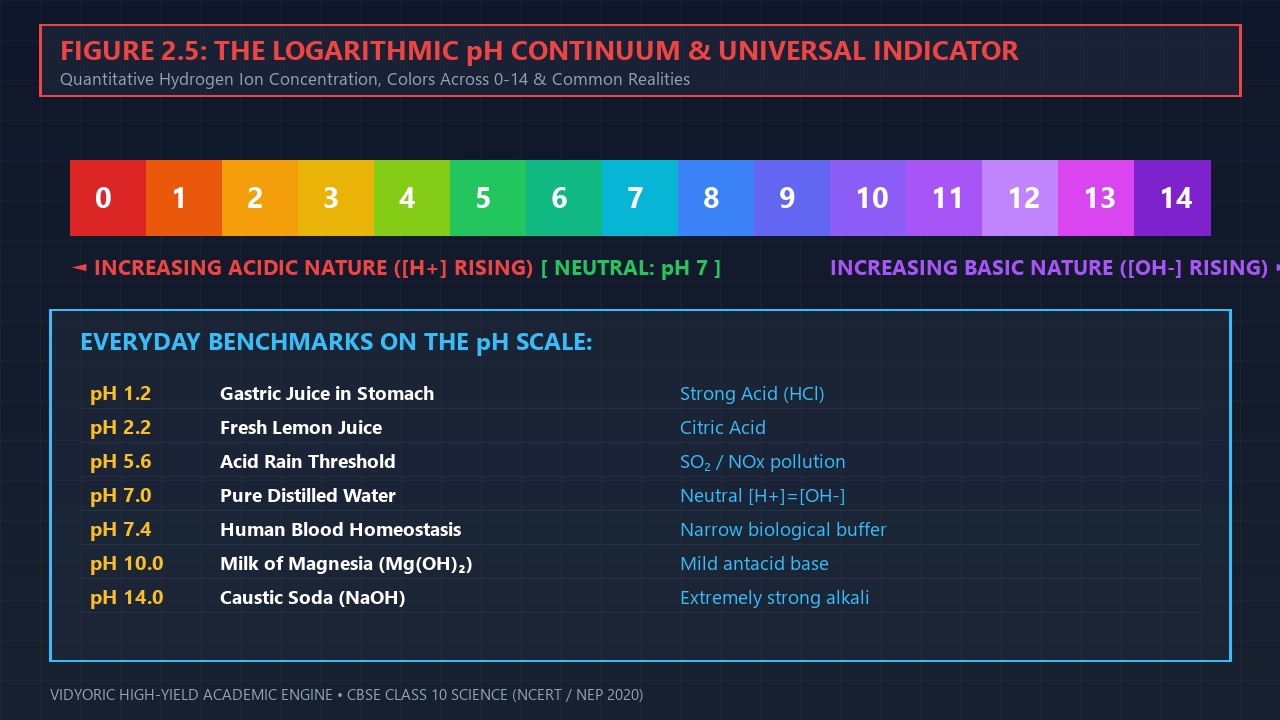
In 1909, Danish biochemist Sรธren Sรธrensen devised the pH scale to express hydrogen ion concentration quantitatively on a convenient scale from 0 to 14.

=============================================================================
                  THE UNIVERSAL INDICATOR pH CONTINUUM
=============================================================================
  0      1      2      3      4      5      6      7      8      9     10     11     12     13     14
[RED] [CRIMSON] [ORANGE] [YELLOW-ORANGE] [YELLOW] [GREEN] [CYAN] [BLUE] [INDIGO] [VIOLET] [PURPLE]
โ—„โ”€โ”€โ”€โ”€โ”€โ”€โ”€โ”€โ”€โ”€โ”€โ”€โ”€โ”€โ”€โ”€โ”€โ”€โ”€โ”€โ”€โ”€โ”€โ”€ INCREASING ACIDITY โ”€โ”€โ”€โ”€โ”ผโ”€โ”€โ”€โ”€ INCREASING BASICITY โ”€โ”€โ”€โ”€โ”€โ”€โ”€โ”€โ”€โ”€โ”€โ”€โ”€โ”€โ”€โ”€โ”€โ”€โ”€โ”€โ”€โ”€โ”€โ”€โ–บ
                      High [Hโบ] / Low [OHโป]     NEUTRAL     Low [Hโบ] / High [OHโป]
                                              [Hโบ]=[OHโป]

Figure 2.5: The Logarithmic pH Scale

A. Mathematical Foundations of pH

  • $p$ represents German potenz (power); $H$ represents hydrogen ion concentration:
$$pH = -\log_{10}[H^+]$$
  • Neutral Point: At $298\text{ K}$, pure water has $[H^+] = 10^{-7}\text{ M}$, yielding $pH = 7$.
  • Acidic Solutions: $[H^+] > 10^{-7}\text{ M} \implies pH < 7$.
  • Basic Solutions: $[H^+] < 10^{-7}\text{ M} \implies pH > 7$.
  • Logarithmic Factor: A decrease of 1 pH unit corresponds to a 10-fold increase in $[H^+]$ ion concentration. A solution at $pH = 3$ is 100 times more acidic than a solution at $pH = 5$.

B. Universal Indicator

A single indicator like litmus only tells if a substance is an acid or a base, but not how strong it is. Universal indicator is a carefully calibrated blend of indicators (including phenolphthalein, methyl red, bromothymol blue, and thymol blue) that displays a continuous spectrum of distinct colours across pH 0 to 14.

pH RangeUniversal Indicator ColourTypical Example
0 โ€“ 1Deep Red / CrimsonBattery acid, Concentrated $HCl$
1.2 โ€“ 2.0RedGastric juice in human stomach
2.2 โ€“ 3.0Orange-RedLemon juice, Vinegar
4.0 โ€“ 5.0Orange-YellowTomato juice, Black coffee
5.6Yellow-GreenAcid rain threshold
6.5 โ€“ 6.8Pale GreenFresh milk, Human saliva before meal
7.0Emerald GreenPure distilled water (Neutral)
7.4Greenish-BlueHuman blood
8.5Cyan / Pale BlueBaking soda solution
10.0Deep BlueMilk of Magnesia ($Mg(OH)_2$)
11.5 โ€“ 12.0Violet / PurpleAmmonia solution, Bleach
13.0 โ€“ 14.0Deep Purple / VioletConcentrated $NaOH$ (Caustic soda)
๐Ÿ“
Comprehensive High-Yield Mathematical Relations & Theorems

Complete step-by-step derivations, step traps, and LaTeX formula sheet breakdowns...

๐Ÿ”’

End of Free Notes Preview

Unlock the complete deck to access full LaTeX formula breakdowns, interactive diagrams, exam traps, and personal margin highlights!

๐Ÿ”‘ Sign In / Register Free
๐Ÿ”’
Step 7 is Locked

CBSE Diagnostic Mastery Quiz: Acids, Bases & Salts Board Check

This ๐Ÿ“ LaTeX Concept Notes is part of the full verified curriculum for Chapter 2: Acids, Bases and Salts. Unlock the full deck to gain permanent access to all 13 interactive stages, active recall cards, and diagnostic checkpoints.

Deck Access Price
100% Free with Account
Instant Access
โœ“ UPI & Cards Supported
๐Ÿ”‘ Sign In / Register to Unlock Free →
๐Ÿ”’
Step 8 is Locked

CBSE Diagnostic Mastery Quiz: Acids, Bases & Salts Board Check

This ๐Ÿ“ LaTeX Concept Notes is part of the full verified curriculum for Chapter 2: Acids, Bases and Salts. Unlock the full deck to gain permanent access to all 13 interactive stages, active recall cards, and diagnostic checkpoints.

Deck Access Price
100% Free with Account
Instant Access
โœ“ UPI & Cards Supported
๐Ÿ”‘ Sign In / Register to Unlock Free →
๐Ÿ”’
Step 9 is Locked

CBSE Diagnostic Mastery Quiz: Acids, Bases & Salts Board Check

This ๐Ÿ“ LaTeX Concept Notes is part of the full verified curriculum for Chapter 2: Acids, Bases and Salts. Unlock the full deck to gain permanent access to all 13 interactive stages, active recall cards, and diagnostic checkpoints.

Deck Access Price
100% Free with Account
Instant Access
โœ“ UPI & Cards Supported
๐Ÿ”‘ Sign In / Register to Unlock Free →
๐Ÿ”’
Step 10 is Locked

CBSE Diagnostic Mastery Quiz: Acids, Bases & Salts Board Check

This ๐Ÿ“ LaTeX Concept Notes is part of the full verified curriculum for Chapter 2: Acids, Bases and Salts. Unlock the full deck to gain permanent access to all 13 interactive stages, active recall cards, and diagnostic checkpoints.

Deck Access Price
100% Free with Account
Instant Access
โœ“ UPI & Cards Supported
๐Ÿ”‘ Sign In / Register to Unlock Free →
๐Ÿ”’
Step 11 is Locked

CBSE Diagnostic Mastery Quiz: Acids, Bases & Salts Board Check

This Microlearning Step is part of the full verified curriculum for Chapter 2: Acids, Bases and Salts. Unlock the full deck to gain permanent access to all 13 interactive stages, active recall cards, and diagnostic checkpoints.

Deck Access Price
100% Free with Account
Instant Access
โœ“ UPI & Cards Supported
๐Ÿ”‘ Sign In / Register to Unlock Free →
๐Ÿ”’
Step 12 is Locked

CBSE Diagnostic Mastery Quiz: Acids, Bases & Salts Board Check

This ๐Ÿง  Active Recall Flashcards is part of the full verified curriculum for Chapter 2: Acids, Bases and Salts. Unlock the full deck to gain permanent access to all 13 interactive stages, active recall cards, and diagnostic checkpoints.

Deck Access Price
100% Free with Account
Instant Access
โœ“ UPI & Cards Supported
๐Ÿ”‘ Sign In / Register to Unlock Free →
๐Ÿ”’
Step 13 is Locked

CBSE Diagnostic Mastery Quiz: Acids, Bases & Salts Board Check

This โšก Diagnostic Quiz is part of the full verified curriculum for Chapter 2: Acids, Bases and Salts. Unlock the full deck to gain permanent access to all 13 interactive stages, active recall cards, and diagnostic checkpoints.

Deck Access Price
100% Free with Account
Instant Access
โœ“ UPI & Cards Supported
๐Ÿ”‘ Sign In / Register to Unlock Free →