📑 Interactive Chapter Bookmarks
0 chapters🎙️ Synchronized Transcript
**CBSE Class 10 Mathematics • Chapter 5: Arithmetic Progressions**
**Step 1 | Target Duration: 06:45 min | Educator: Prof. Arvind Swaminathan**
---
### [00:00 - 01:10] Hook: The Rhythm of Uniform Steps
**Visual Scene**:
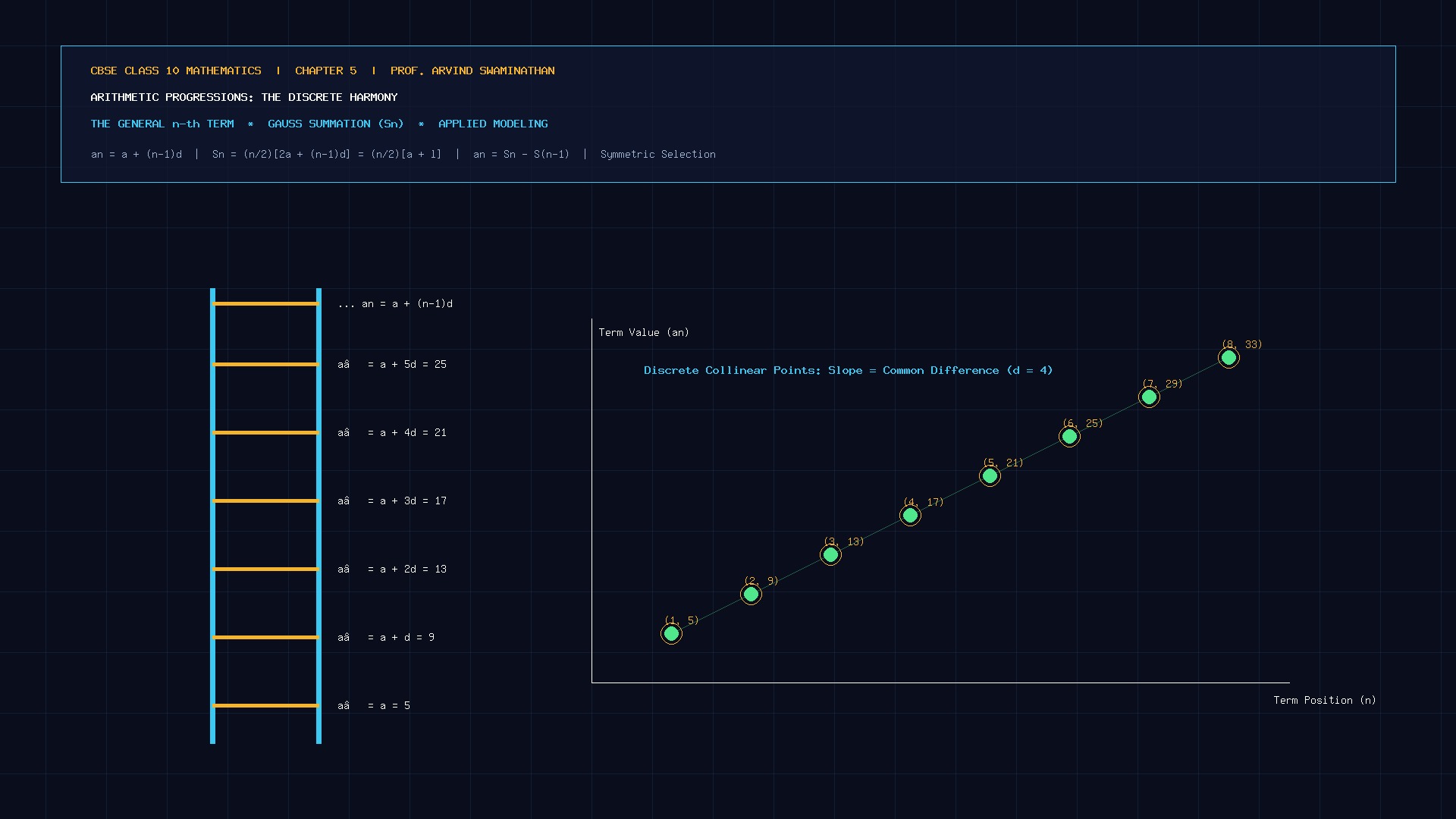
Prof. Arvind Swaminathan stands next to a wooden ladder standing upright on a studio floor. Next to the ladder, an illuminated digital number line glows in deep blue and gold. The rungs of the ladder light up one by one from bottom to top, displaying the numbers: $10, 15, 20, 25, 30\dots$
**Prof. Arvind Swaminathan**:
"Namaste students! Look closely at this ladder. Each rung is spaced at an identical distance from the one below it. When you climb, you don't take a 10 cm step, then a 50 cm leap, then a 2 cm hop. Every single step is predictable, uniform, and rhythmically constant.
In mathematics, whenever a sequence of numbers moves forward—or backward—by adding the exact same number at every single step, we call that rhythm an **Arithmetic Progression**, or an **AP**.
Whether it is your savings account growing by ₹500 every month, the cooling temperature of a furnace dropping by 3 degrees every minute, or the expansion of seating rows in an auditorium, AP is the heartbeat of discrete mathematics. Today, we decode how to predict any term in the future without writing down a hundred intermediate numbers!"
---
### [01:10 - 02:40] The Anatomy of an AP: First Term and Common Difference
**Visual Scene**:
A general sequence appears in glowing KaTeX typography:
$a_1, a_2, a_3, a_4 \dots a_n$
An animated magnifying glass focuses on the leap between each term, labeling the jump $+d$.
**Prof. Arvind Swaminathan**:
"Let us define the two building blocks that completely determine an entire AP.
The first building block is **$a$**—the **First Term**. It is where the journey begins.
The second building block is **$d$**—the **Common Difference**. It is the size and direction of every single step.
How do you find $d$?
Very simple: take ANY term and subtract the term immediately before it!
$$d = a_2 - a_1 = a_3 - a_2 = a_{k+1} - a_k$$
Now, here is a secret students often forget: $d$ does not have to be a positive whole number!
If your sequence is $2, 6, 10, 14\dots$, $d = +4$ (an increasing AP).
If your sequence is $100, 70, 40, 10\dots$, $d = -30$ (a decreasing AP).
And if your sequence is $7, 7, 7, 7\dots$, $d = 0$! Yes, a constant sequence is also an AP with common difference zero!"
---
### [02:40 - 04:20] Deriving the $n$-th Term Formula: The $(n-1)$ Secret
**Visual Scene**:
Prof. Arvind writes a vertical column on the digital blackboard:
Term 1: $a$
Term 2: $a + d$
Term 3: $a + 2d$
Term 4: $a + 3d$
A golden box animates around the coefficient of $d$.
**Prof. Arvind Swaminathan**:
"Now, look at the pattern. This is pure beauty.
To reach the 1st term, you take ZERO steps from $a$: $a + 0d$.
To reach the 2nd term, you take ONE step: $a + 1d$.
To reach the 3rd term, you take TWO steps: $a + 2d$.
To reach the 4th term, you take THREE steps: $a + 3d$.
Do you see it? The number of steps you add is ALWAYS ONE LESS than the term number!
So if I ask you: what is the 100th term?
You don't need to write 100 numbers! You just start at $a$ and take 99 steps of size $d$!
$$a_{100} = a + 99d$$
And universally, for any term $n$:
$$a_n = a + (n - 1)d$$
This is your primary engine for this chapter. $n$ is the position of the term, and $a_n$ is the value of the term."
---
### [04:20 - 05:40] The Reverse Journey: Finding Terms from the End
**Visual Scene**:
A finite sequence is shown with a highlighted last term $l$. The direction of arrows reverses, pointing from right to left with $-d$.
**Prof. Arvind Swaminathan**:
"What if the examiner asks: *'Find the 10th term from the END of the AP: $3, 8, 13\dots 253$'*?
Most students panic and try to calculate the total number of terms first.
Here is the pro-tip:
When walking from left to right, you start at $a$ and ADD $d$.
When walking backward from right to left, you start at the LAST term $l$ and SUBTRACT $d$!
Therefore, the $n$-th term from the end is simply:
$$a_n' = l - (n - 1)d$$
For this AP: $l = 253, d = 5$.
The 10th term from the end is $253 - (10 - 1)(5) = 253 - 45 = 208$! Solved in 15 seconds!"
---
### [05:40 - 06:45] The Roadmap Ahead
**Visual Scene**:
The screen displays the upcoming stages: The Gauss Summation Formula, The Difference Bridge ($a_n = S_n - S_{n-1}$), Symmetric Selection of Terms, and Real-World Modeling.
**Prof. Arvind Swaminathan**:
"In the upcoming steps, we will discover how young Carl Friedrich Gauss stunned his teacher by summing 100 numbers in seconds, derive the summation formulas $S_n = \frac{n}{2}[2a + (n-1)d]$ and $S_n = \frac{n}{2}[a + l]$, and tackle real-world puzzles from salary increments to stacked logs.
Let's master the rhythm of arithmetic progressions together. See you in Step 2!"
Diagnostic Quiz & Mastery MCQs: CBSE Class 10 Board Standards
This 📝 LaTeX Concept Notes is part of the full verified curriculum for Chapter 5: Arithmetic Progressions. Unlock the full deck to gain permanent access to all 13 interactive stages, active recall cards, and diagnostic checkpoints.
Diagnostic Quiz & Mastery MCQs: CBSE Class 10 Board Standards
This 📝 LaTeX Concept Notes is part of the full verified curriculum for Chapter 5: Arithmetic Progressions. Unlock the full deck to gain permanent access to all 13 interactive stages, active recall cards, and diagnostic checkpoints.
Diagnostic Quiz & Mastery MCQs: CBSE Class 10 Board Standards
This 📝 LaTeX Concept Notes is part of the full verified curriculum for Chapter 5: Arithmetic Progressions. Unlock the full deck to gain permanent access to all 13 interactive stages, active recall cards, and diagnostic checkpoints.
Diagnostic Quiz & Mastery MCQs: CBSE Class 10 Board Standards
This 📝 LaTeX Concept Notes is part of the full verified curriculum for Chapter 5: Arithmetic Progressions. Unlock the full deck to gain permanent access to all 13 interactive stages, active recall cards, and diagnostic checkpoints.
Diagnostic Quiz & Mastery MCQs: CBSE Class 10 Board Standards
This 📝 LaTeX Concept Notes is part of the full verified curriculum for Chapter 5: Arithmetic Progressions. Unlock the full deck to gain permanent access to all 13 interactive stages, active recall cards, and diagnostic checkpoints.
Diagnostic Quiz & Mastery MCQs: CBSE Class 10 Board Standards
This 📝 LaTeX Concept Notes is part of the full verified curriculum for Chapter 5: Arithmetic Progressions. Unlock the full deck to gain permanent access to all 13 interactive stages, active recall cards, and diagnostic checkpoints.
Diagnostic Quiz & Mastery MCQs: CBSE Class 10 Board Standards
This 📝 LaTeX Concept Notes is part of the full verified curriculum for Chapter 5: Arithmetic Progressions. Unlock the full deck to gain permanent access to all 13 interactive stages, active recall cards, and diagnostic checkpoints.
Diagnostic Quiz & Mastery MCQs: CBSE Class 10 Board Standards
This 📝 LaTeX Concept Notes is part of the full verified curriculum for Chapter 5: Arithmetic Progressions. Unlock the full deck to gain permanent access to all 13 interactive stages, active recall cards, and diagnostic checkpoints.
Diagnostic Quiz & Mastery MCQs: CBSE Class 10 Board Standards
This 📝 LaTeX Concept Notes is part of the full verified curriculum for Chapter 5: Arithmetic Progressions. Unlock the full deck to gain permanent access to all 13 interactive stages, active recall cards, and diagnostic checkpoints.
Movement 1: The Beauty of Discrete Harmony
00:00Movement 2: The Two Pillars: First Term a and Common Difference d
00:00Movement 3: Gauss, Symmetry, and the Summation Formula
00:00Movement 4: The Bridge Between Sn and an
00:00Movement 5: The Exam Hall Master Checklist
00:00**CBSE Class 10 Mathematics • Chapter 5: Arithmetic Progressions**
**Step 11 | Duration: 21:00 min (~5,300 characters) | Narrator: Prof. Arvind Swaminathan**
---
### [00:00 - 04:00] Movement 1: The Beauty of Discrete Harmony
Namaste and welcome to this deep-dive audio masterclass on Arithmetic Progressions. I am Prof. Arvind Swaminathan.
Listen to the ticking of a grandfather clock: tick, tick, tick. Each second that elapses is identical in duration to the last. Look at the frets along the neck of a sitar or veena: they are positioned with mathematical precision so that stepping from one note to the next produces a harmonious acoustic progression.
In mathematics, continuity is beautiful—curves flow smoothly like rivers across the Cartesian plane. But the universe is equally discrete: quantum energy levels, atomic layers in a crystal lattice, and uniform calendar days all unfold in discrete steps. When each step maintains an unchanging magnitude, we enter the realm of the **Arithmetic Progression**.
Fifteen hundred years ago, in the ancient university city of Kusumpura, the great Indian astronomer and mathematician Aryabhata composed the *Aryabhatiya*. In his chapter on mathematics—the Ganitapada—he formulated exact rules for calculating the sum of arithmetic sequences and determining the number of terms. Today, that very same mathematical rhythm powers financial installment schedules, computer algorithms, and architectural engineering.
---
### [04:00 - 08:30] Movement 2: The Two Pillars: First Term $a$ and Common Difference $d$
Let us strip an Arithmetic Progression down to its fundamental essence. Any AP, no matter how vast or complex, is completely governed by two parameters: its starting coordinate $a$, and its step size $d$.
The first term $a$ establishes the baseline. The common difference $d$ is the constant difference between any term and its immediate predecessor: $d = a_{k+1} - a_k$.
Notice the exact order of subtraction: it is always the *next* term minus the *current* term. If an AP descends from $100$ to $70$ to $40$, the common difference is $70 - 100 = -30$, not $+30$. Forgetting that negative sign is the single most common pitfall among students in secondary examinations.
Now, consider the journey along this number ladder. To find the second term, you add $d$ once: $a + d$. To find the third term, you add $d$ twice: $a + 2d$. To find the $n$-th term, you start at $a$ and take $(n - 1)$ steps of size $d$.
Hence:
$$a_n = a + (n - 1)d$$
Why is the coefficient $(n - 1)$ instead of $n$? Because you are already standing on the first term at the very beginning! You only need $(n - 1)$ steps to travel from the first term to the $n$-th term.
And if you ever need to find the $n$-th term from the *end* of a finite sequence terminating at last term $l$, you simply reverse your perspective: you stand at $l$ and step backward, subtracting $d$ at each stage:
$$a_n' = l - (n - 1)d$$
---
### [08:30 - 13:00] Movement 3: Gauss, Symmetry, and the Summation Formula
Let us now explore how an entire sequence of numbers can be summed instantly.
In the late 18th century, an elementary school teacher in Germany wanted to keep his students occupied for an hour, so he commanded them to add all the integers from $1$ to $100$. Within seconds, a young boy named Carl Friedrich Gauss walked up to the teacher's desk and placed his slate down with the exact answer: $5050$.
How did he do it? Gauss did not add sequentially: $1+2=3, 3+3=6\dots$ That is the brute-force way. Instead, he looked at the sequence as a whole and saw symmetry.
He paired the very first number with the very last number: $1 + 100 = 101$.
He paired the second number with the second-last number: $2 + 99 = 101$.
The third with the third-last: $3 + 98 = 101$.
There were $50$ such pairs, each summing to $101$. And $50 \times 101 = 5050$!
When we generalize this pairing method to any arithmetic progression, we write the sum forward, write the sum backward, and add the two lines together. Each of the $n$ vertical pairs sums to $2a + (n - 1)d$.
Dividing by $2$ gives the master summation formula:
$$S_n = \frac{n}{2}[2a + (n - 1)d]$$
And if the last term $l$ is known directly, since $l = a + (n - 1)d$, the formula simplifies into pure elegance:
$$S_n = \frac{n}{2}[a + l]$$
The average of the first and last term, multiplied by the number of terms.
---
### [13:00 - 17:30] Movement 4: The Bridge Between $S_n$ and $a_n$
Now let us uncover the profound bridge connecting the sum of terms with individual terms.
Suppose you know the sum of the first $n$ terms, $S_n$. How do you find the $n$-th term itself?
Consider: $S_n$ is the total sum from term $1$ all the way to term $n$. $S_{n-1}$ is the total sum from term $1$ to term $(n - 1)$. If you subtract $S_{n-1}$ from $S_n$, every single earlier term is stripped away, leaving only the $n$-th term:
$$a_n = S_n - S_{n-1}$$
In board examinations, you will often be given an expression like:
$$S_n = 3n^2 + 5n$$
And asked to find the common difference $d$.
Here is the master educator shortcut: In any arithmetic progression, the sum $S_n$ is always a quadratic expression in $n$ of the form $An^2 + Bn$, with no constant term. The coefficient of $n^2$ is ALWAYS equal to half the common difference: $A = \frac{d}{2}$.
Therefore, the common difference $d$ is simply twice the coefficient of $n^2$: $d = 2A$!
If $S_n = 3n^2 + 5n$, then $d = 2 \times 3 = 6$ instantly, without performing five minutes of algebraic expansion.
---
### [17:30 - 21:00] Movement 5: The Exam Hall Master Checklist
As you approach your examination hall, fix these three essential safeguards in your memory:
First: Check whether $n$ makes physical sense. In an AP, $n$ represents the rank or number of terms. It must strictly be a positive integer: $1, 2, 3\dots$ If your equation yields $n = 4.5$ or $n = -7$, you must immediately state that such a term cannot exist in the sequence!
Second: When dealing with word problems where sum $S_n$ yields two positive integer values for $n$—such as stacking $200$ logs giving $n = 16$ and $n = 25$—always calculate the $n$-th term for both values! If $a_n$ becomes negative, examine whether negative physical quantities are possible. In the log problem, $a_{25} = -4$, which is physically impossible, leading you to reject $n = 25$ with confidence.
Third: When selecting 3 terms in AP, always choose $(a - d), a, (a + d)$. Their sum is $3a$, eliminating $d$ in the first step. When choosing 4 terms, choose $(a - 3d), (a - d), (a + d), (a + 3d)$, and remember that their common difference is $2d$!
Arithmetic Progressions are the rhythm of order in numbers. Trust the formulas, respect the common difference, and you will achieve absolute mastery. Keep practicing, and I will see you in Chapter 6!
Diagnostic Quiz & Mastery MCQs: CBSE Class 10 Board Standards
This 🧠 Active Recall Flashcards is part of the full verified curriculum for Chapter 5: Arithmetic Progressions. Unlock the full deck to gain permanent access to all 13 interactive stages, active recall cards, and diagnostic checkpoints.
Diagnostic Quiz & Mastery MCQs: CBSE Class 10 Board Standards
This ⚡ Diagnostic Quiz is part of the full verified curriculum for Chapter 5: Arithmetic Progressions. Unlock the full deck to gain permanent access to all 13 interactive stages, active recall cards, and diagnostic checkpoints.