Chapter 4: Carbon and its Compounds
๐Ÿ‡ฎ๐Ÿ‡ณ National Curriculum Standard โ–พ
๐Ÿ› Vidyoric Certified โ€ข Dr. Ananya Sharma
๐Ÿ”ฅ 0 days
โšก 0 Sparks +
Chapter 4: Carbon and its Compounds

Visual Overview: Covalent Bonding, Tetravalency & Functional Isomerism

STEP 1: VIDEO LESSON ๐Ÿ“ค Uploaded HTML5 Video

๐Ÿ“‘ Interactive Chapter Bookmarks

0 chapters

๐ŸŽ™๏ธ Synchronized Transcript

๐Ÿ”
# Vidyoric Video Lecture Production Script
## CBSE Class 10 Science โ€” Chapter 04: Carbon and its Compounds
**Target Runtime**: 15:30 Minutes | **Format**: Cinematic 4K Visual Lecture with 3D Molecular Graphics, Laboratory Demonstrations & Nanoscale CGI

---

### [Scene 1: 00:00 - 02:15] The Covalent Genesis: Why Carbon Refuses to Ionise
- **Visual (Cinematic Cut)**: High-resolution atomic visualization of Carbon (6 protons, 6 neutrons, 4 valence electrons).
- **Narrator**: "Carbon sits quietly at atomic number six. Yet from living DNA to diamond jewellery and petroleum fuels, ninety percent of all known chemical compounds contain carbon. Why?"
- **3D Molecular Animation**:
* Attempt 1: Attempting to add 4 electrons to carbon. Intense electron-electron repulsion destabilizes the tiny atomic shell. Red warning text: *Electrostatic Instability: 6 Protons Cannot Bind 10 Electrons ($C^{4-}$)*.
* Attempt 2: Attempting to strip 4 electrons. Escalating ionization energy graph spikes exponentially. Red warning text: *Prohibitive Ionization Barrier ($C^{4+}$)*.
* The Solution: Four hydrogen atoms approach. Shared orbital electron pairs overlap smoothly. The tetrahedral methane molecule ($CH_4$) emerges in brilliant cyan luminescence.

---

### [Scene 2: 02:15 - 05:00] The Allotropic Trinity: Diamond, Graphite & Fullerene
- **Visual (3D Structural CGI)**:
* *Diamond Lattice*: Infinite 3D interlocking tetrahedral cage ($sp^3$). A laser pulse attempts to pass through: high refractive index sparkles, zero electrical conduction. Extreme hardness test: scratch resistance demonstrated.
* *Graphite Lattice*: Two-dimensional hexagonal graphene sheets stacked in parallel layers ($sp^2$). The sheets glide effortlessly across each other under mechanical shear. Blue electrical spark trails visualize free delocalized pi-electrons migrating between sheets.
* *Buckminsterfullerene ($C_{60}$)*: 60 carbon atoms assembling into a soccer-ball cage of 20 hexagons and 12 pentagons.
- **On-Screen Summary Table**:
* Diamond: Hardest solid, 0 electrical conductivity, $sp^3$ tetrahedral.
* Graphite: Soft & slippery lubricant, high electrical conductivity, $sp^2$ planar sheets.
* Fullerene: $C_{60}$ spherical geodesic nanoparticle.

---

### [Scene 3: 05:00 - 08:30] The Chemical Repertoire: Combustion, Addition & Hydrogenation
- **Visual (Laboratory Footage & CGI)**:
* *Flame Dynamics*:
- Beaker A: Methane gas burning with a clear, non-luminous blue flame (complete combustion).
- Beaker B: Acetylene (ethyne) burning in open air with a yellow, smoky sooty flame. Oxygen jet introduced: flame instantly shifts to blinding, non-sooty blue oxy-acetylene welding flame (3000ยฐC).
* *Bromine Water Test*:
- Test tube with saturated alkane: brown bromine color persists untouched.
- Test tube with unsaturated alkene: reddish-brown bromine water immediately discharges to clear transparent within seconds!
* *Industrial Hydrogenation Demo*:
- Liquid vegetable oil + $H_2$ gas over finely divided Nickel catalyst at 473 K.
- Double bonds saturate; liquid oil solidifies into creamy white vanaspati ghee.

---

### [Scene 4: 08:30 - 11:45] Chemical Titans: Ethanol & Ethanoic Acid
- **Visual (Laboratory Close-Up)**:
* *Sodium in Ethanol*: Small pellet of sodium dropped into absolute ethanol. Steady effervescence of hydrogen gas captured and tested with *pop* sound ($2Na + 2C_2H_5OH \rightarrow 2C_2H_5ONa + H_2 \uparrow$).
* *Acidic Dehydration*: Ethanol boiled with concentrated sulphuric acid at 443 K. Gas collection tube captures ethene gas ($C_2H_4$).
* *Esterification & Saponification*:
- Ethanoic acid + Ethanol + Conc. $H_2SO_4$ heated in water bath.
- Flask poured into beaker of water: sweet fruity fragrance of ethyl ethanoate fills the lab.
- Sodium hydroxide added and boiled (Saponification): ester cleaves, yielding soap foam and ethanol!
* *Glacial Acetic Acid*: Flask of pure ethanoic acid placed in ice bath: liquid freezes solid into glistening ice sheets at 17ยฐC (290 K).

---

### [Scene 5: 11:45 - 15:30] Cleansing Science: Micelles vs Hard Water Scum
- **Visual (Nanoscale 3D CGI Animation)**:
* Anatomy of a soap molecule: Polar hydrophilic ionic head ($-\text{COO}^-Na^+$) and non-polar zigzag hydrophobic hydrocarbon tail ($C_{17}H_{35}-$).
* Oily grease droplet on fabric: Hundreds of soap molecules plunge their hydrocarbon tails into the grease.
* Assembly of the spherical **Micelle**: Polar heads point outward, shielding the grease inside an ionic sphere.
* Water agitated: The spherical micelles repel each other due to negative surface charges, preventing oil droplets from coalescing. Rinsing water sweeps the dirt away effortlessly!
* *The Hard Water Scum Crisis*:
- Hard water containing $Ca^{2+}$ and $Mg^{2+}$ added to soap: instant white curdy precipitate (Scum).
- Hard water added to synthetic detergent (sulphonate head): zero scum, instant frothy lather!
- **Closing Recap**: Dr. Roy directs students to the active recall flashcard bank and diagnostic mastery quiz on Vidyoric.
STEP 2 โ€ข CONCEPT NOTES โฑ๏ธ 8 min read
๐Ÿ“Œ 0 Notes

1. The Covalent Paradigm & The Allotropes of Carbon

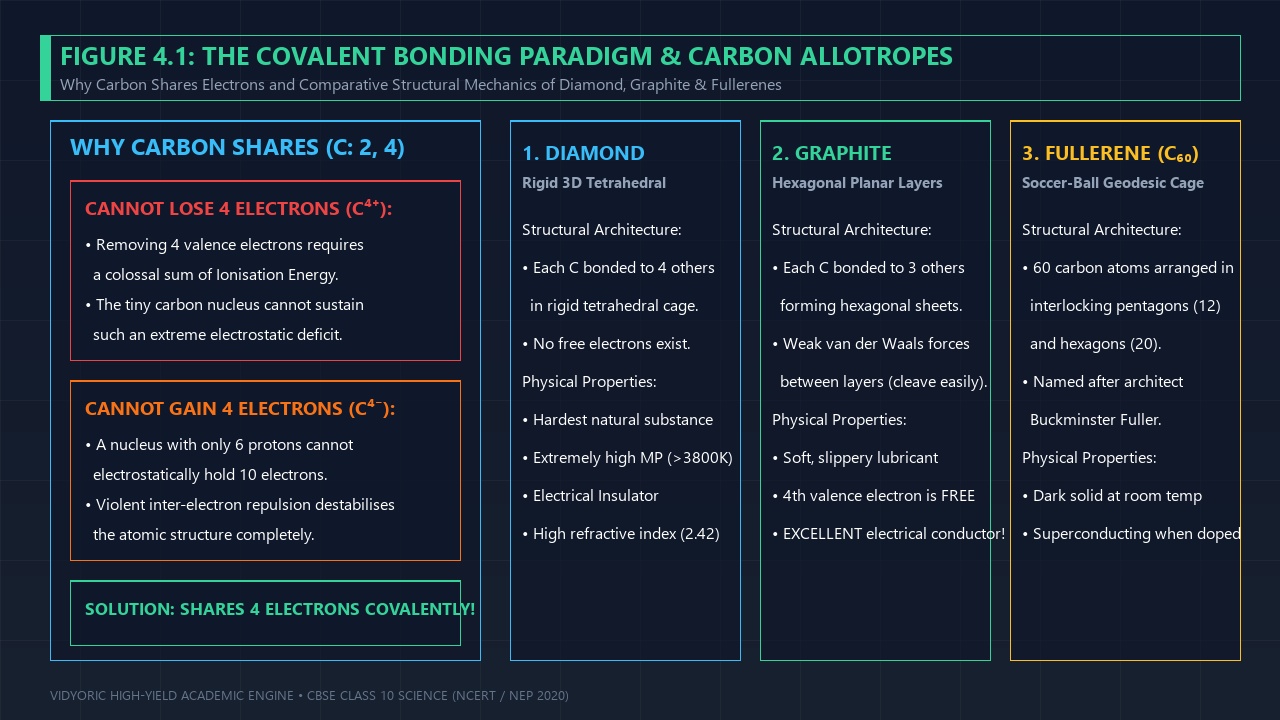
Carbon possesses atomic number 6 with electronic configuration $(2,4)$. It cannot form $C^{4-}$ (a nucleus with 6 protons cannot stabilize 10 electrons) or $C^{4+}$ (prohibitive ionization energy barrier). Carbon achieves noble gas octet stability by sharing electrons through covalent bonds.

=============================================================================
                  THE COVALENT BOND & ALLOTROPIC TRINITY
=============================================================================
                                      โ”‚
     โ”Œโ”€โ”€โ”€โ”€โ”€โ”€โ”€โ”€โ”€โ”€โ”€โ”€โ”€โ”€โ”€โ”€โ”€โ”€โ”€โ”€โ”€โ”€โ”€โ”€โ”€โ”€โ”€โ”€โ”€โ”€โ”€โ”€โ”ผโ”€โ”€โ”€โ”€โ”€โ”€โ”€โ”€โ”€โ”€โ”€โ”€โ”€โ”€โ”€โ”€โ”€โ”€โ”€โ”€โ”€โ”€โ”€โ”€โ”€โ”€โ”€โ”€โ”€โ”€โ”€โ”€โ”
     โ–ผ                                โ–ผ                                โ–ผ
[DIAMOND (3D TETRAHEDRAL)]   [GRAPHITE (HEXAGONAL SHEETS)] [FULLERENE (Cโ‚†โ‚€ NANOBALL)]
  โ”œโ”€ spยณ hybridization         โ”œโ”€ spยฒ hybridization          โ”œโ”€ Discovered in 1985
  โ”œโ”€ Each C bonded to 4 C      โ”œโ”€ Each C bonded to 3 C       โ”œโ”€ 60 Carbon atoms in cage
  โ”œโ”€ Rigid 3D interlocking cageโ”œโ”€ Free delocalized pi-eโป     โ”œโ”€ Resembles geodesic dome
  โ”œโ”€ Hardest natural solid!    โ”œโ”€ CONDUCTS ELECTRICITY!      โ”‚   (Soccer ball shape)
  โ””โ”€ Electrical Insulator      โ””โ”€ Soft, slippery lubricant   โ””โ”€ 20 Hexagons + 12 Pentagons

Figure 4.1: The Covalent Paradigm & Allotropes

A. The Covalent Bond

A covalent bond is formed by the mutual sharing of valence electrons between atoms:

  • Single Covalent Bond: 1 shared pair ($H_2, Cl_2, CH_4$).
  • Double Covalent Bond: 2 shared pairs ($O_2, CO_2, C_2H_4$).
  • Triple Covalent Bond: 3 shared pairs ($N_2, C_2H_2$).

B. The Three Allotropes of Carbon

  1. Diamond: Each carbon atom is bonded to 4 other carbons in a rigid 3D tetrahedral framework. All 4 valence electrons are tied in strong single bonds, making diamond an electrical insulator, yet the hardest naturally occurring substance with a melting point above $3800\text{ K}$.
  2. Graphite: Each carbon atom is bonded to 3 other carbons in planar hexagonal rings. The flat layers are stacked and held together by weak van der Waals forces, allowing sheets to slide past one another (making graphite soft and an exceptional dry lubricant). One free delocalized pi-electron per carbon atom allows graphite to conduct electricity readily!
  3. Buckminsterfullerene ($C_{60}$): An allotrope consisting of 60 carbon atoms arranged in a spherical geodesic cage resembling a soccer ball, composed of 20 hexagonal rings and 12 pentagonal rings.
๐Ÿ“
Comprehensive High-Yield Mathematical Relations & Theorems

Complete step-by-step derivations, step traps, and LaTeX formula sheet breakdowns...

๐Ÿ”’

End of Free Notes Preview

Unlock the complete deck to access full LaTeX formula breakdowns, interactive diagrams, exam traps, and personal margin highlights!

๐Ÿ”‘ Sign In / Register Free
STEP 3 โ€ข CONCEPT NOTES โฑ๏ธ 8 min read
๐Ÿ“Œ 0 Notes

2. The Versatile Nature of Carbon: Catenation & Isomerism

Carbon forms millions of compounds due to two unique properties: Catenation and Tetravalency.

=============================================================================
                  CATENATION DYNAMICS & ISOMERISM
=============================================================================
                                     โ”‚
     โ”Œโ”€โ”€โ”€โ”€โ”€โ”€โ”€โ”€โ”€โ”€โ”€โ”€โ”€โ”€โ”€โ”€โ”€โ”€โ”€โ”€โ”€โ”€โ”€โ”€โ”€โ”€โ”€โ”€โ”€โ”€โ”€โ”ดโ”€โ”€โ”€โ”€โ”€โ”€โ”€โ”€โ”€โ”€โ”€โ”€โ”€โ”€โ”€โ”€โ”€โ”€โ”€โ”€โ”€โ”€โ”€โ”€โ”€โ”€โ”€โ”€โ”€โ”€โ”€โ”
     โ–ผ                                                               โ–ผ
[CATENATION SUPERPOWER]                                     [STRUCTURAL ISOMERISM]
  โ”œโ”€ Ability to form strong C-C bonds                         โ”œโ”€ Butane (Cโ‚„Hโ‚โ‚€) has 2 Isomers:
  โ”‚   yielding long chains, branches, rings.                  โ”‚   1. n-Butane: CHโ‚ƒ-CHโ‚‚-CHโ‚‚-CHโ‚ƒ
  โ”œโ”€ Why Silicon Fails:                                       โ”‚   2. Isobutane: CHโ‚ƒ-CH(CHโ‚ƒ)-CHโ‚ƒ
  โ”‚   Si atoms are larger โ†’ Si-Si bonds                       โ”œโ”€ Pentane (Cโ‚…Hโ‚โ‚‚) has 3 Isomers:
  โ”‚   are weak & explode in air!                              โ”‚   n-pentane, isopentane, neopentane
  โ””โ”€ High C-C Bond Energy:                                    โ””โ”€ Cyclic Aromatic Benchmark:
      348 kJ/mol gives eternal stability!                         Benzene (Cโ‚†Hโ‚†) with alternating bonds

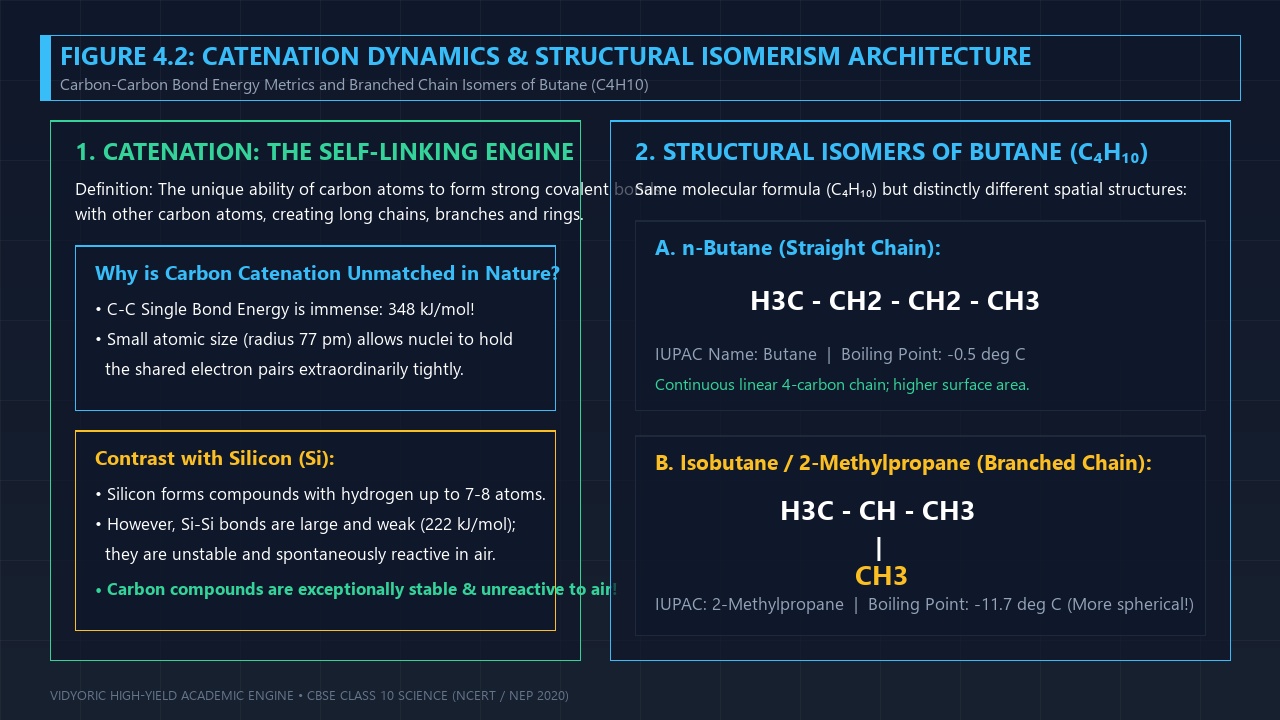
Figure 4.2: Catenation & Isomers

A. Catenation & Bond Stability

  • Catenation: The unique self-linking of carbon atoms through covalent bonds to form straight chains, branched frameworks, or closed rings.
  • Why Carbon is Unique: Carbon's atomic radius is small, allowing its nucleus to hold shared electron pairs tightly and form exceptionally strong, stable $C-C$ bonds ($348\text{ kJ/mol}$). Elements like Silicon can form chains with hydrogen only up to 7โ€“8 atoms, but $Si-Si$ bonds are weak and react explosively with oxygen.

B. Structural Isomerism

Compounds with the same molecular formula but different structural arrangements are called structural isomers:

  1. Butane ($C_4H_{10}$):
  • n-Butane: $CH_3-CH_2-CH_2-CH_3$ (straight 4-carbon chain).
  • Isobutane (2-Methylpropane): $CH_3-CH(CH_3)-CH_3$ (branched chain).
  1. Pentane ($C_5H_{12}$) has 3 isomers: n-pentane, isopentane (2-methylbutane), and neopentane (2,2-dimethylpropane).
  2. Cyclic Compounds:
  • Cyclohexane ($C_6H_{12}$): Closed ring with 6 single $C-C$ bonds.
  • Benzene ($C_6H_6$): Planar aromatic ring with 6 carbons and 6 hydrogens, having alternating single and double bonds.
๐Ÿ“
Comprehensive High-Yield Mathematical Relations & Theorems

Complete step-by-step derivations, step traps, and LaTeX formula sheet breakdowns...

๐Ÿ”’

End of Free Notes Preview

Unlock the complete deck to access full LaTeX formula breakdowns, interactive diagrams, exam traps, and personal margin highlights!

๐Ÿ”‘ Sign In / Register Free
STEP 4 โ€ข CONCEPT NOTES โฑ๏ธ 8 min read
๐Ÿ“Œ 0 Notes

3. Homologous Series & Functional Group Taxonomy

Organic chemistry categorizes millions of carbon compounds through families called homologous series and reactive sites called functional groups.

=============================================================================
                  HOMOLOGOUS SERIES & FUNCTIONAL SITES
=============================================================================
                                     โ”‚
     โ”Œโ”€โ”€โ”€โ”€โ”€โ”€โ”€โ”€โ”€โ”€โ”€โ”€โ”€โ”€โ”€โ”€โ”€โ”€โ”€โ”€โ”€โ”€โ”€โ”€โ”€โ”€โ”€โ”€โ”€โ”€โ”€โ”ผโ”€โ”€โ”€โ”€โ”€โ”€โ”€โ”€โ”€โ”€โ”€โ”€โ”€โ”€โ”€โ”€โ”€โ”€โ”€โ”€โ”€โ”€โ”€โ”€โ”€โ”€โ”€โ”€โ”€โ”€โ”€โ”
     โ–ผ                               โ–ผ                               โ–ผ
[HOMOLOGOUS GOLDEN RULES]    [OXYGEN HETEROATOMS]          [HYDROCARBON FAMILIES]
  โ”œโ”€ Successive member shift:  โ”œโ”€ Alcohol: -OH (-ol)         โ”œโ”€ Alkanes (CnH2n+2)
  โ”‚   ฮ”CHโ‚‚ unit difference     โ”œโ”€ Aldehyde: -CHO (-al)       โ”‚   Single bonds (Saturated)
  โ”œโ”€ Molecular Mass jump:      โ”œโ”€ Ketone: >C=O (-one)        โ”œโ”€ Alkenes (CnH2n)
  โ”‚   Exactly 14 u difference! โ”œโ”€ Carboxylic Acid:           โ”‚   Double bond (Unsaturated)
  โ””โ”€ Identical chemical traits โ”‚   -COOH (-oic acid)         โ””โ”€ Alkynes (CnH2n-2)
      Graded physical traits   โ””โ”€ Ester: -COO- (Fruity)          Triple bond (Unsaturated)

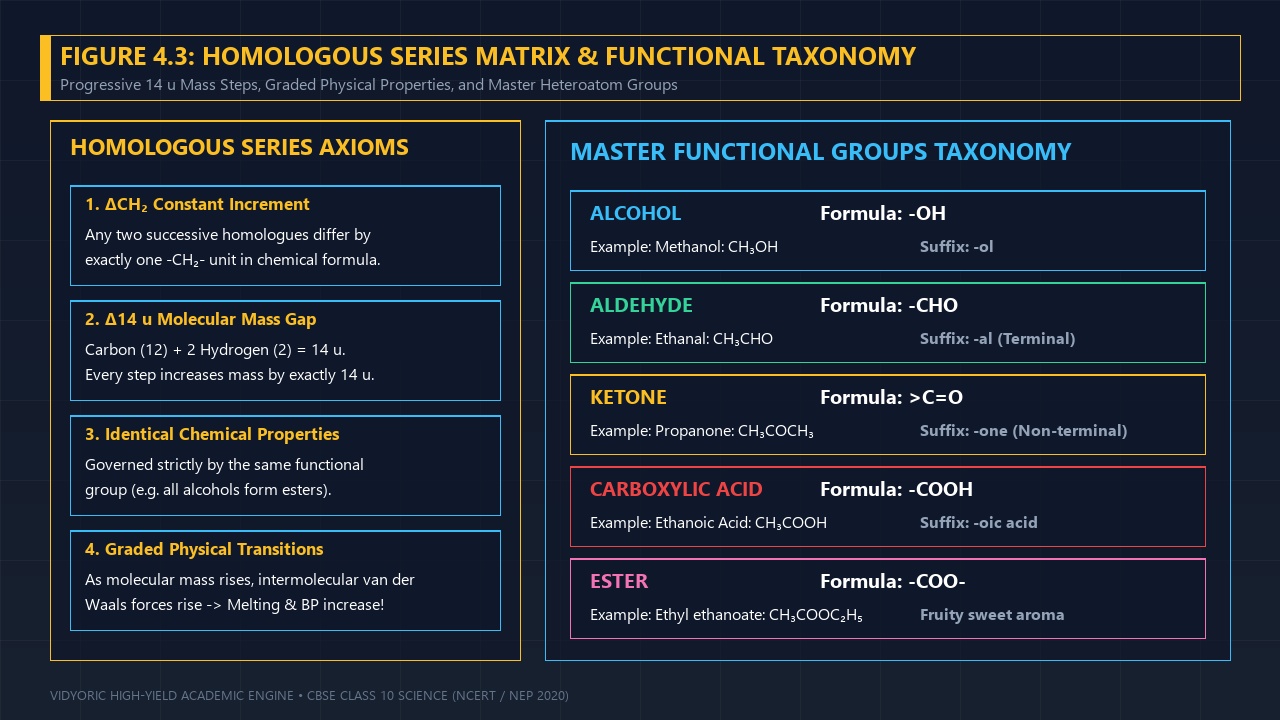
Figure 4.3: Homologous Series Matrix

A. Characteristics of a Homologous Series

  1. Any two consecutive members differ by a $-\mathbf{CH_2}-$ unit.
  2. Any two consecutive members differ in molecular mass by exactly $\mathbf{14\text{ u}}$ (Carbon = 12 u, 2 Hydrogens = 2 u).
  3. All members can be represented by a single general molecular formula:
  • Alkanes: $C_n H_{2n+2}$
  • Alkenes: $C_n H_{2n}$
  • Alkynes: $C_n H_{2n-2}$
  1. Chemical properties remain identical throughout the series because all members possess the same functional group.
  2. Physical properties (boiling point, melting point, density) show a regular gradation as molecular weight increases.

B. Functional Groups & Nomenclature

  • Halo-alkanes: $-\text{Cl}$ (Chloro-), $-\text{Br}$ (Bromo-). Example: Chloromethane ($CH_3Cl$).
  • Alcohols: $-\text{OH}$ (Suffix: -ol). Example: Methanol ($CH_3OH$), Ethanol ($C_2H_5OH$).
  • Aldehydes: $-\text{CHO}$ (Suffix: -al). Example: Methanal ($HCHO$), Ethanal ($CH_3CHO$).
  • Ketones: $>\text{C=O}$ (Suffix: -one). Example: Propanone ($CH_3COCH_3$, minimum 3 carbons).
  • Carboxylic Acids: $-\text{COOH}$ (Suffix: -oic acid). Example: Ethanoic acid ($CH_3COOH$).
๐Ÿ“
Comprehensive High-Yield Mathematical Relations & Theorems

Complete step-by-step derivations, step traps, and LaTeX formula sheet breakdowns...

๐Ÿ”’

End of Free Notes Preview

Unlock the complete deck to access full LaTeX formula breakdowns, interactive diagrams, exam traps, and personal margin highlights!

๐Ÿ”‘ Sign In / Register Free
STEP 5 โ€ข CONCEPT NOTES โฑ๏ธ 8 min read
๐Ÿ“Œ 0 Notes

4. Fundamental Reaction Pathways of Carbon Compounds

Carbon compounds participate in four major classes of chemical transformations: Combustion, Oxidation, Addition, and Substitution.

=============================================================================
                  THE FOUR MASTER ORGANIC PATHWAYS
=============================================================================
                                     โ”‚
     โ”Œโ”€โ”€โ”€โ”€โ”€โ”€โ”€โ”€โ”€โ”€โ”€โ”€โ”€โ”€โ”€โ”€โ”€โ”€โ”€โ”€โ”€โ”€โ”€โ”€โ”€โ”€โ”€โ”€โ”€โ”€โ”€โ”ผโ”€โ”€โ”€โ”€โ”€โ”€โ”€โ”€โ”€โ”€โ”€โ”€โ”€โ”€โ”€โ”€โ”€โ”€โ”€โ”€โ”€โ”€โ”€โ”€โ”€โ”€โ”€โ”€โ”€โ”€โ”€โ”
     โ–ผ                               โ–ผ                               โ–ผ
[1. COMBUSTION]              [2. OXIDATION]                [3. ADDITION & SUBSTITUTION]
  โ”œโ”€ Complete Combustion:      โ”œโ”€ Reagents:                  โ”œโ”€ Hydrogenation (Addition):
  โ”‚   Clean BLUE flame!        โ”‚   Alk. KMnOโ‚„ + Heat         โ”‚   Unsaturated Oil + Hโ‚‚
  โ”‚   CHโ‚„ + 2Oโ‚‚ โ†’ COโ‚‚ + 2Hโ‚‚O   โ”‚   or Acid. Kโ‚‚Crโ‚‚Oโ‚‡ + Heat   โ”‚   --[Ni, Heat]--> Saturated Ghee
  โ”œโ”€ Incomplete Combustion:    โ”œโ”€ Conversion:                โ”œโ”€ Bromine Water Test:
  โ”‚   Sooty YELLOW flame!      โ”‚   Ethanol oxidizes          โ”‚   Unsaturated decolourises Brโ‚‚!
  โ”‚   Unburnt carbon particles โ”‚   directly into             โ””โ”€ Sunlight Substitution:
  โ””โ”€ High C:H ratio = Soot!    โ””โ”€  Ethanoic Acid!                CHโ‚„ + Clโ‚‚ --[hฮฝ]--> CHโ‚ƒCl + HCl

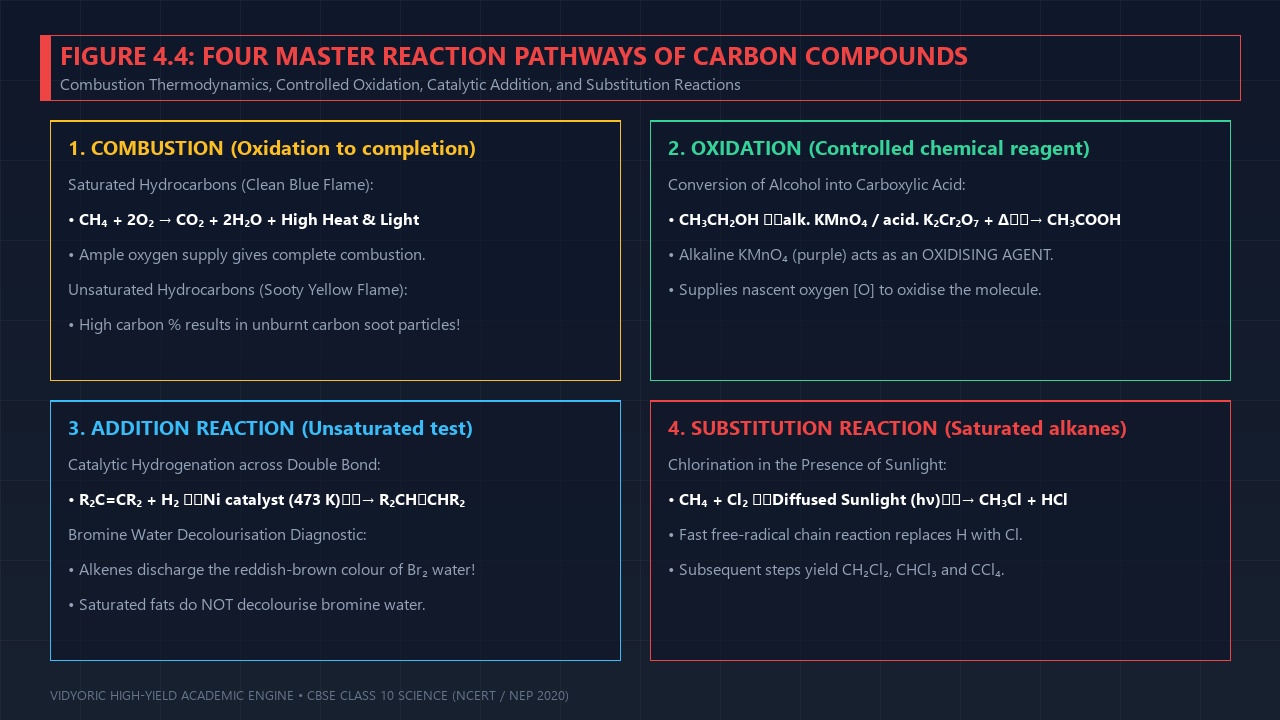
Figure 4.4: Four Master Organic Pathways

A. Combustion

  • Hydrocarbons burn in oxygen to liberate carbon dioxide, water vapor, and massive thermal energy:
$$CH_4(g) + 2O_2(g) \rightarrow CO_2(g) + 2H_2O(g) + \text{Heat and Light}$$
  • Flame Character: Saturated hydrocarbons burn with a clean non-sooty blue flame in plenty of air. Unsaturated hydrocarbons have a higher carbon-to-hydrogen ratio, leaving glowing unburnt carbon particles that create a yellow smoky sooty flame.

B. Oxidation

Alcohols are converted into carboxylic acids using strong chemical oxidizing agents:

$$CH_3CH_2OH \xrightarrow{\text{alkaline } KMnO_4 + \Delta \text{ or acidified } K_2Cr_2O_7 + \Delta} CH_3COOH$$

Substances like alkaline potassium permanganate and acidified potassium dichromate supply nascent oxygen and are called oxidizing agents.

C. Addition Reaction

Unsaturated hydrocarbons add hydrogen in the presence of a Nickel ($Ni$) or Palladium ($Pd$) catalyst to become saturated:

$$R_2C=CR_2 + H_2 \xrightarrow{Ni, \Delta} R_2CH-CHR_2$$
  • Bromine Water Test: Unsaturated hydrocarbons decolorize reddish-brown bromine water; saturated hydrocarbons do not react.

D. Substitution Reaction

Saturated hydrocarbons are unreactive to most reagents, but in the presence of sunlight ($h\nu$), chlorine atoms substitute hydrogen atoms one by one:

$$CH_4 + Cl_2 \xrightarrow{\text{Sunlight } h\nu} CH_3Cl + HCl$$
๐Ÿ“
Comprehensive High-Yield Mathematical Relations & Theorems

Complete step-by-step derivations, step traps, and LaTeX formula sheet breakdowns...

๐Ÿ”’

End of Free Notes Preview

Unlock the complete deck to access full LaTeX formula breakdowns, interactive diagrams, exam traps, and personal margin highlights!

๐Ÿ”‘ Sign In / Register Free
๐Ÿ”’
Step 6 is Locked

CBSE Diagnostic Mastery Quiz: Carbon & its Compounds Board Check

This ๐Ÿ“ LaTeX Concept Notes is part of the full verified curriculum for Chapter 4: Carbon and its Compounds. Unlock the full deck to gain permanent access to all 13 interactive stages, active recall cards, and diagnostic checkpoints.

Deck Access Price
100% Free with Account
Instant Access
โœ“ UPI & Cards Supported
๐Ÿ”‘ Sign In / Register to Unlock Free →
๐Ÿ”’
Step 7 is Locked

CBSE Diagnostic Mastery Quiz: Carbon & its Compounds Board Check

This ๐Ÿ“ LaTeX Concept Notes is part of the full verified curriculum for Chapter 4: Carbon and its Compounds. Unlock the full deck to gain permanent access to all 13 interactive stages, active recall cards, and diagnostic checkpoints.

Deck Access Price
100% Free with Account
Instant Access
โœ“ UPI & Cards Supported
๐Ÿ”‘ Sign In / Register to Unlock Free →
๐Ÿ”’
Step 8 is Locked

CBSE Diagnostic Mastery Quiz: Carbon & its Compounds Board Check

This ๐Ÿ“ LaTeX Concept Notes is part of the full verified curriculum for Chapter 4: Carbon and its Compounds. Unlock the full deck to gain permanent access to all 13 interactive stages, active recall cards, and diagnostic checkpoints.

Deck Access Price
100% Free with Account
Instant Access
โœ“ UPI & Cards Supported
๐Ÿ”‘ Sign In / Register to Unlock Free →
๐Ÿ”’
Step 9 is Locked

CBSE Diagnostic Mastery Quiz: Carbon & its Compounds Board Check

This ๐Ÿ“ LaTeX Concept Notes is part of the full verified curriculum for Chapter 4: Carbon and its Compounds. Unlock the full deck to gain permanent access to all 13 interactive stages, active recall cards, and diagnostic checkpoints.

Deck Access Price
100% Free with Account
Instant Access
โœ“ UPI & Cards Supported
๐Ÿ”‘ Sign In / Register to Unlock Free →
๐Ÿ”’
Step 10 is Locked

CBSE Diagnostic Mastery Quiz: Carbon & its Compounds Board Check

This ๐Ÿ“ LaTeX Concept Notes is part of the full verified curriculum for Chapter 4: Carbon and its Compounds. Unlock the full deck to gain permanent access to all 13 interactive stages, active recall cards, and diagnostic checkpoints.

Deck Access Price
100% Free with Account
Instant Access
โœ“ UPI & Cards Supported
๐Ÿ”‘ Sign In / Register to Unlock Free →
๐Ÿ”’
Step 11 is Locked

CBSE Diagnostic Mastery Quiz: Carbon & its Compounds Board Check

This Microlearning Step is part of the full verified curriculum for Chapter 4: Carbon and its Compounds. Unlock the full deck to gain permanent access to all 13 interactive stages, active recall cards, and diagnostic checkpoints.

Deck Access Price
100% Free with Account
Instant Access
โœ“ UPI & Cards Supported
๐Ÿ”‘ Sign In / Register to Unlock Free →
๐Ÿ”’
Step 12 is Locked

CBSE Diagnostic Mastery Quiz: Carbon & its Compounds Board Check

This ๐Ÿง  Active Recall Flashcards is part of the full verified curriculum for Chapter 4: Carbon and its Compounds. Unlock the full deck to gain permanent access to all 13 interactive stages, active recall cards, and diagnostic checkpoints.

Deck Access Price
100% Free with Account
Instant Access
โœ“ UPI & Cards Supported
๐Ÿ”‘ Sign In / Register to Unlock Free →
๐Ÿ”’
Step 13 is Locked

CBSE Diagnostic Mastery Quiz: Carbon & its Compounds Board Check

This โšก Diagnostic Quiz is part of the full verified curriculum for Chapter 4: Carbon and its Compounds. Unlock the full deck to gain permanent access to all 13 interactive stages, active recall cards, and diagnostic checkpoints.

Deck Access Price
100% Free with Account
Instant Access
โœ“ UPI & Cards Supported
๐Ÿ”‘ Sign In / Register to Unlock Free →