Chapter 4: Describing Motion
๐Ÿ‡ฎ๐Ÿ‡ณ National Curriculum Standard โ–พ
๐Ÿ› Vidyoric Certified โ€ข Dr. Ananya Sharma
๐Ÿ”ฅ 0 days
โšก 0 Sparks +
Chapter 4: Describing Motion

Video Lecture 1: The Relativity of Motion, Distance vs Displacement & Speed vs Velocity

STEP 1: VIDEO LESSON ๐Ÿ“ค Uploaded HTML5 Video

๐Ÿ“‘ Interactive Chapter Bookmarks

0 chapters

๐ŸŽ™๏ธ Synchronized Transcript

๐Ÿ”
# Video Lecture Script: The Relativity of Motion, Distance vs Displacement & Speed vs Velocity

**Step Order:** 1 (Stage 1)
**Duration:** ~06:00 minutes
**Speaker:** Dr. Ananya Sharma (Senior Science Educator)
**Tone:** Dynamic, relatable, rigorous English

---

### [00:00 - 01:30] Introduction: Is Anything in the Universe Truly at Rest?
**(Visual: Dr. Sharma sits on a sleek modern train seat. Outside the train window, trees and platform lights streak past in reverse. Beside her, a cup of tea sits perfectly still on the table.)**

**Dr. Ananya Sharma:**
"Welcome, my young physicists! Let me start with a mind-bending puzzle: Right now, as you watch this video, are you at rest, or are you moving?

You might say, *'Dr. Sharma, I am sitting completely still on my study chair!'*
From the perspective of your bedroom walls, yes, you are at rest.
However, the Earth beneath your chair is spinning on its axis at roughly 1,600 kilometers per hour, and orbiting the Sun at an incredible 30 kilometers per second! To an astronaut standing on the Moon, you are hurtling through space at astronomical speeds!

This reveals the first golden rule of kinematics: **Motion is relative.**
An object is said to be in **motion** *if its position changes continuously with respect to a chosen reference point (the origin) over time*."

---

### [01:30 - 03:30] Distance vs Displacement: The Fundamental Vector Distinction
**(Visual: An interactive coordinate axis appears on screen. An animated jogger runs from origin O (0 m) to point A (+100 m), and then turns around and jogs back to point B (+60 m).)**

**Dr. Ananya Sharma:**
"Now let us examine one of the most critical distinctions in all of physics: **Distance** versus **Displacement**!

- **Distance (Scalar Quantity):**
The actual length of the total path traversed by a moving body, regardless of direction.
In our runner's journey: from $O$ to $A$ is $100\text{ meters}$, and from $A$ back to $B$ is $40\text{ meters}$.
Total Distance $= 100 + 40 = \mathbf{140\text{ meters}}$. Distance has magnitude only, can never be negative, and can never decrease as long as the object is moving!

- **Displacement (Vector Quantity):**
The **shortest straight-line distance directed from the initial position to the final position**, along with its specific direction.
Our runner started at $O$ ($0\text{ m}$) and ended at $B$ ($+60\text{ m}$).
Therefore, Net Displacement $= \mathbf{+60\text{ meters east}}$!

Now, think about this top exam question:
*If an athlete runs one complete lap around a 400-meter circular track and returns to the exact starting line, what is their total distance and displacement?*
- Total Distance $= 400\text{ meters}$.
- Total Displacement $= \mathbf{Zero}$! Because the initial and final positions are identical!"

---

### [03:30 - 06:00] Speed, Velocity & Average Metrics
**(Visual: A sports car dashboard speedometer showing instantaneous speed vs velocity vectors with directional compass indicators.)**

**Dr. Ananya Sharma:**
"Just as distance and displacement differ, so do **Speed** and **Velocity**:

1. **Speed ($v$):**
The distance covered per unit time: $\text{Speed} = \frac{\text{Distance}}{\text{Time}}$.
It is a scalar quantity measured in SI units of **meters per second ($\text{m/s}$)**.
When your car speedometer reads $60\text{ km/h}$, it tells you your instantaneous speed, but says nothing about your direction!

2. **Velocity ($\vec{v}$):**
The displacement per unit time: $\text{Velocity} = \frac{\text{Displacement}}{\text{Time}}$.
Velocity is a **vector quantity**โ€”it possesses both magnitude and direction (e.g., $60\text{ km/h north}$).
You can change an objectโ€™s velocity in two ways: by altering its speed, OR simply by altering its direction of travel even if speed remains constant!

3. **Average Speed vs Average Velocity:**
$$\text{Average Speed} = \frac{\text{Total Distance Traversed}}{\text{Total Time Taken}}$$
$$\text{Average Velocity} = \frac{\text{Initial Velocity } (u) + \text{Final Velocity } (v)}{2} \quad (\text{for uniform acceleration})$$

In our next step, we will analyze distance-time and velocity-time graphs, and see how the area under a graph calculates physical displacement!"
STEP 2 โ€ข CONCEPT NOTES โฑ๏ธ 3 min read
๐Ÿ“Œ 0 Notes

Describing Motion: Reference Points, Distance & Displacement
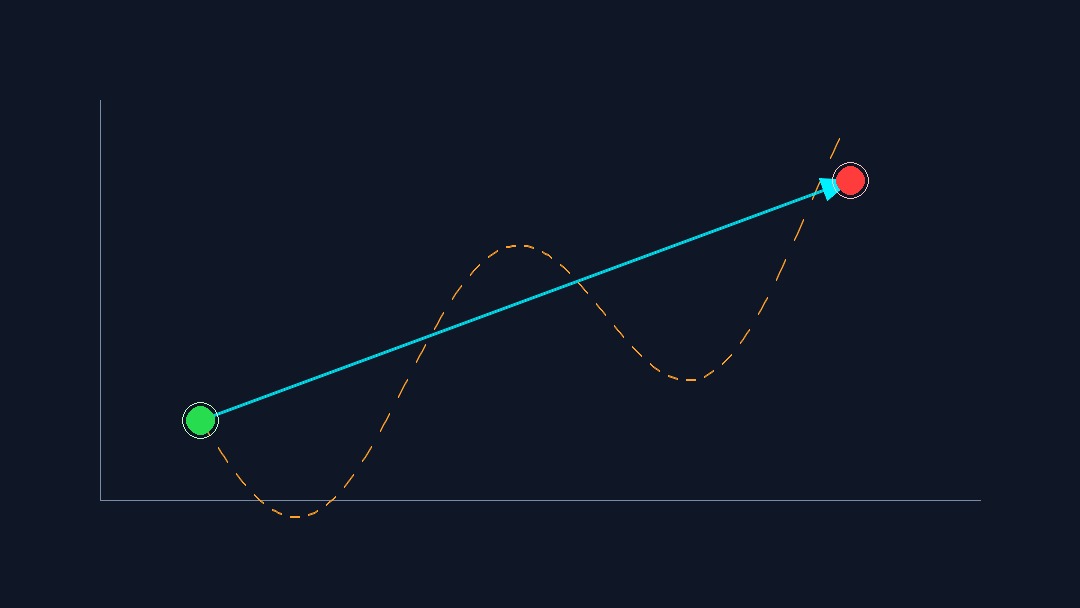
Figure 4.1: Path Comparison between Total Distance Traversed and Vector Displacement with Origin Reference Coordinates

1. The Relativity of Rest and Motion

An object is said to be in motion when its position changes continuously with respect to a stationary reference point called the origin ($O$) over time.

  • Rest and motion are relative concepts. A passenger inside a moving express train is at rest relative to their fellow passengers, but is in rapid motion relative to trees and platform observers outside!

2. Distance vs Displacement: The Core Vector Distinction

A (Start) โ”€โ”€โ”€โ”€โ”€โ”€โ”€โ”€โ”€โ”€โ”€โ”€โ”€โ”€โ”€โ”€โ”€โ”€โ”€โ”€ 100 meters East โ”€โ”€โ”€โ”€โ”€โ”€โ”€โ”€โ”€โ”€โ”€โ”€โ”€โ”€โ”€โ”€โ”€โ”€โ–บ B
โ–ฒ                                                                  โ”‚
โ”‚                                                                  โ–ผ
O โ—„โ”€โ”€โ”€โ”€โ”€โ”€โ”€โ”€โ”€โ”€โ”€โ”€โ”€โ”€โ”€โ”€โ”€โ”€โ”€โ”€โ”€โ”€โ”€โ”€โ”€โ”€โ”€ 60 meters West โ”€โ”€โ”€โ”€โ”€โ”€โ”€โ”€โ”€โ”€โ”€โ”€โ”€โ”€โ”€โ”€โ”€โ”€โ”€โ”€โ”€ C
Physical ParameterDistanceDisplacement
DefinitionThe actual length of the complete path traversed by a moving body.The shortest straight-line distance directed from initial position to final position.
Quantity TypeScalar (has magnitude only).Vector (has both magnitude and direction).
SI UnitMeter ($\text{m}$).Meter ($\text{m}$).
Sign & ValuesAlways positive ($\ge 0$); never decreases over time.Can be positive, negative, or zero!
Zero ConditionDistance is zero only if the object never moved.Displacement is zero whenever the object returns to its initial starting point!
[!IMPORTANT] Fundamental Inequality: $\text{Magnitude of Displacement} \le \text{Total Distance}$. They are equal if and only if the object travels strictly in a single, unchanging straight line!
๐Ÿ“
Comprehensive High-Yield Mathematical Relations & Theorems

Complete step-by-step derivations, step traps, and LaTeX formula sheet breakdowns...

๐Ÿ”’

End of Free Notes Preview

Unlock the complete deck to access full LaTeX formula breakdowns, interactive diagrams, exam traps, and personal margin highlights!

๐Ÿ”‘ Sign In / Register Free
๐Ÿง  Review Due (Interval: 1 Day) Card 1 of 8 (SM-2 Active Recall)
QUESTION (FRONT) Space โ†ต to flip
What is the rigorous scientific definition of Displacement?
ANSWER & EXPLANATION (BACK) Space โ†ต to flip
The shortest straight-line vector distance directed from the initial position to the final position of an object.
๐Ÿ’ก
Tap Card to Flip & Check Your Answer Active recall prompt: Flip the card or press Space โ†ต to unlock the SM-2 recall difficulty rating.
๐Ÿ”’
Step 4 is Locked

Final Diagnostic Mastery Quiz: Describing Motion

This ๐Ÿ“ LaTeX Concept Notes is part of the full verified curriculum for Chapter 4: Describing Motion. Unlock the full deck to gain permanent access to all 11 interactive stages, active recall cards, and diagnostic checkpoints.

Deck Access Price
100% Free with Account
Instant Access
โœ“ UPI & Cards Supported
๐Ÿ”‘ Sign In / Register to Unlock Free →
๐Ÿ”’
Step 5 is Locked

Final Diagnostic Mastery Quiz: Describing Motion

This โšก Diagnostic Quiz is part of the full verified curriculum for Chapter 4: Describing Motion. Unlock the full deck to gain permanent access to all 11 interactive stages, active recall cards, and diagnostic checkpoints.

Deck Access Price
100% Free with Account
Instant Access
โœ“ UPI & Cards Supported
๐Ÿ”‘ Sign In / Register to Unlock Free →
๐Ÿ”’
Step 6 is Locked

Final Diagnostic Mastery Quiz: Describing Motion

This ๐Ÿง  Active Recall Flashcards is part of the full verified curriculum for Chapter 4: Describing Motion. Unlock the full deck to gain permanent access to all 11 interactive stages, active recall cards, and diagnostic checkpoints.

Deck Access Price
100% Free with Account
Instant Access
โœ“ UPI & Cards Supported
๐Ÿ”‘ Sign In / Register to Unlock Free →
๐Ÿ”’
Step 7 is Locked

Final Diagnostic Mastery Quiz: Describing Motion

This ๐ŸŽฅ Video Lesson is part of the full verified curriculum for Chapter 4: Describing Motion. Unlock the full deck to gain permanent access to all 11 interactive stages, active recall cards, and diagnostic checkpoints.

Deck Access Price
100% Free with Account
Instant Access
โœ“ UPI & Cards Supported
๐Ÿ”‘ Sign In / Register to Unlock Free →
๐Ÿ”’
Step 8 is Locked

Final Diagnostic Mastery Quiz: Describing Motion

This ๐Ÿ“ LaTeX Concept Notes is part of the full verified curriculum for Chapter 4: Describing Motion. Unlock the full deck to gain permanent access to all 11 interactive stages, active recall cards, and diagnostic checkpoints.

Deck Access Price
100% Free with Account
Instant Access
โœ“ UPI & Cards Supported
๐Ÿ”‘ Sign In / Register to Unlock Free →
๐Ÿ”’
Step 9 is Locked

Final Diagnostic Mastery Quiz: Describing Motion

This Microlearning Step is part of the full verified curriculum for Chapter 4: Describing Motion. Unlock the full deck to gain permanent access to all 11 interactive stages, active recall cards, and diagnostic checkpoints.

Deck Access Price
100% Free with Account
Instant Access
โœ“ UPI & Cards Supported
๐Ÿ”‘ Sign In / Register to Unlock Free →
๐Ÿ”’
Step 10 is Locked

Final Diagnostic Mastery Quiz: Describing Motion

This ๐Ÿ“ LaTeX Concept Notes is part of the full verified curriculum for Chapter 4: Describing Motion. Unlock the full deck to gain permanent access to all 11 interactive stages, active recall cards, and diagnostic checkpoints.

Deck Access Price
100% Free with Account
Instant Access
โœ“ UPI & Cards Supported
๐Ÿ”‘ Sign In / Register to Unlock Free →
๐Ÿ”’
Step 11 is Locked

Final Diagnostic Mastery Quiz: Describing Motion

This โšก Diagnostic Quiz is part of the full verified curriculum for Chapter 4: Describing Motion. Unlock the full deck to gain permanent access to all 11 interactive stages, active recall cards, and diagnostic checkpoints.

Deck Access Price
100% Free with Account
Instant Access
โœ“ UPI & Cards Supported
๐Ÿ”‘ Sign In / Register to Unlock Free →