Forces, Inertia & Newton's First Law of Motion
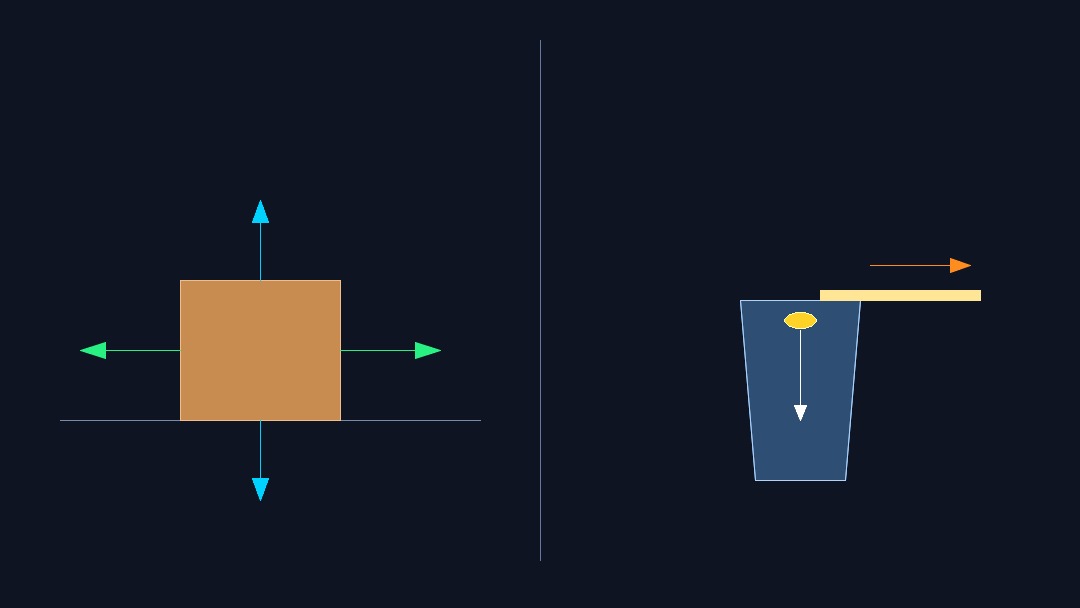
1. Balanced vs Unbalanced Forces
- Balanced Forces: When multiple forces act simultaneously on an object such that their vector sum ($\text{Net Force } F_{\text{net}} = 0$), the forces are balanced. Balanced forces cannot change an object's state of rest or velocity; they can only alter its geometric shape (e.g., squeezing a rubber ball).
- Unbalanced Forces: When the net resultant force is non-zero ($F_{\text{net}} \neq 0$). An unbalanced force causes acceleration—changing speed, direction, or both!
2. Galileo's Thought Experiment & Newton's First Law
Galileo deduced that an object moving on a frictionless horizontal plane requires zero net force to maintain constant velocity. Sir Isaac Newton formalized this as the First Law of Motion:
Every object persists in its state of rest or uniform motion in a straight line unless acted upon by an external unbalanced force.
3. Inertia & Mass
Inertia is the natural tendency of an object to resist changes in its velocity.
- Quantitative Measure: The mass of an object is the quantitative measure of its inertia. Greater mass $\rightarrow$ greater inertia.
- Three Modes of Inertia:
- Inertia of Rest: Dust flying off a carpet when beaten with a stick.
- Inertia of Motion: Passengers falling forward when a speeding bus suddenly applies brakes.
- Inertia of Direction: Water mud droplets flying off tangentially from a rotating bicycle tire (mudguards installed to block them!).