Discovery of Subatomic Particles & Rutherford's Nuclear Experiment
1. Subatomic Particles
- Electron ($e^-$): J.J. Thomson (1897); negative charge ($-1$), mass $\approx \frac{1}{2000}\text{ u}$.
- Proton ($p^+$): E. Goldstein (1886) canal rays; positive charge ($+1$), mass $\approx 1\text{ u}$.
- Neutron ($n^0$): James Chadwick (1932); neutral charge ($0$), mass $\approx 1\text{ u}$.
2. Rutherford's Gold Foil Alpha-Particle Scattering Experiment (1911)
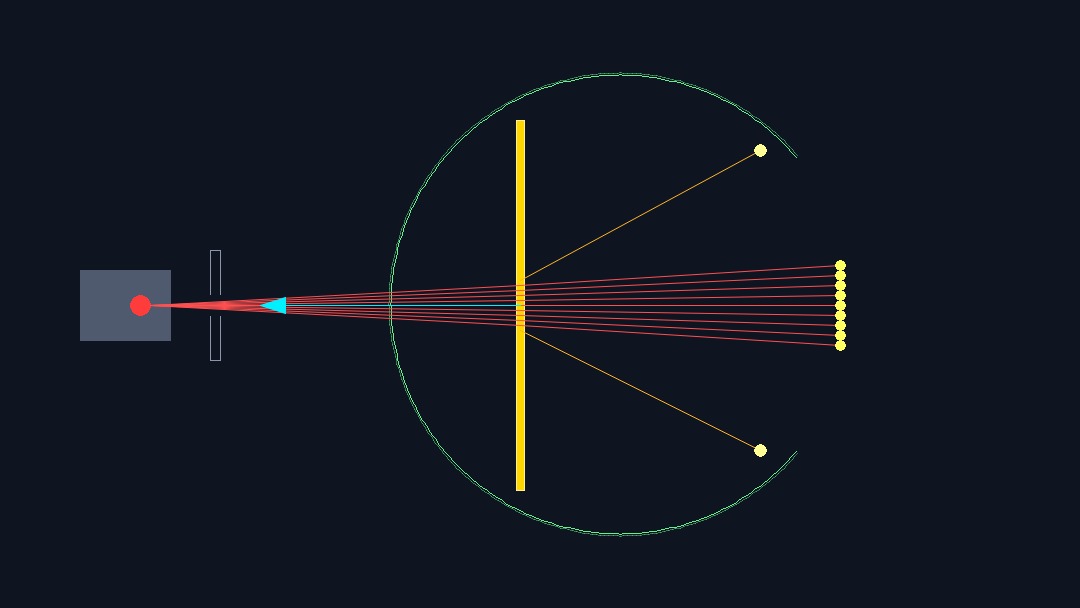
Rutherford bombarded a thin gold foil ($1000$ atoms thick) with fast alpha particles ($He^{2+}$, mass $4\text{ u}$):
- Most particles passed undeflected: Most of the atom is empty space.
- Small deflections: Positive charge occupies very little volume.
- 1 in 12,000 rebounded at $180^\circ$: All the positive charge and virtually all mass of the atom are concentrated in an ultra-dense central core: the Nucleus!