Chapter 10: Sound Waves: Characteristics and Applications
๐Ÿ‡ฎ๐Ÿ‡ณ National Curriculum Standard โ–พ
๐Ÿ› Vidyoric Certified โ€ข Dr. Ananya Sharma
๐Ÿ”ฅ 0 days
โšก 0 Sparks +
Chapter 10: Sound Waves: Characteristics and Applications

Video Lecture 1: Mechanical Waves, Compressions & Rarefactions

STEP 1: VIDEO LESSON ๐Ÿ“ค Uploaded HTML5 Video

๐Ÿ“‘ Interactive Chapter Bookmarks

0 chapters

๐ŸŽ™๏ธ Synchronized Transcript

๐Ÿ”
# Video Lecture 1: Mechanical Waves, Compressions & Rarefactions
**Speaker:** Dr. Ananya Sharma | **Duration:** ~06:00 mins

### Introduction: The Physical Nature of Sound
Welcome to Chapter 10 of Class 9 Science. Today we explore **Sound**, a form of mechanical energy that produces the sensation of hearing in our ears.
Unlike electromagnetic waves (such as light or radio waves) which can propagate through the vacuum of outer space, sound is a **mechanical wave**. It strictly requires a material mediumโ€”solid, liquid, or gasโ€”for its transmission.

### 1. How Vibrating Objects Produce Sound
Sound is created whenever an object vibratesโ€”oscillates rapidly to and fro about a central equilibrium position.
- When you strike a tuning fork with a rubber hammer, its prongs vibrate rapidly.
- In humans, speech is generated when expelled air from the lungs vibrates our vocal cords in the larynx.
- In musical instruments, sound originates from vibrating strings (sitar, guitar), vibrating membranes (tabla, drums), or vibrating air columns (flute, clarinets).

### 2. Propagation: The Wave of Compressions and Rarefactions
When a vibrating prong of a tuning fork moves forward (outward):
- It pushes and compresses the air layers immediately in front of it, creating a localized region of high density and high pressure known as a **Compression ($C$)**.
- As the prong snaps backward (inward), it relieves the pressure, creating a region of low density and low pressure where air molecules spread apart, known as a **Rarefaction ($R$)**.
- As the prong continues to oscillate back and forth, a continuous series of compressions and rarefactions moves outward through the air.

> **Crucial Insight:** Individual air molecules do **NOT** travel from the speaker's mouth to the listener's ear! Instead, each particle merely oscillates back and forth about its mean position, transferring kinetic energy and momentum to its adjacent neighbor like a domino effect. It is the disturbance and energy that travel through the medium!

### 3. Sound as a Longitudinal Wave
In air and fluids, sound travels as a **Longitudinal Wave**, because the particles of the medium oscillate parallel to the direction of propagation of the wave disturbance. In contrast, transverse waves (like water surface ripples or light) oscillate perpendicular to the direction of wave travel.
STEP 2 โ€ข CONCEPT NOTES โฑ๏ธ 3 min read
๐Ÿ“Œ 0 Notes

Concept Notes: Longitudinal Waves, Density/Pressure Variations & Speed in Media

1. Mechanical Wave Nature of Sound

Sound is a mechanical disturbance propagated through an elastic material medium.

  • Medium Requirement: In 1660, Robert Boyle proved via the Bell Jar Experiment that as air is pumped out of an enclosed glass jar containing a ringing electric bell, the sound intensity attenuates to zero. In vacuum, sound cannot propagate because there are no material particles to execute oscillations.
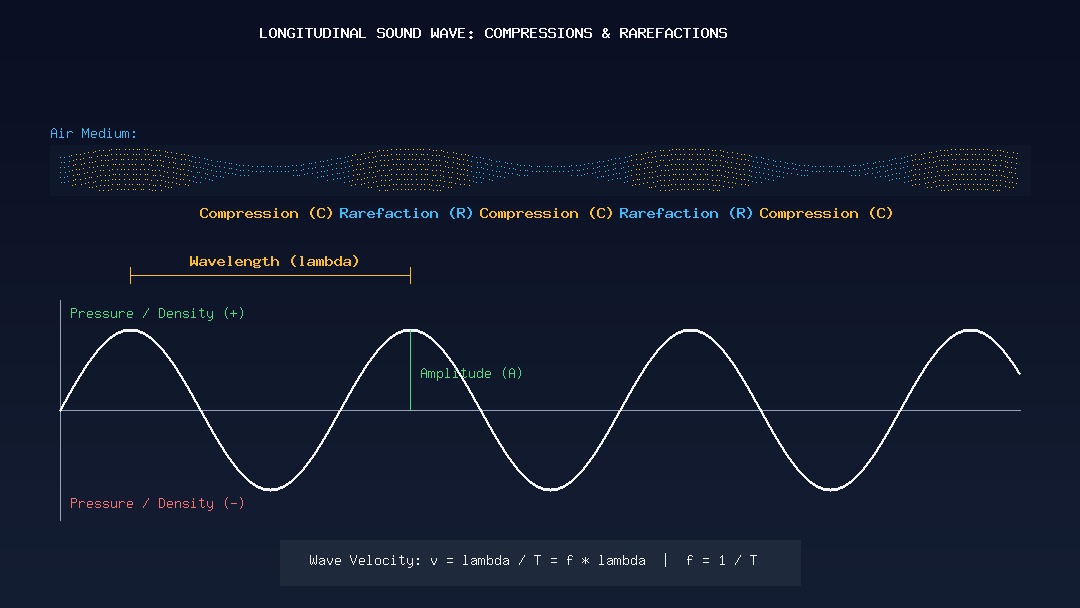
Longitudinal Wave Compressions and Rarefactions

Figure 10.1: Acoustic Density & Pressure Fluctuations in Air โ€” Alternating Compressions (High Density) and Rarefactions (Low Density)

2. Anatomy of Longitudinal Waves

  • Compression ($C$): Region where particles are crowded together. Represents maximum particle density and maximum pressure ($P_{\text{max}}$).
  • Rarefaction ($R$): Region where particles are spaced farthest apart. Represents minimum particle density and minimum pressure ($P_{\text{min}}$).
  • Longitudinal vs Transverse Waves:
  • In Longitudinal Waves (sound in air/fluids), the medium particles vibrate back and forth parallel to the direction of wave propagation.
  • In Transverse Waves (ripples on water surface, light), particles vibrate up and down perpendicular to the wave propagation direction, forming crests and troughs.

3. Speed of Sound Across Different Media ($v$)

Sound speed depends on the medium's elasticity, density, and temperature:

$$v_{\text{solids}} > v_{\text{liquids}} > v_{\text{gases}}$$
MediumStateApproximate Speed at $25^\circ\text{C}$ ($m/s$)
AluminiumSolid$6,420\text{ m/s}$
Steel / IronSolid$5,960\text{ m/s}$ / $5,130\text{ m/s}$
Glass (Crown)Solid$5,170\text{ m/s}$
Sea WaterLiquid$1,531\text{ m/s}$
Pure Water ($20^\circ\text{C}$)Liquid$1,498\text{ m/s}$
Air ($0^\circ\text{C}$)Gas$331\text{ m/s}$
Air ($22^\circ\text{C}$)Gas$344\text{ m/s}$
Temperature Dependence: As temperature increases, the kinetic energy of particles increases, causing sound speed in air to rise: $v \approx 331 + 0.61 \times T(^\circ\text{C})\text{ m/s}$.
๐Ÿ“
Comprehensive High-Yield Mathematical Relations & Theorems

Complete step-by-step derivations, step traps, and LaTeX formula sheet breakdowns...

๐Ÿ”’

End of Free Notes Preview

Unlock the complete deck to access full LaTeX formula breakdowns, interactive diagrams, exam traps, and personal margin highlights!

๐Ÿ”‘ Sign In / Register Free
๐Ÿง  Review Due (Interval: 1 Day) Card 1 of 8 (SM-2 Active Recall)
QUESTION (FRONT) Space โ†ต to flip
Why is sound classified strictly as a mechanical wave?
ANSWER & EXPLANATION (BACK) Space โ†ต to flip
Because sound propagates via the mechanical oscillation of medium particles and cannot propagate through a vacuum.
๐Ÿ’ก
Tap Card to Flip & Check Your Answer Active recall prompt: Flip the card or press Space โ†ต to unlock the SM-2 recall difficulty rating.
๐Ÿ”’
Step 4 is Locked

Final Diagnostic Mastery Quiz: Acoustics, Wave Mechanics & Auditory Physics

This ๐Ÿ“ LaTeX Concept Notes is part of the full verified curriculum for Chapter 10: Sound Waves: Characteristics and Applications. Unlock the full deck to gain permanent access to all 11 interactive stages, active recall cards, and diagnostic checkpoints.

Deck Access Price
100% Free with Account
Instant Access
โœ“ UPI & Cards Supported
๐Ÿ”‘ Sign In / Register to Unlock Free →
๐Ÿ”’
Step 5 is Locked

Final Diagnostic Mastery Quiz: Acoustics, Wave Mechanics & Auditory Physics

This โšก Diagnostic Quiz is part of the full verified curriculum for Chapter 10: Sound Waves: Characteristics and Applications. Unlock the full deck to gain permanent access to all 11 interactive stages, active recall cards, and diagnostic checkpoints.

Deck Access Price
100% Free with Account
Instant Access
โœ“ UPI & Cards Supported
๐Ÿ”‘ Sign In / Register to Unlock Free →
๐Ÿ”’
Step 6 is Locked

Final Diagnostic Mastery Quiz: Acoustics, Wave Mechanics & Auditory Physics

This ๐Ÿง  Active Recall Flashcards is part of the full verified curriculum for Chapter 10: Sound Waves: Characteristics and Applications. Unlock the full deck to gain permanent access to all 11 interactive stages, active recall cards, and diagnostic checkpoints.

Deck Access Price
100% Free with Account
Instant Access
โœ“ UPI & Cards Supported
๐Ÿ”‘ Sign In / Register to Unlock Free →
๐Ÿ”’
Step 7 is Locked

Final Diagnostic Mastery Quiz: Acoustics, Wave Mechanics & Auditory Physics

This ๐ŸŽฅ Video Lesson is part of the full verified curriculum for Chapter 10: Sound Waves: Characteristics and Applications. Unlock the full deck to gain permanent access to all 11 interactive stages, active recall cards, and diagnostic checkpoints.

Deck Access Price
100% Free with Account
Instant Access
โœ“ UPI & Cards Supported
๐Ÿ”‘ Sign In / Register to Unlock Free →
๐Ÿ”’
Step 8 is Locked

Final Diagnostic Mastery Quiz: Acoustics, Wave Mechanics & Auditory Physics

This ๐Ÿ“ LaTeX Concept Notes is part of the full verified curriculum for Chapter 10: Sound Waves: Characteristics and Applications. Unlock the full deck to gain permanent access to all 11 interactive stages, active recall cards, and diagnostic checkpoints.

Deck Access Price
100% Free with Account
Instant Access
โœ“ UPI & Cards Supported
๐Ÿ”‘ Sign In / Register to Unlock Free →
๐Ÿ”’
Step 9 is Locked

Final Diagnostic Mastery Quiz: Acoustics, Wave Mechanics & Auditory Physics

This Microlearning Step is part of the full verified curriculum for Chapter 10: Sound Waves: Characteristics and Applications. Unlock the full deck to gain permanent access to all 11 interactive stages, active recall cards, and diagnostic checkpoints.

Deck Access Price
100% Free with Account
Instant Access
โœ“ UPI & Cards Supported
๐Ÿ”‘ Sign In / Register to Unlock Free →
๐Ÿ”’
Step 10 is Locked

Final Diagnostic Mastery Quiz: Acoustics, Wave Mechanics & Auditory Physics

This ๐Ÿ“ LaTeX Concept Notes is part of the full verified curriculum for Chapter 10: Sound Waves: Characteristics and Applications. Unlock the full deck to gain permanent access to all 11 interactive stages, active recall cards, and diagnostic checkpoints.

Deck Access Price
100% Free with Account
Instant Access
โœ“ UPI & Cards Supported
๐Ÿ”‘ Sign In / Register to Unlock Free →
๐Ÿ”’
Step 11 is Locked

Final Diagnostic Mastery Quiz: Acoustics, Wave Mechanics & Auditory Physics

This โšก Diagnostic Quiz is part of the full verified curriculum for Chapter 10: Sound Waves: Characteristics and Applications. Unlock the full deck to gain permanent access to all 11 interactive stages, active recall cards, and diagnostic checkpoints.

Deck Access Price
100% Free with Account
Instant Access
โœ“ UPI & Cards Supported
๐Ÿ”‘ Sign In / Register to Unlock Free →