Concept Notes: Fission, Budding, Spores, Regeneration & Vegetative Propagation
1. Significance of Reproduction & Genetic Variation
- Species Continuity: Ensures survival of populations over generations.
- DNA Copying & Variations: Biochemical copying of DNA is inherently subject to subtle statistical errors. These resulting variations are crucial for species adaptation to environmental stresses (temperature spikes, droughts, pathogens).
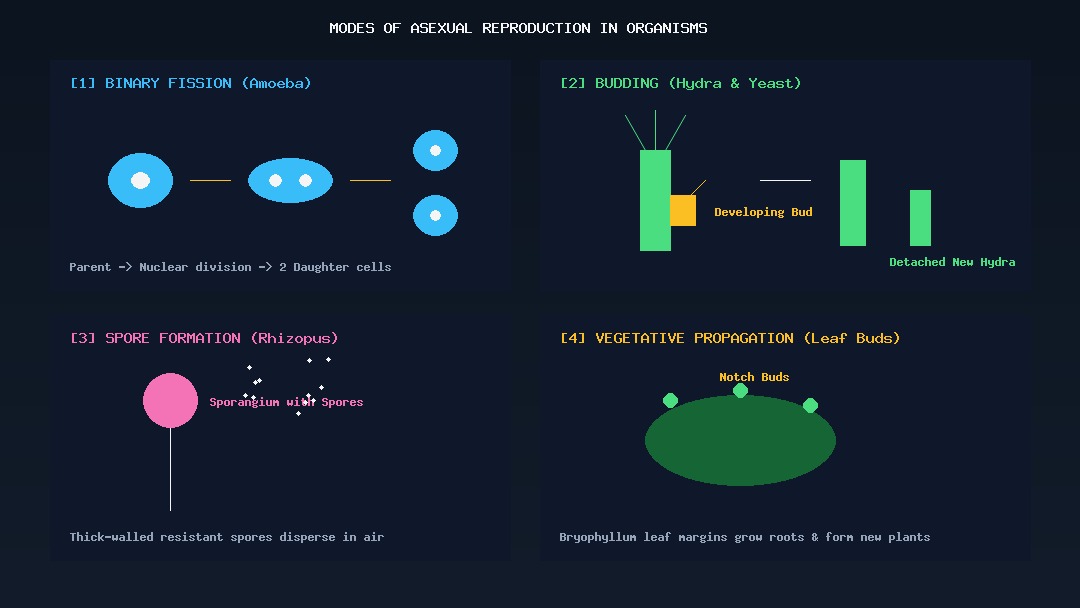
Figure 11.1: Asexual Reproduction Spectrum — Binary Fission (Amoeba), Budding (Hydra), Spores (Rhizopus), Regeneration (Planaria) & Vegetative Propagation
2. Modes of Asexual Reproduction
| Mode | Mechanism | Organism Example | Key Biological Feature |
|---|---|---|---|
| Binary Fission | Parent divides into 2 equal daughters | Amoeba, Leishmania | Leishmania divides longitudinally along a flagellar plane. |
| Multiple Fission | Single parent splits into many daughters inside a cyst | Plasmodium | Survival adaptation against dry/hostile environments. |
| Budding | Outgrowth develops from repeated mitosis at one locus | Hydra, Yeast | Bud matures and detaches as an independent organism. |
| Spore Formation | Thick-walled microscopic spores formed inside sporangia | Rhizopus (Bread mould) | Spores withstand adverse weather, germinate on moist bread. |
| Regeneration | Specialized cells proliferate to regrow severed body parts | Planaria, Hydra | Controlled developmental process, not a regular reproductive method. |
| Fragmentation | Simple multicellular body breaks into mature fragments | Spirogyra | Each piece grows independently via cell division. |
| Vegetative Propagation | New plants grow from vegetative organs (root, stem, leaf) | Bryophyllum (leaf notches), Potato (tubers/eyes), Sugarcane (stem) | Produces exact clones faster; used in layering, grafting & tissue culture. |