Concept Notes: Whittaker's Five Kingdoms, Cellular Complexity & Lichens
1. The Taxonomic Hierarchy (Linnaean Classification)
Organisms are classified in a nested hierarchical sequence:
$$\mathbf{Kingdom \longrightarrow Phylum / Division \longrightarrow Class \longrightarrow Order \longrightarrow Family \longrightarrow Genus \longrightarrow Species}$$
- Species: The fundamental unit of classification; a population of fertile individuals sharing close structural and functional similarities that interbreed in nature.
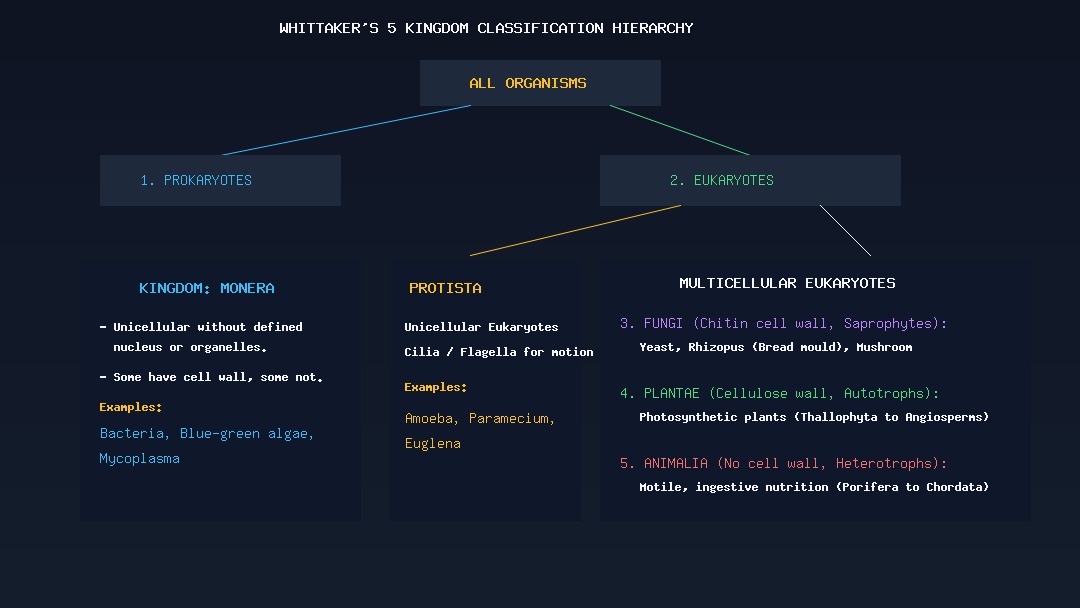
Figure 12.1: Robert Whittaker's Five Kingdom Classification System (1969) — Monera, Protista, Fungi, Plantae, and Animalia
2. The Five Kingdoms Diagnostic Matrix
| Kingdom | Cell Type | Body Organization | Cell Wall | Nutrition Mode | Representative Taxa |
|---|---|---|---|---|---|
| Monera | Prokaryotic | Unicellular | Peptidoglycan (Non-cellulosic) | Autotrophic / Heterotrophic | Bacteria, Cyanobacteria (Anabaena), Mycoplasma |
| Protista | Eukaryotic | Unicellular | Present in some (absent in others) | Autotrophic / Heterotrophic | Amoeba, Paramecium, Euglena, Diatoms |
| Fungi | Eukaryotic | Mostly Multicellular | Made of Chitin | Heterotrophic (Saprophytic) | Yeast (unicellular), Rhizopus, Agaricus (Mushroom) |
| Plantae | Eukaryotic | Multicellular | Made of Cellulose | Autotrophic (Photosynthetic) | Mosses, Ferns, Pines, Flowering plants |
| Animalia | Eukaryotic | Multicellular | Absent | Heterotrophic (Holozoic) | Sponges, Worms, Insects, Birds, Humans |
3. Symbiosis in Fungi: Lichens
Certain fungal species live in a permanent mutualistic symbiotic relationship with photosynthetic cyanobacteria or green algae, forming Lichens.
- Algal Partner (Phycobiont): Synthesizes food via photosynthesis.
- Fungal Partner (Mycobiont): Provides structural anchorage, retains moisture, and absorbs minerals.
- Bioindicator Value: Lichens are highly sensitive to atmospheric sulphur dioxide ($SO_2$) pollution; they vanish from polluted industrial cities.