Concept Notes: Atmosphere as a Blanket, Specific Heat & Sea/Land Breezes, Hydrologic Cycle
1. The Four Spheres of the Earth System
Earth functions as an integrated biogeochemical super-system:
- Atmosphere: Blanket of gases ($78\%\text{ }N_2$, $21\%\text{ }O_2$, $0.93\%\text{ }Ar$, $0.04\%\text{ }CO_2$, water vapor).
- Hydrosphere: All liquid, frozen, and underground water reservoirs covering $71\%$ of Earth.
- Lithosphere: The solid crust and upper mantle providing mineral nutrients and soil.
- Biosphere: The dynamic zone where atmosphere, hydrosphere, and lithosphere interact to support life.
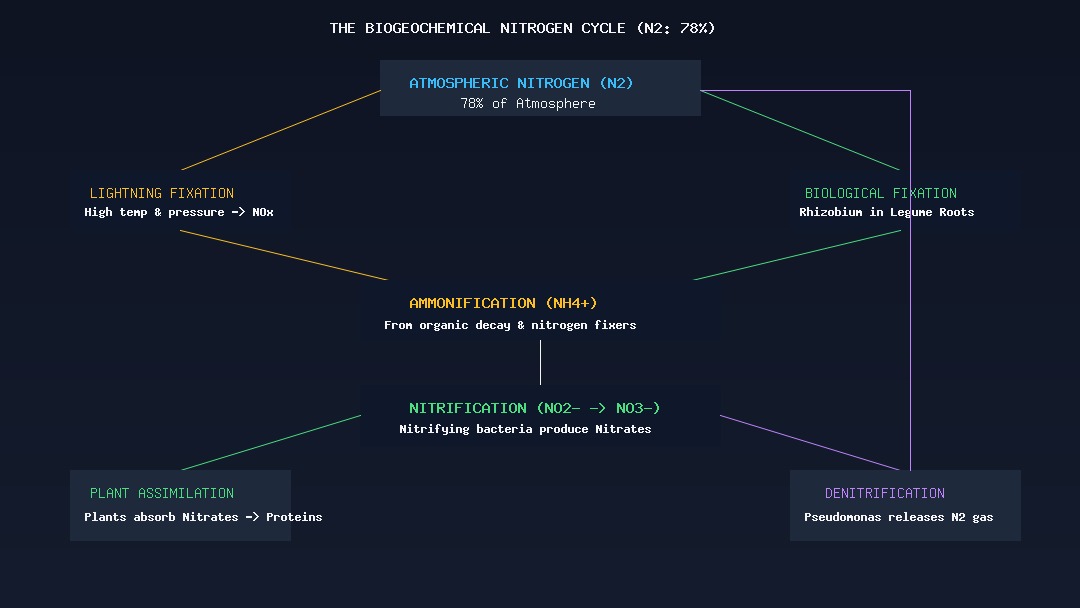
Figure 13.1: Planetary Biogeochemical Dynamics — Atmospheric Thermal Regulation, Coastal Breeze Convection & Nitrogen Transformations
2. Thermal Moderation by the Atmosphere
- Low Thermal Conductivity: Air is a poor conductor of heat.
- Daytime Shield: Reflects and scatters excessive solar radiation, preventing scorching temperatures.
- Nighttime Trap: Retards radiation of terrestrial heat into space.
- Earth vs Moon Comparison: The Moon lacks an atmosphere; its temperature fluctuates between $-190^\circ\text{C}$ at night and $+110^\circ\text{C}$ during the day!
3. Coastal Wind Convection Dynamics
| Characteristic | Sea Breeze (Daytime) | Land Breeze (Nighttime) |
|---|---|---|
| Heating / Cooling Rate | Land heats up faster than water | Land cools down faster than water |
| Pressure Differential | Low pressure over land; High pressure over sea | High pressure over land; Low pressure over sea |
| Air Movement | Sea $\longrightarrow$ Land (Inland cooling breeze) | Land $\longrightarrow$ Sea (Offshore breeze) |
| Physics Mechanism | High specific heat capacity of water | Convective atmospheric circulation |
4. The Hydrologic (Water) Cycle & Pedogenesis
- Water Cycle: Evaporation from oceans and transpiration from forests $\longrightarrow$ Cloud condensation $\longrightarrow$ Precipitation (rain, snow) $\longrightarrow$ Groundwater percolation and river runoff.
- Soil Formation (Pedogenesis): Physical weathering (sun temperature fluctuations, freezing water crack expansion), chemical weathering (rainwater acids), and biological weathering (lichens secreting organic acids that pulverize rock surfaces into humus-rich fertile soil).