Concept Notes 1: The Biosphere, Ecosystem Structure & Biogeochemical Cycles
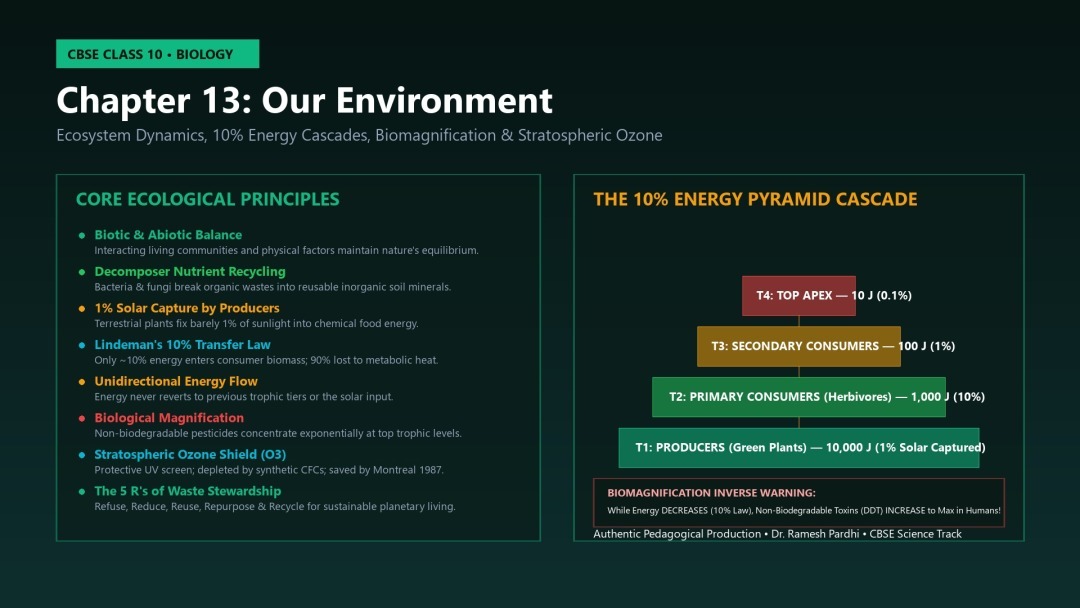
1. The Architecture of the Biosphere & Ecosystems
- The Biosphere: The global ecological system integrating all living beings and their relationships; extends vertically from deep ocean trenches (~11 km) to high alpine peaks (~8 km).
- Ecosystem: A community of biotic organisms (plants, animals, microbes) interacting with abiotic elements (solar energy, soil, water, atmospheric gases).
                             [ THE SOLAR ENERGY INFLOW ]
                                          |
                               [ PRODUCERS (T1) ]
                        Green plants, phytoplankton (Photosynthesis)
                                          | (10% energy transfer)
                               [ HERBIVORES (T2) ]
                        Deer, cattle, zooplankton, insects
                                          | (10% energy transfer)
                               [ CARNIVORES (T3) ]
                        Frogs, foxes, small fish
                                          | (10% energy transfer)
                             [ APEX PREDATORS (T4) ]
                        Tigers, eagles, lions
                                          |
                        [ DECOMPOSERS & NUTRIENT POOL ]
                        Bacteria & fungi return mineral ions to soil
2. Lindeman’s 10% Energy Transfer Law & Food Webs
- 10% Law of Energy Transfer: Formulated by Raymond Lindeman (1942). In any trophic transition from one level to the next, only approximately 10% of the energy is stored as biomass; 90% is expended during respiration, locomotion, digestion, and heat loss.
- Biological Magnification (Biomagnification): Non-biodegradable persistent pollutants (e.g., DDT, heavy metals) cannot be metabolized, concentrating in exponentially higher ratios at higher trophic levels, devastating apex predators.
3. Biogeochemical Nutrient Cycles
| Nutrient Cycle | Atmospheric Reservoir | Primary Biological Transformation Mechanism | Critical Human Disturbance |
|---|---|---|---|
| Carbon Cycle | $CO_2$ in air (~0.04%) and dissolved carbonates in oceans. | Photosynthesis fixes $CO_2$ into glucose; cellular respiration and combustion release $CO_2$. | Excessive fossil fuel combustion driving global warming and ocean acidification. |
| Nitrogen Cycle | $N_2$ gas comprising 78% of dry atmospheric air. | Nitrogen-fixing bacteria (Rhizobium in leguminous roots, Azotobacter) convert $N_2 \to NH_3 \to NO_3^-$; denitrifying bacteria return $N_2$ to air. | Chemical fertilizer runoff causing eutrophication and dead zones in freshwater lakes. |