Concept Notes 1: Nature of a Constitution & The Constituent Assembly
1. What is a Constitution?
A Constitution is the supreme fundamental legal document of a nation that sets out the framework of governance, defines the powers of state organs, limits executive authority, and guarantees the rights of citizens:
- Why Do Democratic Nations Need a Written Constitution?
- Rule of Law: Ensures that government is governed by established laws, not the personal whims of individual rulers.
- Defines Powers and Limits: Clearly delineates the boundaries of the Legislature, Executive, and Judiciary, preventing any organ from usurping dictatorial power.
- Prevents Majority Tyranny: Protects the linguistic, cultural, and religious rights of minorities against arbitrary majoritarian decisions.
- Articulates Fundamental Ideals: Enshrines the philosophical vision and collective aspirations of the people.
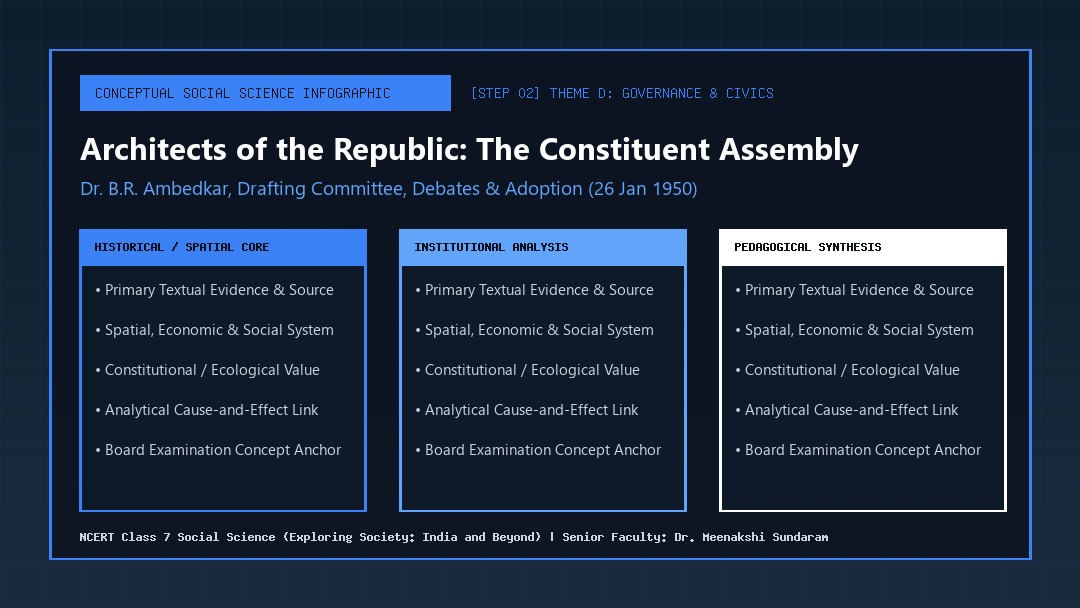
2. The Making of the Indian Constitution
- The Constituent Assembly:
- Constituted under the Cabinet Mission Plan in December 1946.
- Total membership: 299 members following Partition.
- Permanent President: Dr. Rajendra Prasad.
- Constitutional Advisor: Sir B.N. Rau (prepared the initial legal drafts).
- The Drafting Committee:
- Appointed on 29th August 1947, comprising seven legal luminaries.
- Chaired by Dr. Bhimrao Ramji Ambedkar, universally revered as the Father of the Indian Constitution.
- Deliberation Timeline:
- Took exactly 2 years, 11 months, and 18 days.
- Held 11 formal sessions spanning 165 days of active debate; considered over 2,000 amendments.
- Adoption and Commencement:
- Adopted: 26th November 1949 (Celebrated annually as Constitution Day / Samvidhan Diwas).
- Came into Full Effect: 26th January 1950 (Celebrated as Republic Day), commemorating the 1930 declaration of Purna Swaraj (Complete Independence).