Chapter 1: Chemical Reactions and Equations
๐Ÿ‡ฎ๐Ÿ‡ณ National Curriculum Standard โ–พ
๐Ÿ› Vidyoric Certified โ€ข Dr. Ananya Sharma
๐Ÿ”ฅ 0 days
โšก 0 Sparks +
Chapter 1: Chemical Reactions and Equations

Visual Overview: Chemical Reactions & Macro-Indicators

STEP 1: VIDEO LESSON ๐Ÿ“ค Uploaded HTML5 Video

๐Ÿ“‘ Interactive Chapter Bookmarks

0 chapters

๐ŸŽ™๏ธ Synchronized Transcript

๐Ÿ”
# Video Lecture Production Script โ€” Step 1: Visual Overview: Chemical Reactions & Macro-Indicators

- **Step Order**: Step 1 of 13 (Stage 1: Foundations of Chemical Change & Balancing)
- **Step Type**: `video` (Video Lecture)
- **Deck**: CBSE Class 10 Science Chapter 1: Chemical Reactions and Equations
- **Presenter**: Dr. Ananya Sharma, Senior NCERT Chemistry Faculty
- **Production Duration**: ~5 Minutes 30 Seconds (~720 Words Spoken Dialogue)
- **Format**: Dynamic Classroom Studio with 4K Lab Cutaways, 3D Molecular Balance Scales, and KaTeX Formula Overlays

---

## ? Production Scenes & Cue Breakdown

### Scene 1: The Molecular Threshold & Cold Open (0:00 โ€“ 1:00)
- **Visual Setup**: Wide studio shot. Dr. Ananya Sharma holds a pair of laboratory crucible tongs gripping a metallic ribbon. Behind her, a dark slate background displays floating glowing molecules.
- **Presenter Dialogue**:
> *"Hello, young chemists! Welcome to Vidyoric. I am Dr. Ananya Sharma, and today, we begin our exploration of the molecular alphabet of physical reality: **Class 10 Science Chapter 1 โ€” Chemical Reactions and Equations**.*
>
> *Look at what I hold in my hand: a strip of metallic magnesium ribbon. If I hold it over this Bunsen flame straight out of the box, it hesitates to ignite. Why? Because over weeks of contact with ambient air, magnesium forms a thin, invisible, non-reactive film of basic magnesium oxide that shields it from heat.*
>
> *Watch what happens once we vigorously clean it with sandpaper to strip away that inert coat."*
- **On-Screen Display (OSD)**:
- Header: `CHAPTER 1: CHEMICAL REACTIONS AND EQUATIONS`
- Subtitle: `Atomic Rearrangement & Law of Conservation of Mass`
- Warning Badge: `EXAM MANDATE: Always clean magnesium ribbon with sandpaper before ignition!`

---

### Scene 2: The Magnesium Flare & 4 Cardinal Indicators (1:00 โ€“ 2:15)
- **Visual Setup**: 120fps high-speed camera close-up on the Bunsen burner. The cleaned magnesium ribbon ignites with a blinding, dazzling white luminescence, depositing white powdery ash on a watch glass.
- **Presenter Dialogue**:
> *"Look at that extraordinary flash! The ribbon burns with an intense, dazzling white luminescence that demands dark safety goggles.*
>
> *And what remains in the watch glass? A brittle, white powdery ash. The shiny silvery metal is completely gone, transformed into **Magnesium Oxide ($MgO$)**:*
>
> *$$2Mg(s) + O_2(g) \longrightarrow 2MgO(s)$$*
>
> *This brings us to the foundational question: How do we know a chemical reaction has taken place? In every chemical reaction, pre-existing chemical bonds break and new bonds form. This is confirmed by four cardinal macroscopic observations:*
> 1. *Change in State*
> 2. *Change in Colour*
> 3. *Evolution of a Gas*
> 4. *Change in Temperature (Thermal Energy Transfer)*"*
- **On-Screen Display (OSD)**:
- Chemical Equation Callout:
$$2Mg(s) + O_2(g) \longrightarrow 2MgO(s) \quad [\text{Dazzling White Flame}]$$
- Four Cardinal Indicators Matrix:
- ? `Change in Colour` ($Pb(NO_3)_2 + 2KI \longrightarrow PbI_2\downarrow$ yellow ppt)
- ?๏ธ `Change in Temperature` ($CaO + H_2O \longrightarrow Ca(OH)_2$ boiling exothermic)
- ? `Evolution of Gas` ($Zn + H_2SO_4 \longrightarrow ZnSO_4 + H_2\uparrow$ "pop" test)
- ? `Change in State` (Solid precipitate from aqueous solutions)

---

### Scene 3: The Law of Conservation of Mass & The Balance Scale (2:15 โ€“ 3:30)
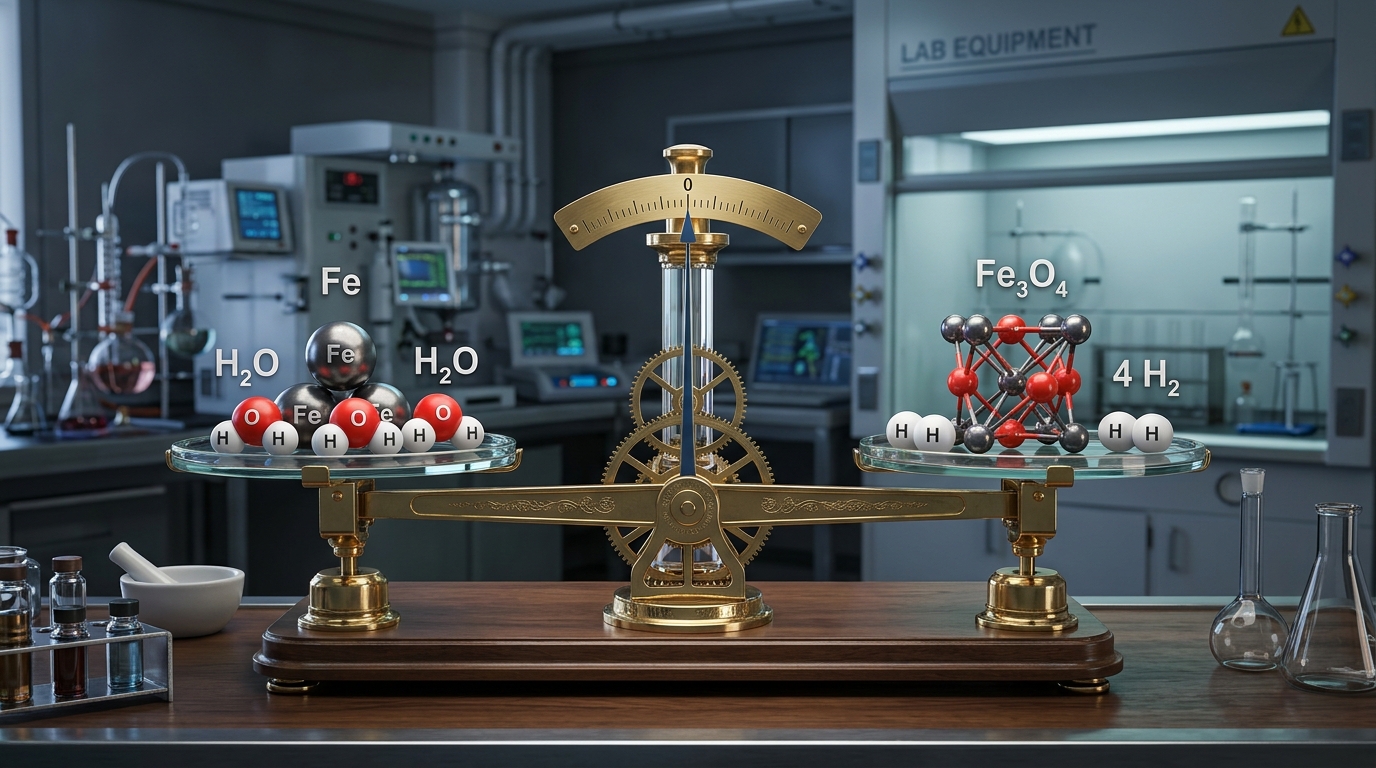
- **Visual Setup**: A 3D interactive molecular balance scale materializes in the center of the frame. Reactant atoms on the left pan balance against product atoms on the right pan.
- **Presenter Dialogue**:
> *"Now, how do we write this down scientifically? Through a balanced chemical equation.*
>
> *In 1789, Antoine Lavoisier formulated the inviolable **Law of Conservation of Mass**: Mass can neither be created nor destroyed in a chemical reaction.*
>
> *That means the total massโ€”and the exact count of each type of atomโ€”must be identical on both sides of the arrow.*
>
> *Watch this balance scale. If 3 iron atoms and 4 water molecules enter on the left, we cannot invent or delete atoms! They must balance into 1 unit of $Fe_3O_4$ and 4 diatomic $H_2$ molecules on the right.*
>
> *And remember the cardinal rule of balancing: NEVER touch chemical subscripts! Changing $H_2O$ to $H_2O_2$ turns harmless water into corrosive peroxide. Change only the stoichiometric coefficients preceding the formula!"*
- **On-Screen Display (OSD)**:
- Conservation Principle:
$$\sum \text{Atoms of Reactants} = \sum \text{Atoms of Products}$$
- Balancing Animation:
$$3Fe(s) + 4H_2O(g) \longrightarrow Fe_3O_4(s) + 4H_2(g)$$
- Red Alert Callout: `Subscript Inviolability: Modify stoichiometric coefficients ONLY!`

---

### Scene 4: Roadmap of Reaction Classes & Heritage Spotlight (3:30 โ€“ 4:45)
- **Visual Setup**: Four quadrants appear on screen, each displaying an iconic experiment:
1. Quicklime slaking into boiling $Ca(OH)_2$
2. Thermal decomposition of green $FeSO_4$ into red $Fe_2O_3$
3. Blue $CuSO_4$ fading as an iron nail turns copper-red
4. Delhi Iron Pillar standing in the monsoon rain
- **Presenter Dialogue**:
> *"Across this chapter, we will master four major families of chemical reactions:*
> - ***Combination***: *Two or more substances unite into a single product, like quicklime boiling in water.*
> - ***Decomposition***: *A single compound splits into simpler fragments via heat, electric current, or sunlightโ€”always endothermic!*
> - ***Displacement & Double Displacement***: *More reactive elements displace less reactive ions, or swap ionic partners to form precipitates.*
> - ***Redox Reactions***: *Simultaneous loss and gain of oxygen, hydrogen, and electrons.*
>
> *And we will explore a metallurgical triumph right here in India: The 1,600-year-old **Iron Pillar of Delhi**, forged by ancient Indian smiths with high phosphorus content that catalyzed a self-healing passivating layer of misawite, protecting it from rust across sixteen centuries of tropical monsoons!"*
- **On-Screen Display (OSD)**:
- Quad Split Screen:
- `Combination` ($CaO + H_2O \longrightarrow Ca(OH)_2 + \Delta$)
- `Decomposition` ($2FeSO_4 \xrightarrow{\Delta} Fe_2O_3 + SO_2 + SO_3$)
- `Displacement` ($Fe + CuSO_4 \longrightarrow FeSO_4 + Cu$)
- `Everyday Redox` (Rusting, Rancidity & Delhi Iron Pillar)

---

### Scene 5: Roadmap Recap & Stepping into Step 2 (4:45 โ€“ 5:30)
- **Visual Setup**: Full studio shot. Dr. Sharma points to the navigation bar showing Step 2 (Concept Notes) glowing and ready.
- **Presenter Dialogue**:
> *"You now possess the foundational vision of chemical transformation!*
>
> *Head directly into **Step 2**, where we break down the exact laboratory procedures for Magnesium combustion, Lead Nitrate precipitation, and Zinc acid effervescence, backed by 3D concept cutaways.*
>
> *Let's master CBSE Class 10 Chemistry together!"*
- **On-Screen Display (OSD)**:
- Summary Checklist:
- [x] Sandpaper mandate for magnesium ribbon
- [x] Four indicators of chemical reaction
- [x] Law of conservation of mass & coefficient balancing rules
- [x] 4 reaction classes roadmap
- Action Button: `Proceed to Step 2: Concept Notes โž”`
STEP 2 โ€ข CONCEPT NOTES โฑ๏ธ 5 min read
๐Ÿ“Œ 0 Notes

Chemical Reactions & Macroscopic Evidence of Change ??

A chemical reaction is an atomic transformation in which chemical bonds between reactant atoms are broken, atoms undergo rearrangement, and new bonds are formed to yield products with completely distinct chemical identities.

TEXT
โ”Œโ”€โ”€โ”€ FOUR CARDINAL INDICATORS OF CHEMICAL CHANGE โ”€โ”€โ”€โ”
โ”œโ”€โ”€ 1. Change in State    โ”€โ”€> Gas or precipitate formation
โ”œโ”€โ”€ 2. Change in Colour   โ”€โ”€> Pb(NO3)2 + 2KI โ”€โ”€> Yellow PbI2 precipitate
โ”œโ”€โ”€ 3. Evolution of Gas   โ”€โ”€> Zn + H2SO4 โ”€โ”€> H2 gas ("Pop" sound test)
โ””โ”€โ”€ 4. Temperature Shift  โ”€โ”€> Exothermic heat release (warm flask)

1. Activity 1.1: The Burning of Magnesium Ribbon

When a clean piece of magnesium ribbon is ignited using a Bunsen burner:

$$2Mg(s) + O_2(g) \longrightarrow 2MgO(s)$$
  • Visible Observations:
  1. It burns with a blinding, dazzling white luminescence.
  2. The shiny, metallic silvery ribbon transforms into a white powdery ash: Magnesium Oxide ($MgO$).

? Visual Concept Diagrams & Figures
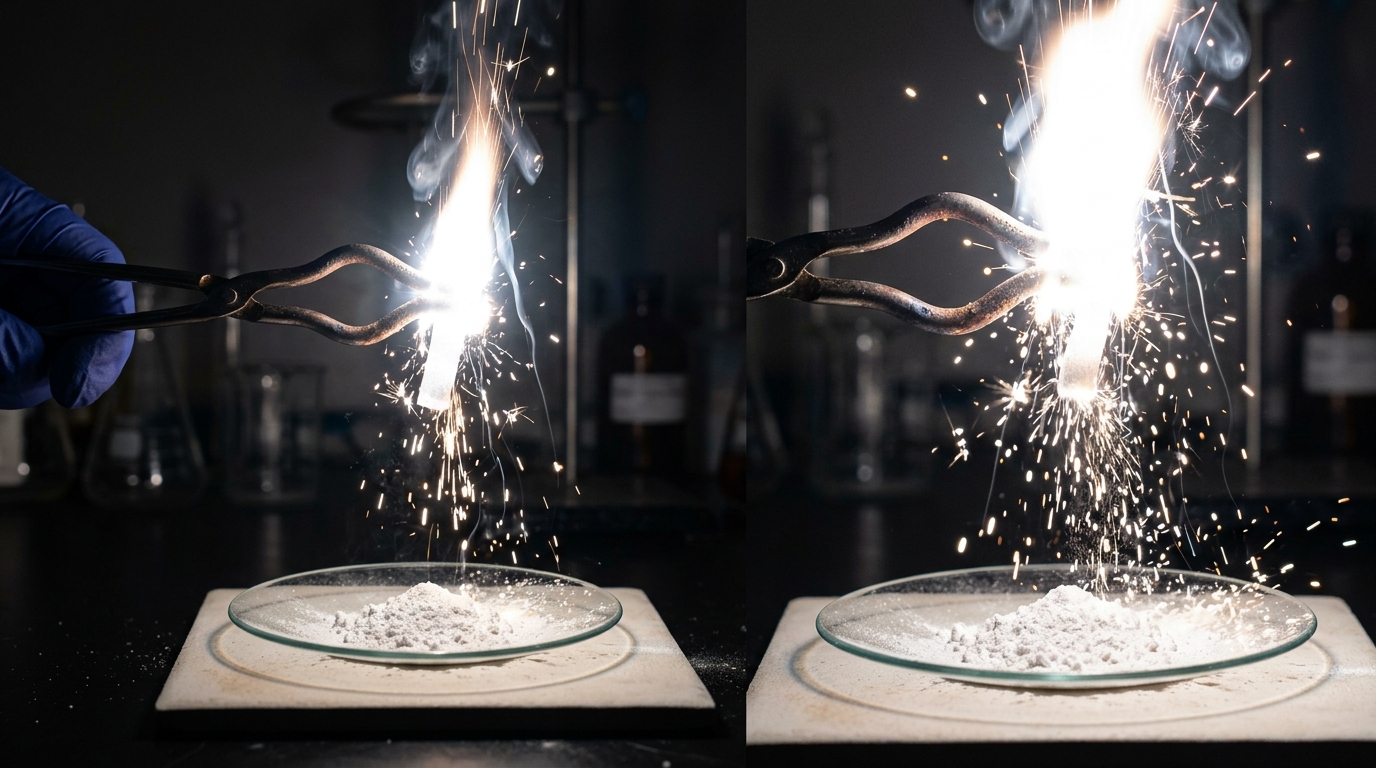
Figure 1.1: Laboratory ignition of magnesium ribbon showing intense dazzling white flame and watch glass collecting white magnesium oxide ash

Figure 1.1: High-speed photographic capture of the magnesium ignition reaction. The intense combustion releases thermal and radiant energy as pure white $MgO$ precipitates.


2. Activity 1.2 & 1.3: Precipitation & Gas Effervescence

  • Lead Nitrate & Potassium Iodide: Two transparent aqueous solutions yield a canary yellow precipitate:
$$Pb(NO_3)_2(aq) + 2KI(aq) \longrightarrow PbI_2(s) \downarrow (\text{Yellow precipitate}) + 2KNO_3(aq)$$
  • Zinc Granules & Acid: Zinc reacting with dilute sulphuric acid produces effervescence and warms the container:
$$Zn(s) + H_2SO_4(aq) \longrightarrow ZnSO_4(aq) + H_2(g) \uparrow$$

Hydrogen gas extinguishes a burning splinter with a sharp, distinctive "pop" sound!
๐Ÿ“
Comprehensive High-Yield Mathematical Relations & Theorems

Complete step-by-step derivations, step traps, and LaTeX formula sheet breakdowns...

๐Ÿ”’

End of Free Notes Preview

Unlock the complete deck to access full LaTeX formula breakdowns, interactive diagrams, exam traps, and personal margin highlights!

๐Ÿ”‘ Sign In / Register Free
STEP 3 โ€ข CONCEPT NOTES โฑ๏ธ 6 min read
๐Ÿ“Œ 0 Notes

Chemical Equations & The Law of Conservation of Mass โš–๏ธโš›๏ธ

According to Antoine Lavoisierโ€™s Law of Conservation of Mass, matter cannot be created or destroyed in a chemical reaction. Therefore:

$$\sum \text{Atoms of Reactants} = \sum \text{Atoms of Products}$$
TEXT
โ”Œโ”€โ”€โ”€ BALANCING EQUATIONS: HIT-AND-TRIAL PROTOCOL โ”€โ”€โ”€โ”
โ”œโ”€โ”€ Step 1: Write skeletal word equation with boxes around formulas
โ”œโ”€โ”€ Step 2: Tabulate atom inventory (LHS Reactants vs RHS Products)
โ”œโ”€โ”€ Step 3: Balance the element with highest atom count first (O or Fe)
โ”œโ”€โ”€ Step 4: Adjust stoichiometric coefficients (Never touch subscripts!)
โ””โ”€โ”€ Step 5: Append physical states: (s) solid, (l) liquid, (g) gas, (aq) aqueous

Step-by-Step Balancing: Iron Reacting with Steam

Consider the skeletal equation:

$$Fe + H_2O \longrightarrow Fe_3O_4 + H_2$$
  1. Balance Oxygen: Right side has 4 oxygens in $Fe_3O_4$. Multiply $H_2O$ by 4:
$$Fe + 4H_2O \longrightarrow Fe_3O_4 + H_2$$
  1. Balance Hydrogen: Left side has $4 \times 2 = 8$ hydrogens. Multiply $H_2$ on right by 4:
$$Fe + 4H_2O \longrightarrow Fe_3O_4 + 4H_2$$
  1. Balance Iron: Right side has 3 iron atoms. Multiply $Fe$ on left by 3:
$$3Fe(s) + 4H_2O(g) \longrightarrow Fe_3O_4(s) + 4H_2(g)$$

? Visual Concept Diagrams & Figures

Figure 1.2: 3D molecular balance scale illustrating conservation of mass between iron, steam, magnetic oxide, and hydrogen molecules

Figure 1.2: Precision molecular balance scale demonstrating that 3 Iron atoms and 4 Water molecules ($H_2O$) balance exactly with 1 $Fe_3O_4$ lattice and 4 $H_2$ molecules.


Reaction Conditions Notation

Environmental variables are explicitly listed across the reaction arrow:

$$CO(g) + 2H_2(g) \xrightarrow{340\text{ atm}} CH_3OH(l)$$
$$6CO_2(aq) + 12H_2O(l) \xrightarrow[\text{Chlorophyll}]{\text{Sunlight}} C_6H_{12}O_6(aq) + 6O_2(aq) + 6H_2O(l)$$
๐Ÿ“
Comprehensive High-Yield Mathematical Relations & Theorems

Complete step-by-step derivations, step traps, and LaTeX formula sheet breakdowns...

๐Ÿ”’

End of Free Notes Preview

Unlock the complete deck to access full LaTeX formula breakdowns, interactive diagrams, exam traps, and personal margin highlights!

๐Ÿ”‘ Sign In / Register Free
STEP 4 โ€ข CONCEPT NOTES โฑ๏ธ 5 min read
๐Ÿ“Œ 0 Notes

Combination Reactions & Exothermic Heat Dynamics ?โ™จ๏ธ

A Combination Reaction occurs when two or more substances (elements or compounds) react chemically to produce a single product:

$$A + B \longrightarrow AB$$
TEXT
โ”Œโ”€โ”€โ”€ COMBINATION & EXOTHERMIC DYNAMICS โ”€โ”€โ”€โ”
โ”œโ”€โ”€ Definition: Two or more reactants combine to form ONE single product (A + B โ”€โ”€> AB)
โ”œโ”€โ”€ Slaking of Lime: CaO(s) + H2O(l) โ”€โ”€> Ca(OH)2(aq) + Heat [Boiling steam released]
โ”œโ”€โ”€ White-Wash Magic: Ca(OH)2(aq) + CO2(g) โ”€โ”€> CaCO3(s) + H2O(l) [Shiny marble finish in 3 days]
โ””โ”€โ”€ Exothermic Examples: 
    โ€ข Combustion of Methane: CH4 + 2O2 โ”€โ”€> CO2 + 2H2O + Heat
    โ€ข Cellular Respiration: C6H12O6 + 6O2 โ”€โ”€> 6CO2 + 6H2O + Energy (ATP)

The Slaking of Lime & The Chemistry of White-Washing

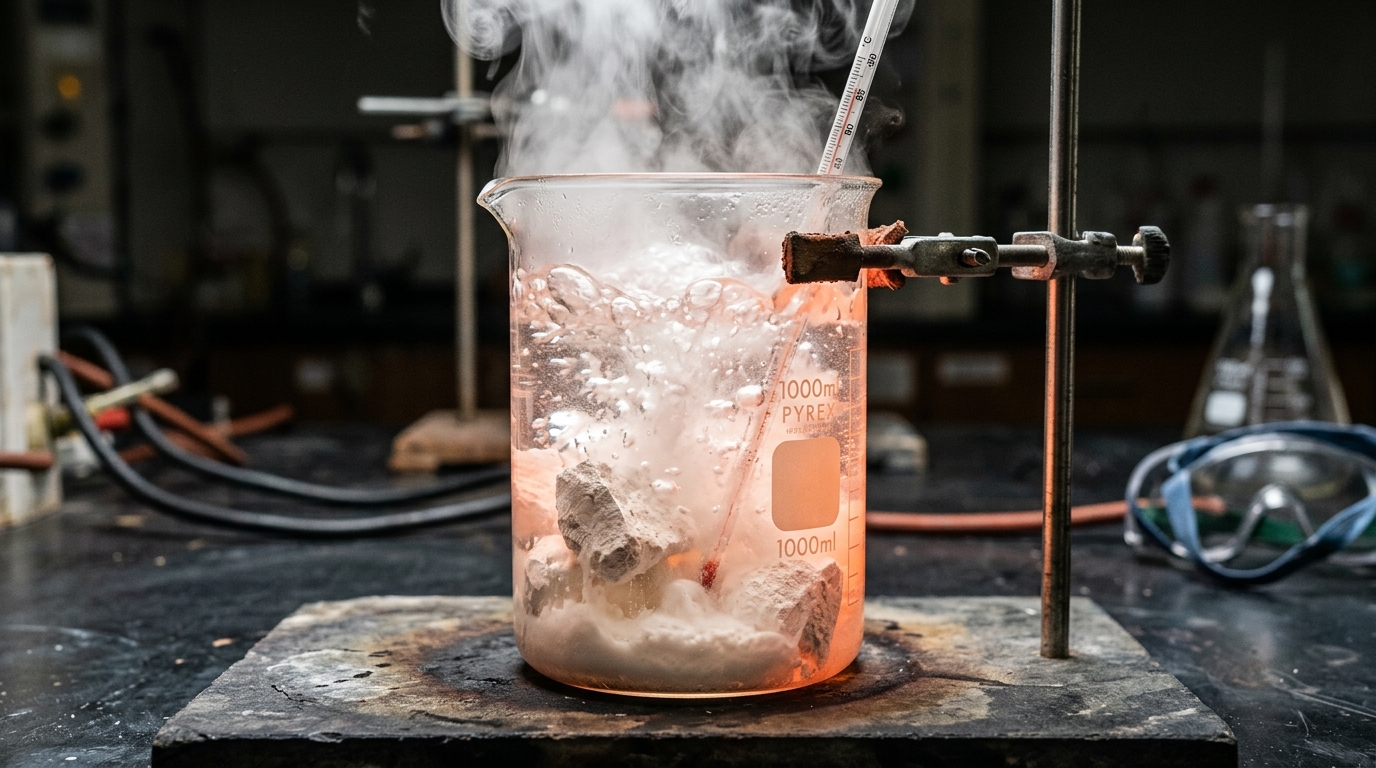
When solid Calcium Oxide (Quicklime, $CaO$) is immersed in water:

$$CaO(s) + H_2O(l) \longrightarrow Ca(OH)_2(aq) + \text{Heat}$$

The reaction is so fiercely exothermic that water in the beaker hisses and boils violently.

? Visual Concept Diagrams & Figures

Figure 1.3: Exothermic combination reaction of quicklime chunks boiling in water with steam rising

Figure 1.3: Beaker containing slaking quicklime with steam vapors rising as thermal energy is released during the synthesis of $Ca(OH)_2$.


Why White-Washed Walls Shine After 3 Days

When slaked lime ($Ca(OH)_2$) is applied to walls, it slowly absorbs atmospheric carbon dioxide over 2 to 3 days, forming an insoluble, lustrous crystalline layer of Calcium Carbonate ($CaCO_3$):

$$Ca(OH)_2(aq) + CO_2(g) \longrightarrow CaCO_3(s) + H_2O(l)$$

This crystalline deposit is chemically identical to natural marble, giving the wall an exquisite, durable sheen!

๐Ÿ“
Comprehensive High-Yield Mathematical Relations & Theorems

Complete step-by-step derivations, step traps, and LaTeX formula sheet breakdowns...

๐Ÿ”’

End of Free Notes Preview

Unlock the complete deck to access full LaTeX formula breakdowns, interactive diagrams, exam traps, and personal margin highlights!

๐Ÿ”‘ Sign In / Register Free
STEP 5 โ€ข CONCEPT NOTES โฑ๏ธ 6 min read
๐Ÿ“Œ 0 Notes

Decomposition Reactions: Energy-Driven Cleavage ?โšกโ˜€๏ธ

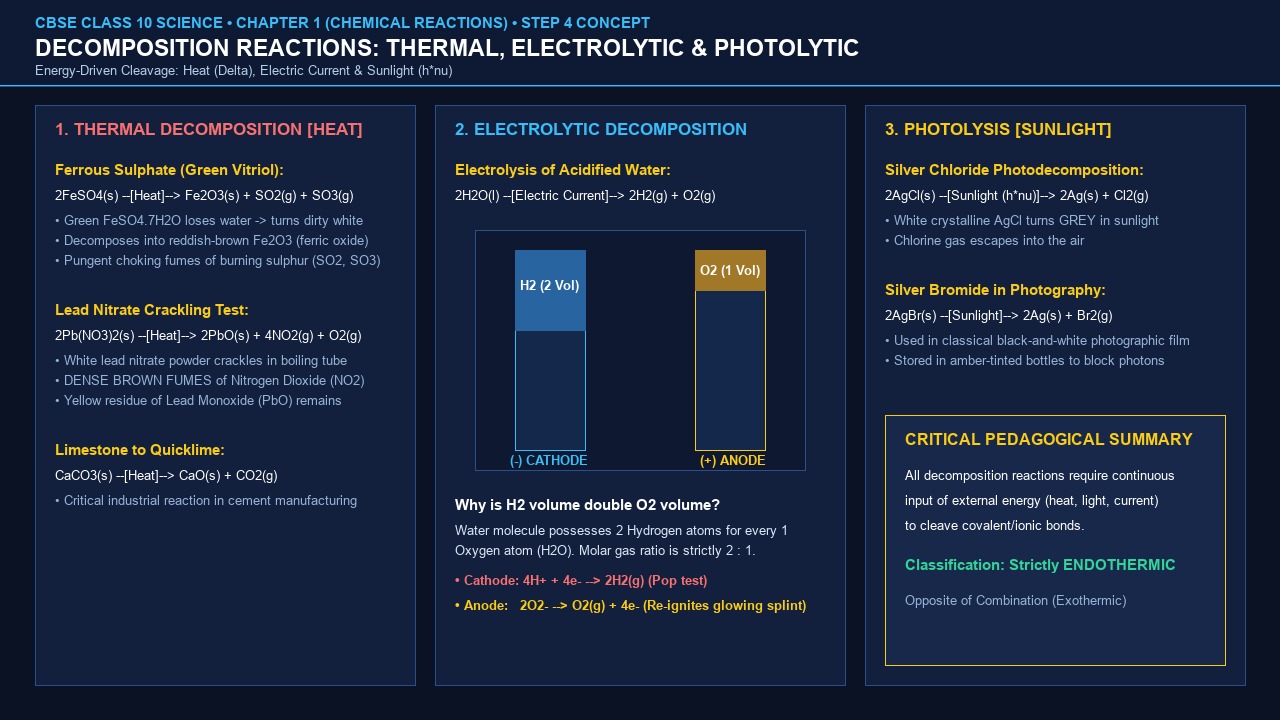
A Decomposition Reaction occurs when a single chemical reactant splits into two or more simpler products upon absorbing energy. Because breaking chemical bonds requires an input of energy, all decomposition reactions are strictly endothermic.

TEXT
โ”Œโ”€โ”€โ”€ DECOMPOSITION REACTIONS (Strictly Endothermic) โ”€โ”€โ”€โ”
โ”œโ”€โ”€ 1. THERMAL [HEAT (ฮ”)]:
โ”‚   โ€ข 2FeSO4(s) โ”€โ”€> Fe2O3(s) [red-brown] + SO2(g) + SO3(g) [choking smell]
โ”‚   โ€ข 2Pb(NO3)2(s) โ”€โ”€> 2PbO(s) [yellow] + 4NO2(g) [BROWN FUMES] + O2(g)
โ”œโ”€โ”€ 2. ELECTROLYTIC [CURRENT]:
โ”‚   โ€ข 2H2O(l) โ”€โ”€> 2H2(g) [Cathode (-), 2 vol] + O2(g) [Anode (+), 1 vol]
โ””โ”€โ”€ 3. PHOTOLYTIC [SUNLIGHT (hฮฝ)]:
    โ€ข 2AgCl(s) โ”€โ”€> 2Ag(s) [Grey] + Cl2(g) [White turns grey]
    โ€ข 2AgBr(s) โ”€โ”€> 2Ag(s) + Br2(g) [Used in black & white photography]

1. Thermal Decomposition (Heat)

  • Ferrous Sulphate Heating:
$$2FeSO_4(s) \xrightarrow{\Delta} Fe_2O_3(s) + SO_2(g) \uparrow + SO_3(g) \uparrow$$

Green vitriol crystals turn white, then decompose into reddish-brown ferric oxide with pungent, suffocating sulphur fumes.

  • Lead Nitrate Thermal Crackling:
$$2Pb(NO_3)_2(s) \xrightarrow{\Delta} 2PbO(s) + 4NO_2(g) \uparrow + O_2(g) \uparrow$$

White powder emits crackling sounds and dense, suffocating brown fumes of Nitrogen Dioxide ($NO_2$).

? Visual Concept Diagrams & Figures

Figure 1.4: Scientific infographic of thermal decomposition, water electrolysis with 2:1 volume ratio, and photolysis

Figure 1.4: Detailed overview of the three energy pathways for decomposition: heat, electric current, and photon absorption.


2. Electrolytic Decomposition (Electricity)

In the electrolysis of acidified water:

$$2H_2O(l) \xrightarrow{\text{Electric Current}} 2H_2(g) [\text{Cathode}] + O_2(g) [\text{Anode}]$$

The volume of hydrogen gas accumulated at the cathode is strictly double ($2:1$) the volume of oxygen at the anode because water contains two hydrogen atoms per oxygen atom.

๐Ÿ“
Comprehensive High-Yield Mathematical Relations & Theorems

Complete step-by-step derivations, step traps, and LaTeX formula sheet breakdowns...

๐Ÿ”’

End of Free Notes Preview

Unlock the complete deck to access full LaTeX formula breakdowns, interactive diagrams, exam traps, and personal margin highlights!

๐Ÿ”‘ Sign In / Register Free
๐Ÿ”’
Step 6 is Locked

CBSE Diagnostic Mastery Quiz: Chemical Reactions & Equations Board Check

This ๐Ÿ“ LaTeX Concept Notes is part of the full verified curriculum for Chapter 1: Chemical Reactions and Equations. Unlock the full deck to gain permanent access to all 13 interactive stages, active recall cards, and diagnostic checkpoints.

Deck Access Price
100% Free with Account
Instant Access
โœ“ UPI & Cards Supported
๐Ÿ”‘ Sign In / Register to Unlock Free →
๐Ÿ”’
Step 7 is Locked

CBSE Diagnostic Mastery Quiz: Chemical Reactions & Equations Board Check

This ๐Ÿ“ LaTeX Concept Notes is part of the full verified curriculum for Chapter 1: Chemical Reactions and Equations. Unlock the full deck to gain permanent access to all 13 interactive stages, active recall cards, and diagnostic checkpoints.

Deck Access Price
100% Free with Account
Instant Access
โœ“ UPI & Cards Supported
๐Ÿ”‘ Sign In / Register to Unlock Free →
๐Ÿ”’
Step 8 is Locked

CBSE Diagnostic Mastery Quiz: Chemical Reactions & Equations Board Check

This ๐Ÿ“ LaTeX Concept Notes is part of the full verified curriculum for Chapter 1: Chemical Reactions and Equations. Unlock the full deck to gain permanent access to all 13 interactive stages, active recall cards, and diagnostic checkpoints.

Deck Access Price
100% Free with Account
Instant Access
โœ“ UPI & Cards Supported
๐Ÿ”‘ Sign In / Register to Unlock Free →
๐Ÿ”’
Step 9 is Locked

CBSE Diagnostic Mastery Quiz: Chemical Reactions & Equations Board Check

This ๐Ÿ“ LaTeX Concept Notes is part of the full verified curriculum for Chapter 1: Chemical Reactions and Equations. Unlock the full deck to gain permanent access to all 13 interactive stages, active recall cards, and diagnostic checkpoints.

Deck Access Price
100% Free with Account
Instant Access
โœ“ UPI & Cards Supported
๐Ÿ”‘ Sign In / Register to Unlock Free →
๐Ÿ”’
Step 10 is Locked

CBSE Diagnostic Mastery Quiz: Chemical Reactions & Equations Board Check

This ๐Ÿ“ LaTeX Concept Notes is part of the full verified curriculum for Chapter 1: Chemical Reactions and Equations. Unlock the full deck to gain permanent access to all 13 interactive stages, active recall cards, and diagnostic checkpoints.

Deck Access Price
100% Free with Account
Instant Access
โœ“ UPI & Cards Supported
๐Ÿ”‘ Sign In / Register to Unlock Free →
๐Ÿ”’
Step 11 is Locked

CBSE Diagnostic Mastery Quiz: Chemical Reactions & Equations Board Check

This Microlearning Step is part of the full verified curriculum for Chapter 1: Chemical Reactions and Equations. Unlock the full deck to gain permanent access to all 13 interactive stages, active recall cards, and diagnostic checkpoints.

Deck Access Price
100% Free with Account
Instant Access
โœ“ UPI & Cards Supported
๐Ÿ”‘ Sign In / Register to Unlock Free →
๐Ÿ”’
Step 12 is Locked

CBSE Diagnostic Mastery Quiz: Chemical Reactions & Equations Board Check

This ๐Ÿง  Active Recall Flashcards is part of the full verified curriculum for Chapter 1: Chemical Reactions and Equations. Unlock the full deck to gain permanent access to all 13 interactive stages, active recall cards, and diagnostic checkpoints.

Deck Access Price
100% Free with Account
Instant Access
โœ“ UPI & Cards Supported
๐Ÿ”‘ Sign In / Register to Unlock Free →
๐Ÿ”’
Step 13 is Locked

CBSE Diagnostic Mastery Quiz: Chemical Reactions & Equations Board Check

This โšก Diagnostic Quiz is part of the full verified curriculum for Chapter 1: Chemical Reactions and Equations. Unlock the full deck to gain permanent access to all 13 interactive stages, active recall cards, and diagnostic checkpoints.

Deck Access Price
100% Free with Account
Instant Access
โœ“ UPI & Cards Supported
๐Ÿ”‘ Sign In / Register to Unlock Free →