Secants, Tangents & The Topology of Lines on Circles
Lead Educator: Prof. Arvind Swaminathan (Senior NCERT Mathematics Faculty)
? Visual Concept Diagrams & Figures
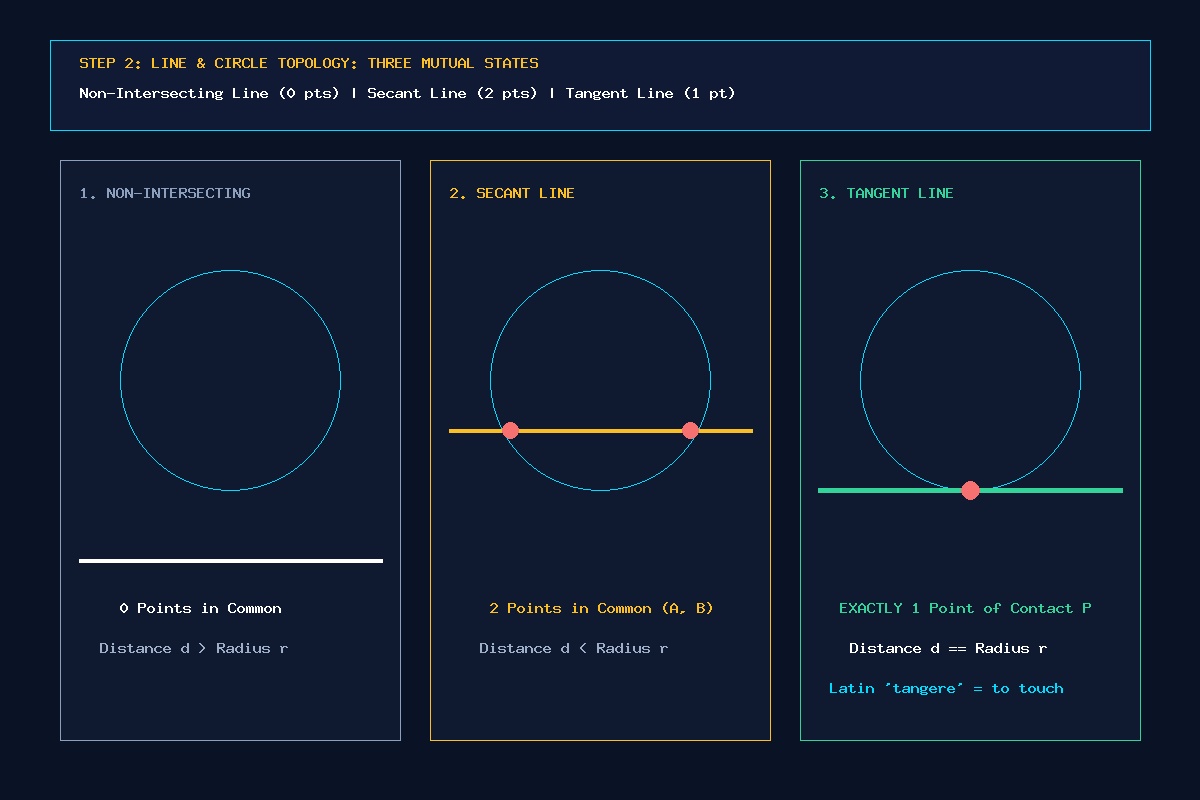
1. The Three Spatial Relationships
When a straight line $L$ and a circle $C$ lie in the same geometric plane, exactly three mutually exclusive topological configurations can occur based on the perpendicular distance $d$ from the circle's center $O$ to line $L$:
- Non-Intersecting Line ($d > r$):
- The line and the circle share $0$ common points.
- Perpendicular distance from center strictly exceeds the radius: $OP > r$.
- Secant ($d < r$):
- The line cuts completely through the circle, intersecting it at exactly $2$ distinct points ($A$ and $B$).
- The line segment $AB$ inside the circle is a chord.
- Tangent ($d = r$):
- The line touches the circle at exactly $1$ unique point $P$.
- The single point of contact is called the Point of Contact.
      Non-Intersecting (d > r)        Secant (d < r)              Tangent (d = r)
             ( O )                         ( O )                       ( O )
                                           /   \                         |
                                       ---A-----B---                 ----+----
      ------------------------           2 Points                   Point P (1 Point)
2. Tangent as a Limiting Case of a Secant
Imagine a chord $AB$ of a circle. If you fix point $A$ and rotate the cutting secant line so that point $B$ moves continuously along the circumference closer and closer to $A$:
- As the distance between $A$ and $B$ approaches zero, the two points coalesce into a single coincident point.
- Fundamental Definition: The tangent to a circle is the limiting position of a secant when the two ends of its corresponding chord coincide.
Key Rule: At any single given point on a circle, there can be one and only one tangent line.