Chapter 6: Control and Coordination
๐Ÿ‡ฎ๐Ÿ‡ณ National Curriculum Standard โ–พ
๐Ÿ› Vidyoric Certified โ€ข Dr. Ramesh Pardhi
๐Ÿ”ฅ 0 days
โšก 0 Sparks +
Chapter 6: Control and Coordination

Visual Overview: The Neural Architecture, Reflexes & Chemical Masterminds

STEP 1: VIDEO LESSON ๐Ÿ“ค Uploaded HTML5 Video

๐Ÿ“‘ Interactive Chapter Bookmarks

0 chapters

๐ŸŽ™๏ธ Synchronized Transcript

๐Ÿ”
# Production Video Lecture Script: Step 1
## Visual Overview: The Neural Architecture, Reflexes & Chemical Masterminds
**Chapter**: CBSE Class 10 Science โ€” Chapter 6: Control and Coordination
**Target Runtime**: 05:45 Minutes (~750 words) | **Lead Educator**: Dr. Ramesh Pardhi
**Format**: Cinematic 4K Scientific Presentation with 3D Neural Animations, Synapse Electron Microscopy & Phytohormone Time-Lapse

---

### [Scene 1: 00:00 - 01:10] The Hot Pan Dilemma & The Millisecond Imperative
- **Visual Setup**: Macro shot of a human finger approaching a steaming copper vessel. As the dermal skin makes contact, glowing red electrical spikes burst along microscopic nerve fibers inside the translucent arm.
- **Presenter (Dr. Ramesh Pardhi)**:
"Picture this: your hand inadvertently brushes against a sizzling hot skillet. Before you even have time to consciously say 'Ouch!' or formulate a thought in your cerebral cortex, your arm has already yanked backwards into safety.

How did your body pull off this miraculous survival maneuver? If your brain had to consciously debate the temperature, consult your memory banks, and deliberate an action, third-degree burns would have already seared your skin.

Welcome to Chapter Six: Control and Coordination. Today, we decode the marvelous electrical wiring of neurons, the genius evolutionary shortcut called the Reflex Arc, the tripartite architecture of the human brain, and the hidden chemical signals orchestrating life in both animals and plants."
- **On-Screen Graphics (OSD)**:
* "Stimulus $\rightarrow$ Receptor $\rightarrow$ Impulse $\rightarrow$ Action"
* "Action Potential Speed: Up to 120 meters per second!"

---

### [Scene 2: 01:10 - 02:20] Anatomy of a Neuron & The Synaptic Chasm
- **Visual Setup**: 3D photorealistic holographic cutaway of a multipolar motor neuron. A glowing cyan electrical wave flows from the branching dendrites into the cyton, races down the golden myelin-sheathed axon, and reaches the bulbous synaptic terminal.
- **Presenter**:
"Look closely at this single structural masterpiece: the neuron. At the front, dendritic branches act as sensory antennae, intercepting chemical signals from receptors in your eyes, ears, skin, or tongue.

Within a fraction of a millisecond, that chemical stimulus sparks an electrical action potential. It surges across the soma, zips down the elongated axon like electricity through an insulated cable, and arrives at the terminal bulb.

But here lies nature's great engineering challenge: neurons do not physically touch! There is a microscopic fluid-filled gapโ€”the synapseโ€”measuring barely twenty nanometers wide. Electricity cannot jump this chasm.

So, what does the neuron do? It converts the electrical wave into chemical neurotransmitter moleculesโ€”like acetylcholineโ€”stored in tiny synaptic vesicles. These vesicles fuse with the membrane, spill their contents across the synaptic cleft, and bind to receptors on the next dendrite, sparking a brand-new electrical wave. This guarantees that nerve impulses travel strictly one-way!"

---

### [Scene 3: 02:20 - 03:30] The Spinal Short-Circuit: The Reflex Arc
- **Visual Setup**: Anatomical 3D cross-section of the human spinal cord (butterfly-shaped gray matter surrounded by white matter). Animated sensory and motor neural loops activate instantaneously.
- **Presenter**:
"Now, let us revisit that hot skillet. Why didn't you have to wait for your brain?

The answer is the Reflex Arc. The pain and heat receptors in your dermal skin fire an impulse along a sensory afferent neuron directly into the dorsal horn of your spinal cord.

Here, a specialized relay neuron makes an immediate, executive command decision: it bridges directly into a motor efferent neuron! The motor neuron delivers an instantaneous signal to your biceps muscle fibers, which contract and yank your hand away.

Notice the brilliance: while an informational report *does* travel up the spinal tract to inform your brain, the physical response was executed at the spinal level in a mere fifty milliseconds! Reflex arcs evolved as evolutionary fail-safes when conscious thinking is too slow to save life."

---

### [Scene 4: 03:30 - 04:45] The Brain's Tripartite Map & The Plant Paradox
- **Visual Setup**: Sagittal cross-section of the human brain with color-coded lobes (Cerebrum, Cerebellum, Medulla), transitioning to a split-screen showing a *Mimosa pudica* plant collapsing and a sunflower turning toward the sun.
- **Presenter**:
"Of course, for voluntary masteryโ€”like speaking, writing, playing guitar, or balancing on a bicycleโ€”the Central Nervous System utilizes the human brain.

Your convoluted Cerebrum handles thinking, sensory association, and conscious motor commands. Your Cerebellum fine-tunes your posture, equilibrium, and physical precision. And your Medulla Oblongata silently controls non-negotiable life support: heartbeat, blood pressure, and breathing.

Now look at plants. A plant has no brain, no nerves, and not a single muscle cell. Yet, if you touch a *Mimosa pudica*โ€”the sensitive touch-me-not plantโ€”its leaves droop within two seconds! How? By rapid osmotic shifts in potassium and water within its pulvinar cells, collapsing cellular turgor pressure.

And when a shoot bends gracefully toward a sunny window, it uses a chemical phytohormone called Auxin. Auxin migrates to the shaded side of the stem, stimulating those cells to grow faster and longer, mechanically forcing the stem to bend right toward the sunlight!"

---

### [Scene 5: 04:45 - 05:45] Chemical Messages & The Adrenaline Surge
- **Visual Setup**: 3D rendering of the human endocrine glands with glowing hormone molecules traversing capillary blood vessels toward the heart, lungs, and liver.
- **Presenter**:
"Finally, why do animals need an Endocrine System alongside their nervous system? Because electrical impulses can only reach innervated cells and need recovery time between firings.

When danger strikes, your adrenal glands dump Adrenaline directly into your bloodstream. Your heart pounds, your airways dilate, and glucose floods your musclesโ€”preparing every cell simultaneously for fight or flight!

Throughout this deck, you will master every receptor, every brain center, every plant tropism, and every endocrine feedback loop. Let us begin Stage One!"
STEP 2 โ€ข CONCEPT NOTES โฑ๏ธ 8 min read
๐Ÿ“Œ 0 Notes

1. Sensory Perception & The Electrochemical Transmission of Signals

Living organisms detect environmental events through specialized cellular sensors known as receptors, clustered predominantly inside sense organs:

TEXT
================================================================================
                    SENSORY RECEPTOR CLASSIFICATION
================================================================================
  RECEPTOR TYPE       ANATOMICAL LOCATION        STIMULUS DETECTED
  โ”€โ”€โ”€โ”€โ”€โ”€โ”€โ”€โ”€โ”€โ”€โ”€โ”€โ”€โ”€โ”€โ”€โ”€โ”€โ”€โ”€โ”€โ”€โ”€โ”€โ”€โ”€โ”€โ”€โ”€โ”€โ”€โ”€โ”€โ”€โ”€โ”€โ”€โ”€โ”€โ”€โ”€โ”€โ”€โ”€โ”€โ”€โ”€โ”€โ”€โ”€โ”€โ”€โ”€โ”€โ”€โ”€โ”€โ”€โ”€โ”€โ”€โ”€โ”€โ”€โ”€โ”€โ”€โ”€โ”€โ”€โ”€โ”€โ”€โ”€โ”€โ”€
  Photoreceptors      Retina of Eyes             Light photons, color & imagery
  Phonoreceptors      Cochlea of Inner Ear       Sound pressure waves & balance
  Olfactory           Nasal Mucosa Epithelium    Volatile airborne odorant chemicals
  Gustatory           Taste Buds on Tongue       Dissolved chemical tastants
  Thermoreceptors     Dermal Layer of Skin       Temperature differentials (heat/cold)
  Tangoreceptors      Skin Papillae              Mechanical tactile touch/pressure
================================================================================

? Visual Concept Diagram: Neuron & Synaptic Cleft
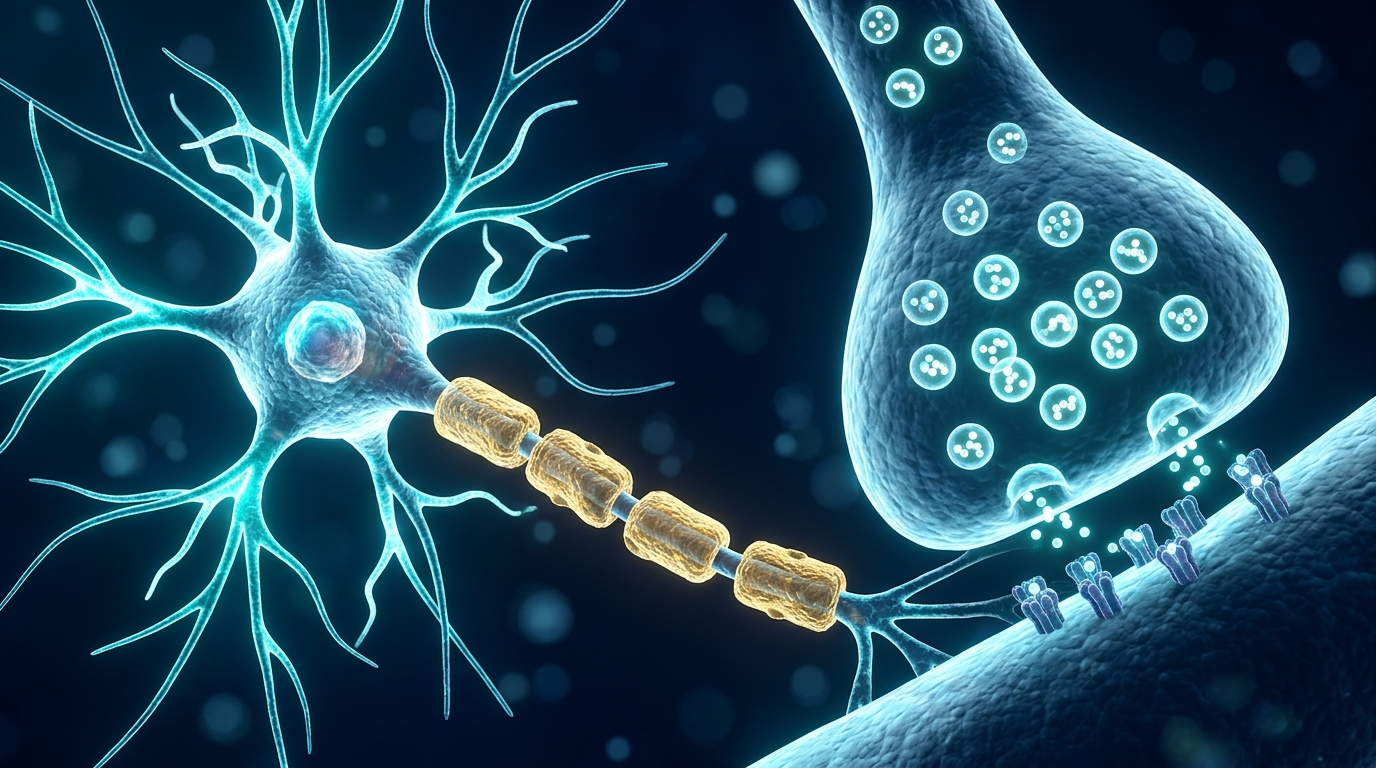
Figure 6.1: Microscopic Structure of a Multipolar Neuron and Synapse

A. The Structural Blueprint of a Neuron

The neuron is the specialized cellular building block of the nervous system:

  1. Dendrites: Branching cytoplasmic extensions that receive chemical signals from adjacent cells or receptors, converting them into an electrical action potential.
  2. Cyton (Soma / Cell Body): Contains the nucleus, metabolic organelles, and Nissl granules; synthesizes cellular enzymes and neurotransmitter precursors.
  3. Axon: A long, cylindrical cytoplasmic projection extending from the axon hillock that carries the electrical impulse away from the soma.
  4. Myelin Sheath: Fatty insulating layer produced by Schwann cells, interrupted at periodic gaps called Nodes of Ranvier, enabling lightning-fast saltatory impulse conduction (up to 120 m/s).
  5. Axon Terminal / Synaptic Knob: Bulbous terminals containing neurotransmitter storage vesicles.

B. The Synaptic Transmission Paradigm

Two neurons do not physically touch; they are separated by a fluid-filled gap (~20 nm) called the synaptic cleft:

  • When an electrical impulse reaches the axon terminus, it triggers the exocytosis of chemical neurotransmitters (e.g., acetylcholine).
  • These molecules diffuse across the cleft and bind to specific receptor proteins on the dendritic membrane of the next neuron.
  • This chemical binding alters membrane ion permeability, initiating a fresh electrical impulse.
  • Unidirectional Transmission Law: Impulses can never travel backwards because neurotransmitter vesicles exist exclusively in axon terminals, and ligand receptors exist exclusively on postsynaptic dendrites.
๐Ÿ“
Comprehensive High-Yield Mathematical Relations & Theorems

Complete step-by-step derivations, step traps, and LaTeX formula sheet breakdowns...

๐Ÿ”’

End of Free Notes Preview

Unlock the complete deck to access full LaTeX formula breakdowns, interactive diagrams, exam traps, and personal margin highlights!

๐Ÿ”‘ Sign In / Register Free
STEP 3 โ€ข CONCEPT NOTES โฑ๏ธ 8 min read
๐Ÿ“Œ 0 Notes

2. Emergency Neural Circuits: The Reflex Arc

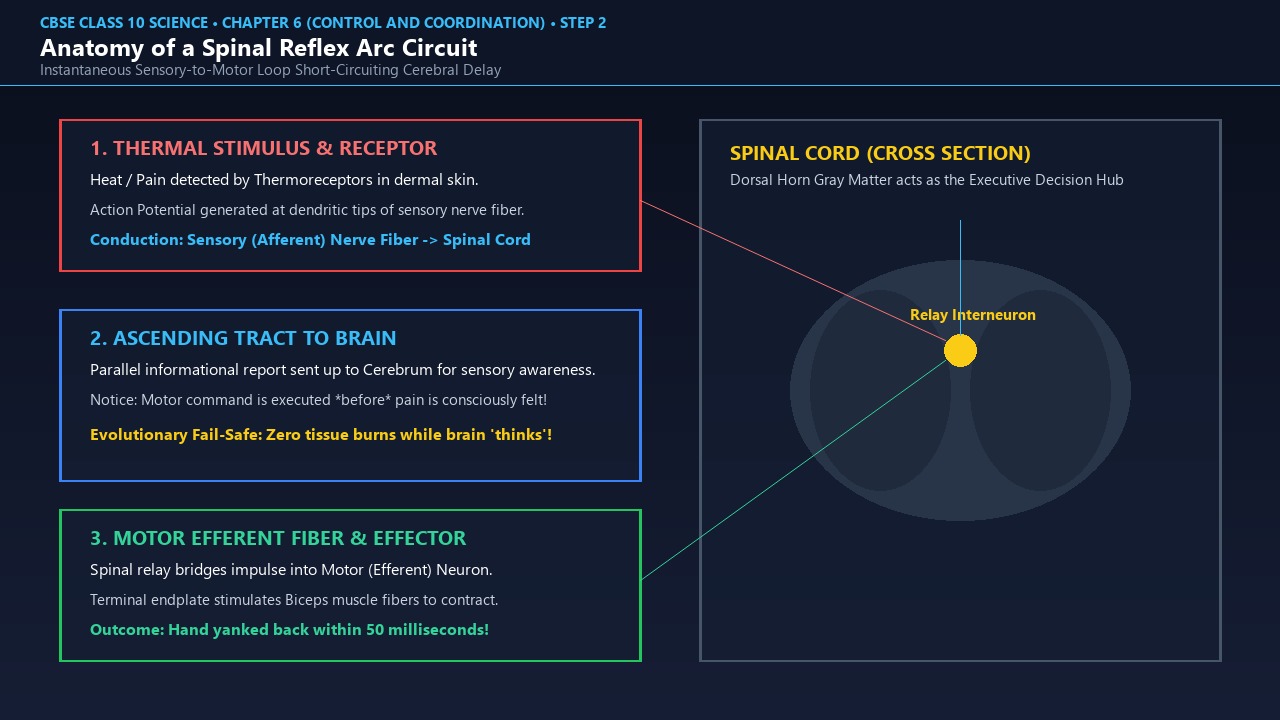
A reflex action is an involuntary, spontaneous, automatic, and rapid response to an external environmental stimulus that does not involve conscious deliberation by the cerebral cortex.

TEXT
================================================================================
                           THE REFLEX ARC CIRCUIT
================================================================================
               [Stimulus: Intense Heat or Sharp Pin]
                                 โ”‚
                                 โ–ผ
                     1. SENSORY RECEPTOR (Skin)
                                 โ”‚
                                 โ–ผ (Sensory Afferent Nerve Fiber)
                 2. SENSORY NEURON CONDUCTS IMPULSE
                                 โ”‚
                                 โ–ผ
            3. SPINAL CORD RELAY NEURON (Interneuron in Gray Matter)
               โ”œโ”€โ”€ Parallel Informational Signal Sent Upward to Brain
               โ””โ”€โ”€ Immediate Motor Execution Command
                                 โ”‚
                                 โ–ผ (Motor Efferent Nerve Fiber)
                  4. MOTOR NEURON TRANSMITS COMMAND
                                 โ”‚
                                 โ–ผ
              5. EFFECTOR ORGAN (Arm Biceps Muscle Contracts)
                                 โ”‚
                                 โ–ผ
                 [Result: Hand Instantly Withdrawn!]
================================================================================

? Visual Concept Diagram: The Reflex Arc Loop

Figure 6.2: Anatomical Circuit of a Spinal Reflex Arc

Why Did Reflex Arcs Evolve?

  • Complex cognitive thinking requires millions of neurons interacting in the brain's cerebral cortex.
  • If you step on a sharp thorn or touch a 100ยฐC flame, waiting 300 milliseconds for cortical deliberation would cause severe tissue destruction.
  • The reflex arc bypasses the brain, forming a rapid closed loop within the spinal cord.
  • The message eventually reaches the brain, creating conscious perception of pain after the hand has already been safely retracted.
๐Ÿ“
Comprehensive High-Yield Mathematical Relations & Theorems

Complete step-by-step derivations, step traps, and LaTeX formula sheet breakdowns...

๐Ÿ”’

End of Free Notes Preview

Unlock the complete deck to access full LaTeX formula breakdowns, interactive diagrams, exam traps, and personal margin highlights!

๐Ÿ”‘ Sign In / Register Free
STEP 4 โ€ข CONCEPT NOTES โฑ๏ธ 8 min read
๐Ÿ“Œ 0 Notes

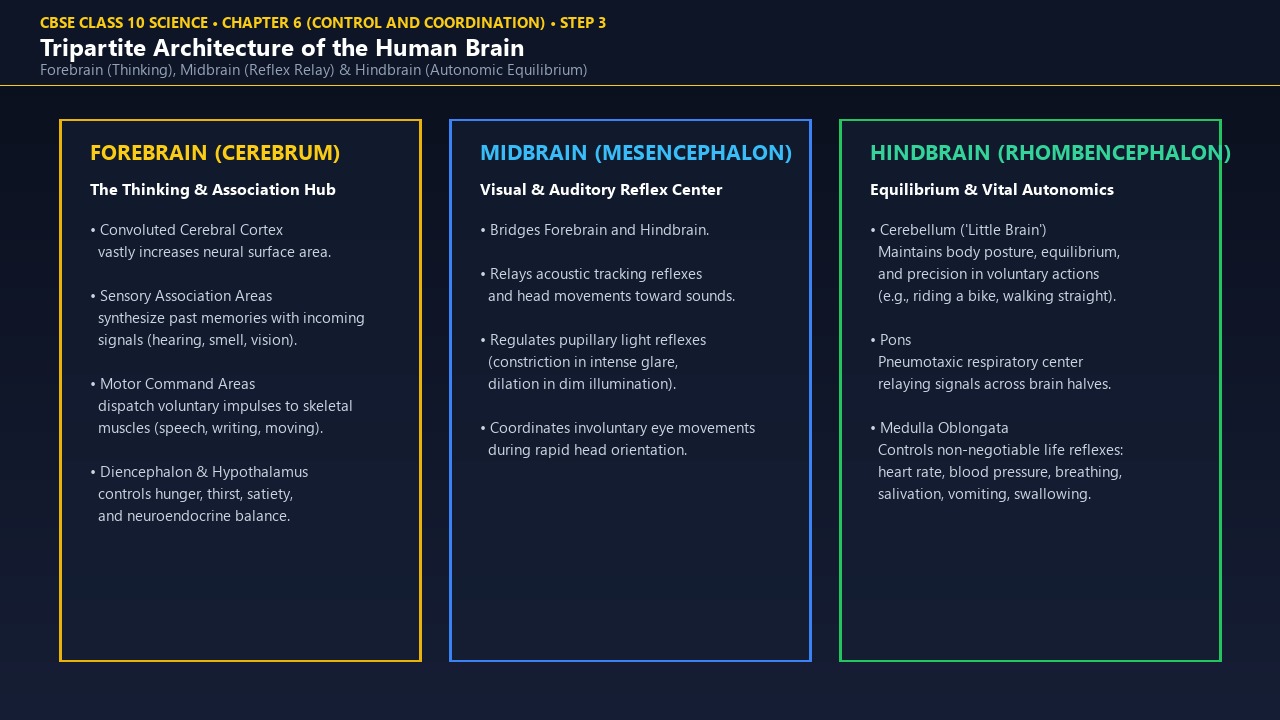
3. The Central Nervous System & Tripartite Brain Anatomy

The Central Nervous System (CNS) comprises the Brain and Spinal Cord, working in concert with the Peripheral Nervous System (PNS) (12 pairs of cranial nerves and 31 pairs of spinal nerves).

TEXT
================================================================================
                       HUMAN BRAIN ANATOMICAL MATRIX
================================================================================
  REGION            ANATOMICAL SUBDIVISIONS    PRIMARY PHYSIOLOGICAL FUNCTIONS
  โ”€โ”€โ”€โ”€โ”€โ”€โ”€โ”€โ”€โ”€โ”€โ”€โ”€โ”€โ”€โ”€โ”€โ”€โ”€โ”€โ”€โ”€โ”€โ”€โ”€โ”€โ”€โ”€โ”€โ”€โ”€โ”€โ”€โ”€โ”€โ”€โ”€โ”€โ”€โ”€โ”€โ”€โ”€โ”€โ”€โ”€โ”€โ”€โ”€โ”€โ”€โ”€โ”€โ”€โ”€โ”€โ”€โ”€โ”€โ”€โ”€โ”€โ”€โ”€โ”€โ”€โ”€โ”€โ”€โ”€โ”€โ”€โ”€โ”€โ”€โ”€โ”€
  FOREBRAIN         Cerebrum (Cortex)          Sensory association, memory, logic,
  (Thinking Hub)                               willpower, speech, voluntary motor areas.
                    Diencephalon/Hypothalamus  Hunger, thirst, body temp, neuroendocrine.
  โ”€โ”€โ”€โ”€โ”€โ”€โ”€โ”€โ”€โ”€โ”€โ”€โ”€โ”€โ”€โ”€โ”€โ”€โ”€โ”€โ”€โ”€โ”€โ”€โ”€โ”€โ”€โ”€โ”€โ”€โ”€โ”€โ”€โ”€โ”€โ”€โ”€โ”€โ”€โ”€โ”€โ”€โ”€โ”€โ”€โ”€โ”€โ”€โ”€โ”€โ”€โ”€โ”€โ”€โ”€โ”€โ”€โ”€โ”€โ”€โ”€โ”€โ”€โ”€โ”€โ”€โ”€โ”€โ”€โ”€โ”€โ”€โ”€โ”€โ”€โ”€โ”€
  MIDBRAIN          Tectum & Cerebral Peduncles Visual tracking & auditory reflex relays;
                                               pupillary dilation reflexes.
  โ”€โ”€โ”€โ”€โ”€โ”€โ”€โ”€โ”€โ”€โ”€โ”€โ”€โ”€โ”€โ”€โ”€โ”€โ”€โ”€โ”€โ”€โ”€โ”€โ”€โ”€โ”€โ”€โ”€โ”€โ”€โ”€โ”€โ”€โ”€โ”€โ”€โ”€โ”€โ”€โ”€โ”€โ”€โ”€โ”€โ”€โ”€โ”€โ”€โ”€โ”€โ”€โ”€โ”€โ”€โ”€โ”€โ”€โ”€โ”€โ”€โ”€โ”€โ”€โ”€โ”€โ”€โ”€โ”€โ”€โ”€โ”€โ”€โ”€โ”€โ”€โ”€
  HINDBRAIN         Cerebellum                 Body equilibrium, physical posture,
  (Autonomic &                                 precision of voluntary muscle movements.
   Coordination)    Pons                       Pneumotaxic respiratory rhythm regulation.
                    Medulla Oblongata          Autonomic life-support: heart rate, BP,
                                               swallowing, salivation, coughing, vomiting.
================================================================================

? Visual Concept Diagram: Sagittal Anatomy of Human Brain

Figure 6.3: Sagittal Section of the Human Brain Showing Forebrain, Midbrain, and Hindbrain

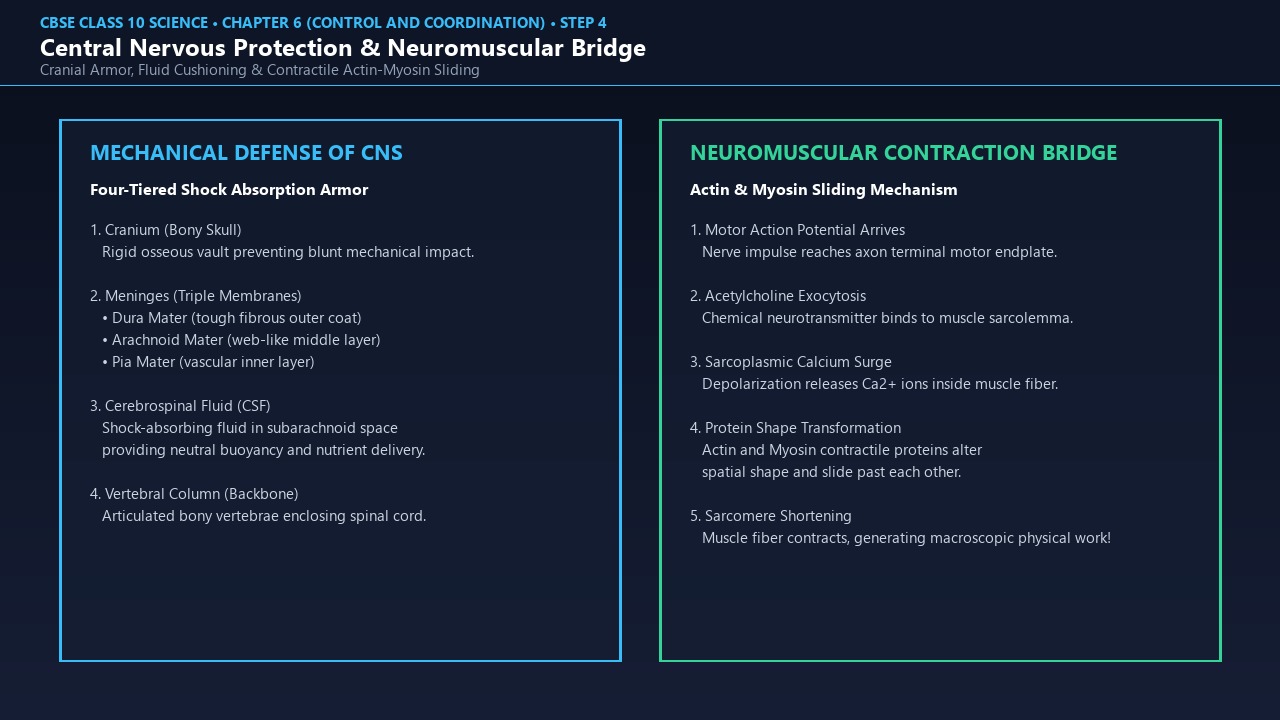
Mechanical Armor of the Brain

The delicate neural tissues of the CNS are shielded by multi-layered biological defenses:

  1. Cranium (Bony Skull): Rigid osseous box preventing blunt impact trauma.
  2. Meninges: Three protective membranes (outer Dura Mater, middle Arachnoid Mater, and inner Pia Mater).
  3. Cerebrospinal Fluid (CSF): Clear shock-absorbing fluid filling the subarachnoid space and cerebral ventricles, maintaining buoyancy and distributing metabolic nutrients.
  4. Vertebral Column: Articulated bony vertebrae enclosing and protecting the spinal cord.
๐Ÿ“
Comprehensive High-Yield Mathematical Relations & Theorems

Complete step-by-step derivations, step traps, and LaTeX formula sheet breakdowns...

๐Ÿ”’

End of Free Notes Preview

Unlock the complete deck to access full LaTeX formula breakdowns, interactive diagrams, exam traps, and personal margin highlights!

๐Ÿ”‘ Sign In / Register Free
STEP 5 โ€ข CONCEPT NOTES โฑ๏ธ 8 min read
๐Ÿ“Œ 0 Notes

4. How Nervous Tissue Translates Thoughts into Physical Action

How does an electrical nerve impulse actually make an animal's muscle move?

TEXT
================================================================================
                   NEUROMUSCULAR JUNCTION ACTION SEQUENCE
================================================================================
  [Action Potential reaches Motor Axon Terminal]
                       โ”‚
                       โ–ผ
  [Voltage-Gated Calcium Channels open -> Acetylcholine Released]
                       โ”‚
                       โ–ผ
  [Acetylcholine binds to Receptors on Muscle Sarcolemma]
                       โ”‚
                       โ–ผ
  [Muscle Action Potential Triggers Calcium Release inside Sarcoplasm]
                       โ”‚
                       โ–ผ
  [Contractile Proteins (Actin & Myosin) Alter Shape & Slide Together]
                       โ”‚
                       โ–ผ
  [Muscle Fiber Shortens -> Macroscopic Movement Occurs!]
================================================================================

? Visual Concept Diagram: Neuromuscular Junction & Cranial Protection

Figure 6.4: The Neuromuscular Junction and Muscle Contraction Mechanism

Cellular Chemistry of Muscle Movement

  • Muscle cells contain specialized contractile proteins: actin and myosin.
  • In response to electrical stimulation at the motor endplate, intracellular calcium surges into the sarcoplasm.
  • The molecular conformation and spatial arrangement of these protein filaments change, causing them to slide past each other.
  • This shortening of individual sarcomeres translates into macroscopic muscle contraction, allowing you to walk, lift, whisper, or jump.
๐Ÿ“
Comprehensive High-Yield Mathematical Relations & Theorems

Complete step-by-step derivations, step traps, and LaTeX formula sheet breakdowns...

๐Ÿ”’

End of Free Notes Preview

Unlock the complete deck to access full LaTeX formula breakdowns, interactive diagrams, exam traps, and personal margin highlights!

๐Ÿ”‘ Sign In / Register Free
๐Ÿ”’
Step 6 is Locked

CBSE Diagnostic Mastery Quiz: Control & Coordination Board Check

This ๐Ÿ“ LaTeX Concept Notes is part of the full verified curriculum for Chapter 6: Control and Coordination. Unlock the full deck to gain permanent access to all 13 interactive stages, active recall cards, and diagnostic checkpoints.

Deck Access Price
100% Free with Account
Instant Access
โœ“ UPI & Cards Supported
๐Ÿ”‘ Sign In / Register to Unlock Free →
๐Ÿ”’
Step 7 is Locked

CBSE Diagnostic Mastery Quiz: Control & Coordination Board Check

This ๐Ÿ“ LaTeX Concept Notes is part of the full verified curriculum for Chapter 6: Control and Coordination. Unlock the full deck to gain permanent access to all 13 interactive stages, active recall cards, and diagnostic checkpoints.

Deck Access Price
100% Free with Account
Instant Access
โœ“ UPI & Cards Supported
๐Ÿ”‘ Sign In / Register to Unlock Free →
๐Ÿ”’
Step 8 is Locked

CBSE Diagnostic Mastery Quiz: Control & Coordination Board Check

This ๐Ÿ“ LaTeX Concept Notes is part of the full verified curriculum for Chapter 6: Control and Coordination. Unlock the full deck to gain permanent access to all 13 interactive stages, active recall cards, and diagnostic checkpoints.

Deck Access Price
100% Free with Account
Instant Access
โœ“ UPI & Cards Supported
๐Ÿ”‘ Sign In / Register to Unlock Free →
๐Ÿ”’
Step 9 is Locked

CBSE Diagnostic Mastery Quiz: Control & Coordination Board Check

This ๐Ÿ“ LaTeX Concept Notes is part of the full verified curriculum for Chapter 6: Control and Coordination. Unlock the full deck to gain permanent access to all 13 interactive stages, active recall cards, and diagnostic checkpoints.

Deck Access Price
100% Free with Account
Instant Access
โœ“ UPI & Cards Supported
๐Ÿ”‘ Sign In / Register to Unlock Free →
๐Ÿ”’
Step 10 is Locked

CBSE Diagnostic Mastery Quiz: Control & Coordination Board Check

This ๐Ÿ“ LaTeX Concept Notes is part of the full verified curriculum for Chapter 6: Control and Coordination. Unlock the full deck to gain permanent access to all 13 interactive stages, active recall cards, and diagnostic checkpoints.

Deck Access Price
100% Free with Account
Instant Access
โœ“ UPI & Cards Supported
๐Ÿ”‘ Sign In / Register to Unlock Free →
๐Ÿ”’
Step 11 is Locked

CBSE Diagnostic Mastery Quiz: Control & Coordination Board Check

This Microlearning Step is part of the full verified curriculum for Chapter 6: Control and Coordination. Unlock the full deck to gain permanent access to all 13 interactive stages, active recall cards, and diagnostic checkpoints.

Deck Access Price
100% Free with Account
Instant Access
โœ“ UPI & Cards Supported
๐Ÿ”‘ Sign In / Register to Unlock Free →
๐Ÿ”’
Step 12 is Locked

CBSE Diagnostic Mastery Quiz: Control & Coordination Board Check

This ๐Ÿง  Active Recall Flashcards is part of the full verified curriculum for Chapter 6: Control and Coordination. Unlock the full deck to gain permanent access to all 13 interactive stages, active recall cards, and diagnostic checkpoints.

Deck Access Price
100% Free with Account
Instant Access
โœ“ UPI & Cards Supported
๐Ÿ”‘ Sign In / Register to Unlock Free →
๐Ÿ”’
Step 13 is Locked

CBSE Diagnostic Mastery Quiz: Control & Coordination Board Check

This โšก Diagnostic Quiz is part of the full verified curriculum for Chapter 6: Control and Coordination. Unlock the full deck to gain permanent access to all 13 interactive stages, active recall cards, and diagnostic checkpoints.

Deck Access Price
100% Free with Account
Instant Access
โœ“ UPI & Cards Supported
๐Ÿ”‘ Sign In / Register to Unlock Free →