1. DNA Replication, Blueprint Fidelity & Species Variation
Reproduction begins at the sub-microscopic molecular realm with the synthesis of accurate genetic copies:
TEXT
================================================================================
                    DNA REPLICATION & CELLULAR SEGREGATION
================================================================================
  [Master DNA in Nucleus] ──[Enzymatic DNA Polymerases]──> [Two DNA Copies]
                                                                  │
  [Simultaneous Synthesis of Additional Cellular Apparatus] <─────┘
                                │
                                ▼
  [Cell Constricts Cytoplasm & Segregates Two Complete Autonomous Cells!]
================================================================================
? Visual Concept Diagram: DNA Replication & Genetic Variation
A. Why Reproduction Requires DNA Replication
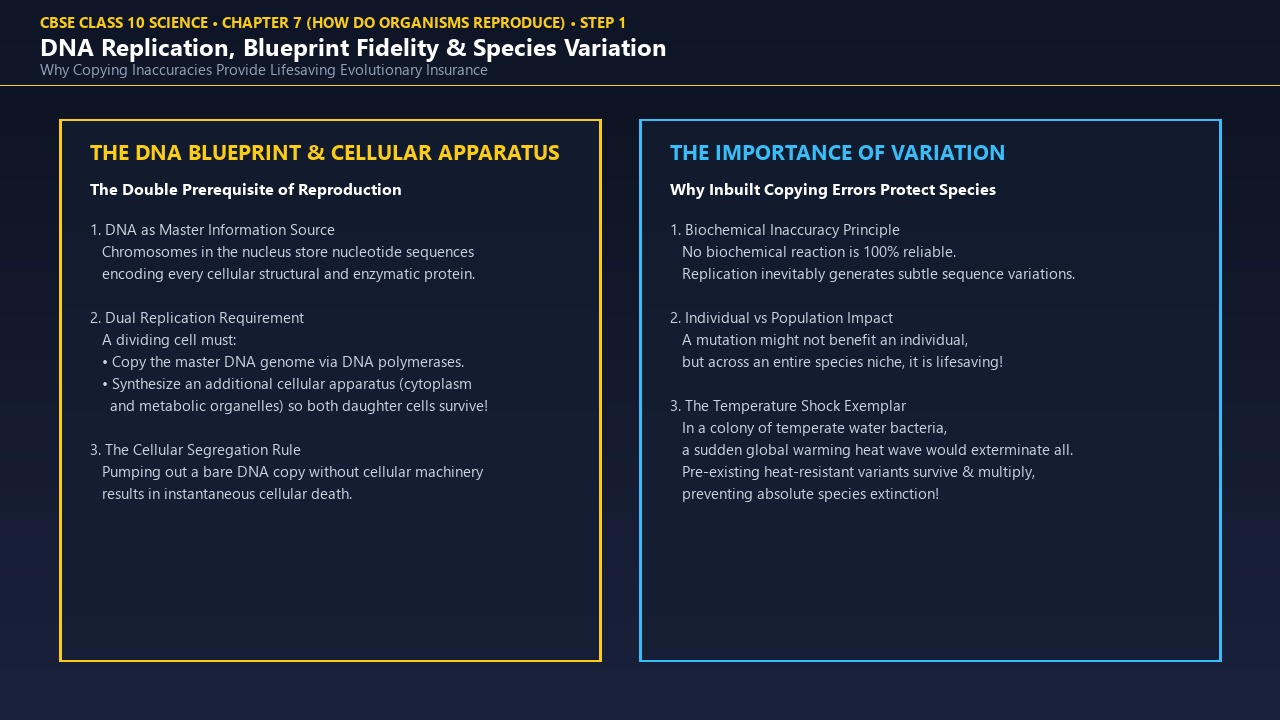
- The chromosomes inside a cell's nucleus are composed of DNA (Deoxyribonucleic Acid) molecules.
- DNA stores the master instructions for making structural and catalytic proteins.
- If DNA sequences are altered, different proteins are synthesized, leading to altered cellular design.
- Therefore, creating a copy of the DNA blueprint is the primary event in reproduction.
- A naked copy of DNA cannot sustain metabolic life on its own; it must be accompanied by the creation of an organized cellular apparatus (cytoplasm and organelles) before the cell divides.
B. The Evolutionary Imperative of Variation
- No biochemical copying reaction is 100% reliable. Inevitably, minor copying inaccuracies occur.
- Severe mutations destroy the cell, but subtle alterations produce surviving variants.
- While a variation may not benefit an individual, it is essential for the survival of the species when ecological niches change.
- Classic Exemplar: If global warming heats a temperate lake, normal bacteria die, but pre-existing heat-resistant mutants survive and multiply, preventing extinction.