Autotrophic Nutrition: Capturing the Sun ☀️?
Autotrophic organisms synthesize complex, high-energy organic compounds (glucose) from simple inorganic raw materials ($CO_2$ and $H_2O$) in the presence of sunlight and chlorophyll pigments.
TEXT
┌─── THE BALANCED PHOTOSYNTHESIS FORMULA ───┐
│ 6 CO2 + 12 H2O  ──(Sunlight / Chlorophyll)──> C6H12O6 + 6 O2 + 6 H2O │
└───────────────────────────────────────────┘
Three Core Photochemical Events
- Absorption: Chlorophyll pigments located in thylakoid membranes capture solar light photons.
- Photolysis & Conversion: Light energy splits water molecules ($2H_2O \longrightarrow 4H^+ + 4e^- + O_2\uparrow$) releasing oxygen, and converts light energy into chemical energy ($ATP$ and $NADPH$).
- Reduction: Carbon dioxide ($CO_2$) is reduced to carbohydrates (glucose: $C_6H_{12}O_6$) via dark/light-independent enzymatic reactions.
Stomatal Guard Cell Hydrodynamic Valve
Stomata are microscopic pores scattered across the leaf epidermis, flanked by a pair of specialized kidney-shaped guard cells.
TEXT
┌─── STOMATAL APERTURE REGULATION ───┐
├── H2O Enters Guard Cells ──> Cells Swell & Turn Turgid ──> Curved outer walls bow outward ──> PORE OPENS
└── H2O Exits Guard Cells  ──> Cells Shrink & Turn Flaccid ──> Walls straighten ───────────> PORE CLOSES
? Visual Concept Diagrams & Figures
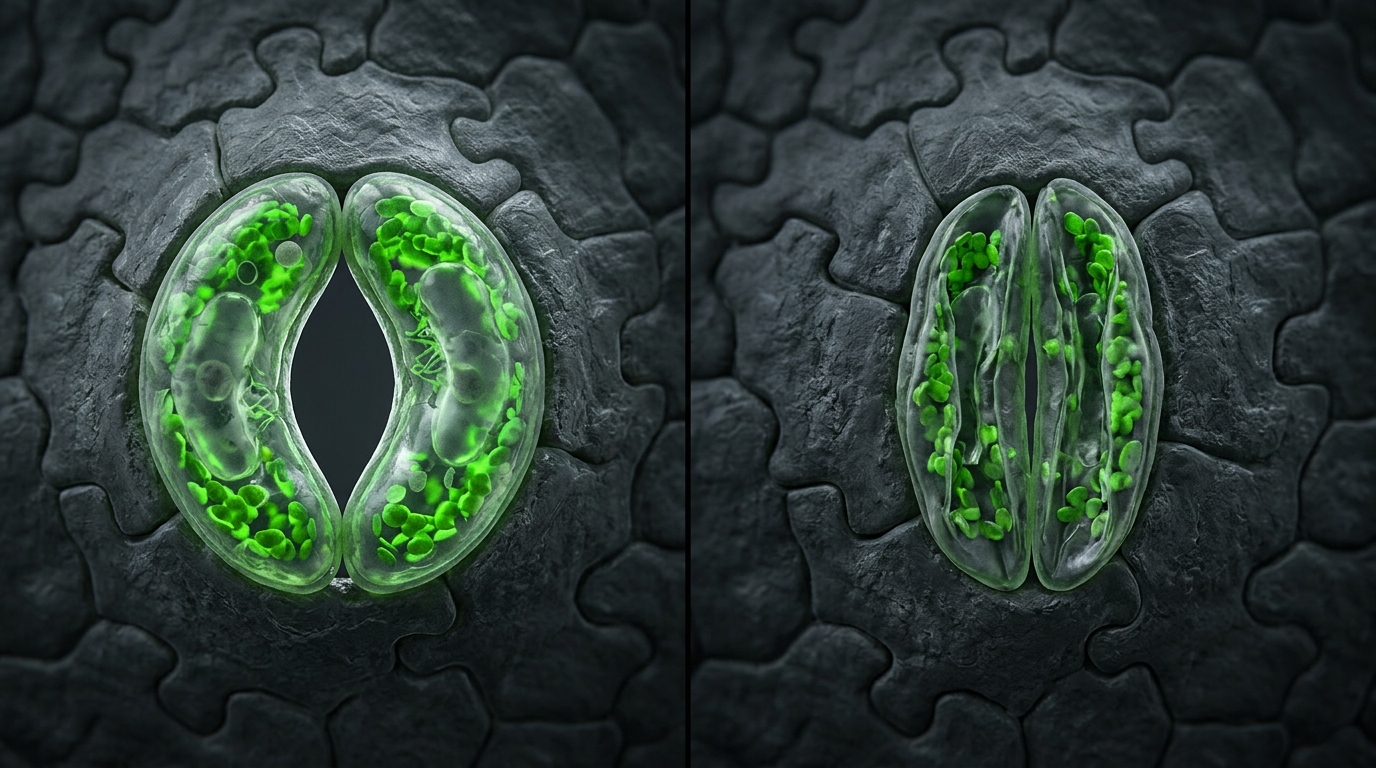
Figure 5.1: High-resolution anatomical model of leaf epidermis. Guard cells possess thick, inelastic inner concave walls and thin, elastic outer convex walls, driving aperture dilation during water influx.
Key NCERT Experimental Proofs
- Variegated Leaf Starch Test (Activity 5.1): Using a croton/money plant leaf with green and white patches proves that chlorophyll is indispensable for photosynthesis; only green patches turn blue-black with iodine.
- $KOH$ Bell Jar Experiment (Activity 5.2): Potassium hydroxide ($KOH$) absorbs $CO_2$. The plant denied $CO_2$ fails to produce starch, proving that carbon dioxide is mandatory for carbon assimilation.