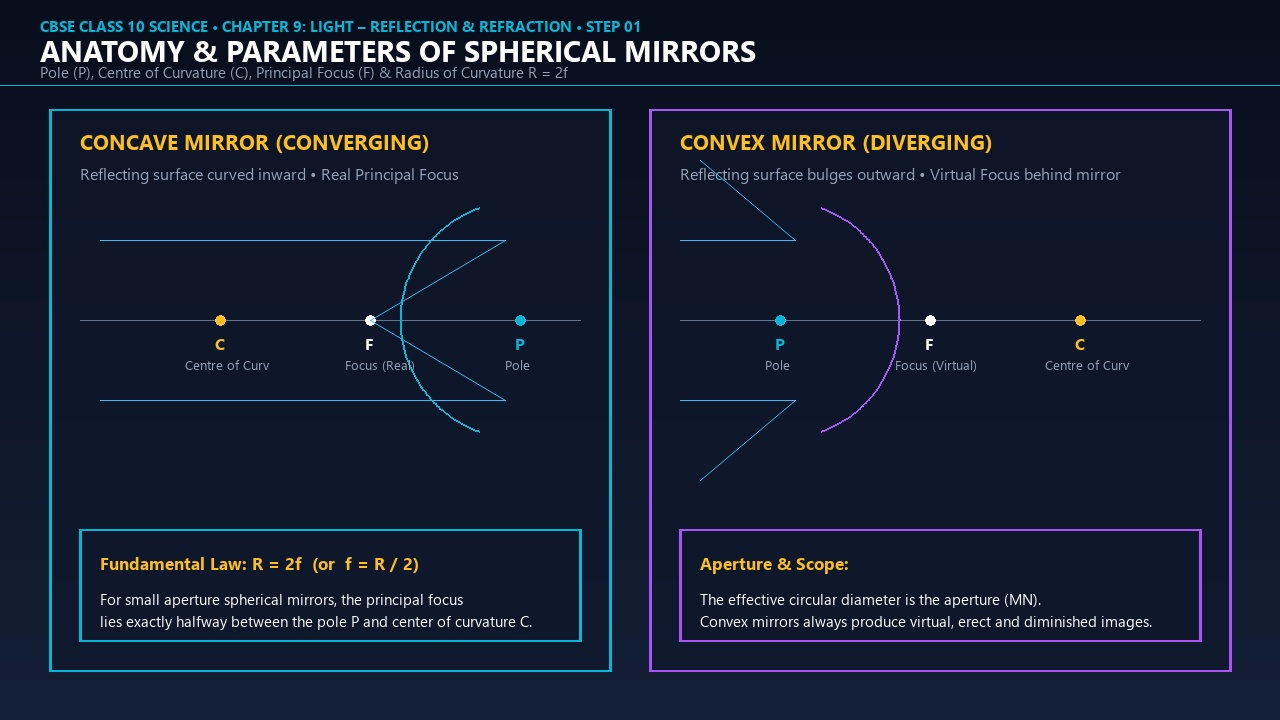
Anatomy & Parameters of Spherical Mirrors
A spherical mirror is a curved reflecting surface that forms a geometrical section of a hollow sphere.
1. Types of Spherical Mirrors
- Concave Mirror (Converging Mirror):
- Reflecting surface is curved inwards (towards the center of the sphere).
- Converges parallel incoming rays to a Real Principal Focus in front of the mirror.
- Convex Mirror (Diverging Mirror):
- Reflecting surface is bulged outwards (away from the center of the sphere).
- Diverges rays as if they emanate from a Virtual Principal Focus behind the mirror.
2. Standard Geometrical Definitions
- Pole ($P$): The center point of the reflecting surface of the mirror.
- Centre of Curvature ($C$): The center of the sphere of which the mirror forms a part. (Lies in front of concave mirror, behind convex mirror).
- Radius of Curvature ($R$): The radius of the parent sphere ($PC = R$).
- Principal Axis: Straight line passing through the pole ($P$) and centre of curvature ($C$). Normal to the mirror at $P$.
- Principal Focus ($F$): Point on the principal axis where rays parallel to the axis intersect (concave) or appear to diverge from (convex) after reflection.
- Focal Length ($f$): Linear distance between pole and principal focus ($PF = f$).
3. The Fundamental Relationship: $R = 2f$
For spherical mirrors of small aperture (aperture much smaller than $R$):
$$R = 2f \quad \Longleftrightarrow \quad f = \frac{R}{2}$$
The principal focus lies exactly midway between the pole and center of curvature!