Hans Christian Oersted's Discovery & Field Line Properties
In 1820, Danish physicist Hans Christian Oersted discovered that an electric current flowing through a metallic wire deflects a nearby magnetic compass needle. This historic observation proved that electricity and magnetism are intimately linked phenomena.
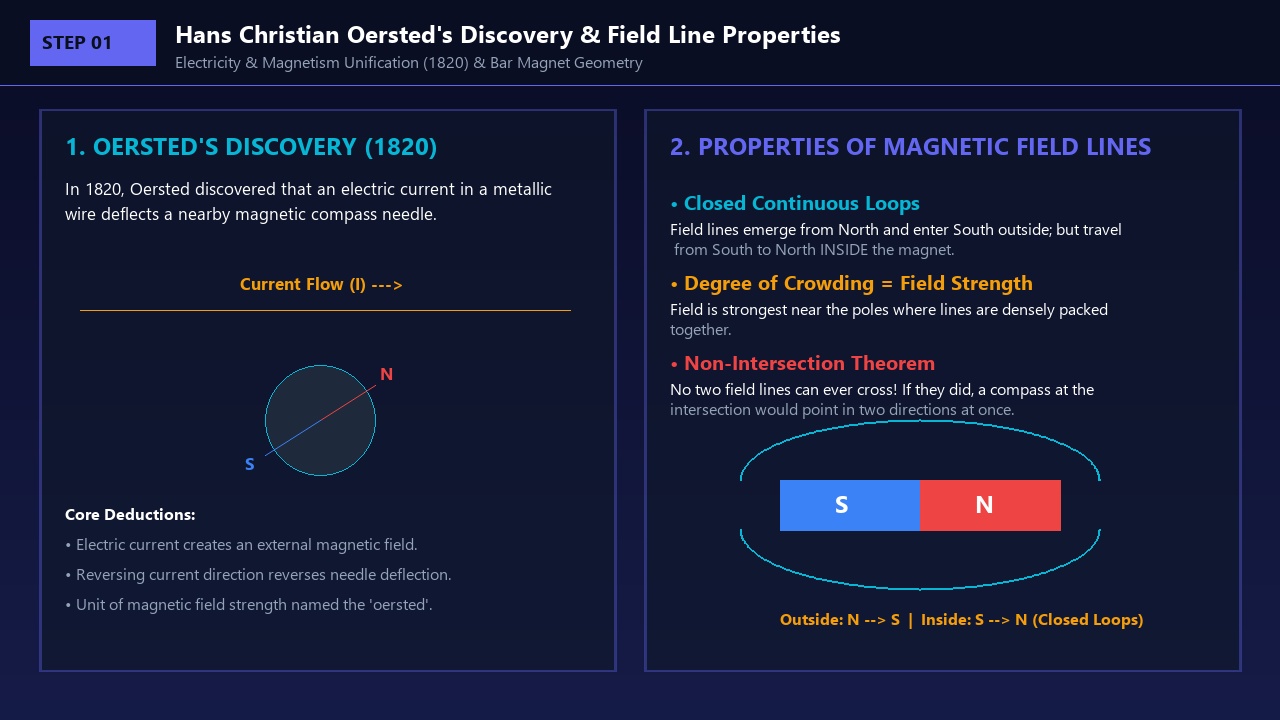
1. Oersted's Landmark Experiment (Activity 12.1)
- A compass needle is placed parallel and close to a straight copper wire.
- When current flows through the wire, the magnetic needle immediately deflects.
- When the direction of current is reversed (by flipping battery terminals), the direction of compass needle deflection also reverses.
- Deduction: A current-carrying conductor generates an external magnetic field around itself. The CGS unit of magnetic field strength was named the oersted in his honor.
2. Definition & Nature of Magnetic Field ($\vec{B}$)
- Magnetic Field: The region surrounding a magnet or current-carrying conductor in which its magnetic force can be experienced and detected.
- Magnetic field is a vector quantity possessing both magnitude and direction.
- The direction of the magnetic field at any point is defined as the direction in which a hypothetical free North pole would tend to move.
3. Golden Properties of Magnetic Field Lines
- Continuous Closed Loops:
- Outside the magnet: Field lines emerge from the North pole and enter the South pole.
- Inside the magnet: Field lines travel from the South pole to the North pole.
- Key Contrast with Electrostatics: Magnetic field lines have no free isolated endpoints; they form unbroken continuous closed curves.
- Degree of Crowding = Field Strength:
- The relative strength of the field is shown by how closely the field lines are packed together.
- Field lines are most densely crowded near the poles, where the magnetic force is greatest.
- The Non-Intersection Law:
- No two magnetic field lines can ever cross or intersect.
- Proof: If two lines intersected at a point, a compass placed at that intersection would have to point in two different directions simultaneously, which is physically impossible!