Chapter 3: Metals and Non-Metals
๐Ÿ‡ฎ๐Ÿ‡ณ National Curriculum Standard โ–พ
๐Ÿ› Vidyoric Certified โ€ข Dr. Ananya Sharma
๐Ÿ”ฅ 0 days
โšก 0 Sparks +
Chapter 3: Metals and Non-Metals

Visual Overview: Physical Anomalies, Chemical Reactivity & Metallurgy

STEP 1: VIDEO LESSON ๐Ÿ“ค Uploaded HTML5 Video

๐Ÿ“‘ Interactive Chapter Bookmarks

0 chapters

๐ŸŽ™๏ธ Synchronized Transcript

๐Ÿ”
# Vidyoric Video Lecture Production Script
## CBSE Class 10 Science โ€” Chapter 03: Metals and Non-Metals
**Target Runtime**: 15:00 Minutes | **Format**: Cinematic 4K Visual Lecture with 3D Molecular Graphics, Field Metallurgy & Historical Reconstructions

---

### [Scene 1: 00:00 - 02:00] The Spectrum of Elements & The Anomaly Matrix
- **Visual (Cinematic Macro)**: A single droplet of liquid mercury quivering on glass beside a glistening golden ingot and a deep purple, lustrous crystal of solid iodine.
- **Narrator**: "For thousands of years, civilizations defined their eras by the metals they mastered โ€” the Copper Age, the Bronze Age, the Iron Age. Yet the periodic boundary between metals and non-metals is paved with extraordinary anomalies."
- **Demonstration / Graphics**:
* Gallium cube placed on a researcher's warm open palm: melts rapidly into liquid mirror at 30ยฐC.
* Sodium metal chunk cut effortlessly with a scalpel, exposing a bright silvery lustre that tarnishes within seconds in air.
* Split screen of carbon: tetrahedral lattice of indestructible diamond versus hexagonal slippery planar sheets of conductive graphite.
- **On-Screen Anomaly Matrix**:
* *Liquids*: Mercury (Metal) | Bromine (Non-Metal).
* *Low Melting Point Metals*: Gallium & Caesium (<30ยฐC).
* *Lustrous Non-Metal*: Iodine crystals ($I_2$).
* *Knife-Cuttable Alkali Metals*: Lithium, Sodium, Potassium.

---

### [Scene 2: 02:00 - 05:00] Chemical Arena: Water, Steam & The Nitric Paradox
- **Visual (High-Speed Lab Action)**:
* Potassium pellet dropped into water: instantaneous ignition into lilac flame ($2K + 2H_2O \rightarrow 2KOH + H_2 \uparrow$).
* Calcium metal dropped into water: effervescence of hydrogen bubbles that adhere to the metal surface, causing calcium to float!
* Steam tube experiment: Mineral wool soaked in water heated to steam, passing over red-hot iron coil. Evolved hydrogen captured and tested with pop sound ($3Fe + 4H_2O(g) \rightarrow Fe_3O_4 + 4H_2 \uparrow$).
- **The Nitric Acid Trap (CGI Animation)**:
* Zinc immersed in dilute $HCl$: vigorous $H_2$ gas evolution.
* Zinc immersed in dilute $HNO_3$: zero $H_2$ gas; dense brown fumes of $NO_2$ evolve.
* Explanation: $HNO_3$ is a relentless oxidizing agent, transforming $H_2$ into $H_2O$.
* Rare exception highlighted: $Mg$ and $Mn$ reacting with 1% very dilute $HNO_3$ to liberate genuine $H_2$.
- **Aqua Regia Showcase**:
* 3 parts conc. $HCl$ + 1 part conc. $HNO_3$. 24-carat gold coin dissolving into orange-yellow chloroauric acid solution.

---

### [Scene 3: 05:00 - 08:00] The Coulombic Lattice: Ionic Bonding & Shear Rupture
- **Visual (3D Molecular CGI)**: Sodium atom valence orbital donating its lone $3s^1$ electron to chlorine's $3p^5$ orbital.
- **Lattice Assembly**: Thousands of alternating $Na^+$ and $Cl^-$ ions snapping into an interlocking rock-salt cubic lattice.
- **Physics of Brittleness**:
* An animated microscopic hammer strikes the top face of the crystal.
* The top atomic layer slides by 1 atomic distance.
* Positive ions align with positive ions; negative align with negative.
* Huge repulsive force triggers instantaneous cleavage along lattice planes!
- **Conductivity Rig**:
* Solid $NaCl$ in beaker: bulb stays off (ions immobilized).
* Bunsen flame melts the salt: molten $NaCl$ conducts immediately, bulb flashes intensely.

---

### [Scene 4: 08:00 - 11:30] Metallurgy: From Crustal Ore to Gleaming Ingot
- **Visual (Industrial Animation & Lab Furnace)**:
* Carbonate vs Sulphide separation:
- *Calcination*: $ZnCO_3 \xrightarrow{\Delta} ZnO + CO_2$ in sealed furnace.
- *Roasting*: $2ZnS + 3O_2 \xrightarrow{\Delta} 2ZnO + 2SO_2$ with blasting air nozzles.
- **The Spectacular Thermite Reaction**:
* Mixture of $Fe_2O_3$ and aluminium powder ignited with magnesium fuse ribbon.
* Blinding white flare erupts; molten liquid iron at 2500ยฐC cascades into mold joining two severed heavy railway track sections.
- **Electrolytic Refining of Copper**:
* Impure copper slab (Anode) dissolving in blue acidified $CuSO_4$.
* Pure copper cathode growing in thickness.
* Black sludge settling beneath anode: Anode Mud containing gold, silver, and platinum.

---

### [Scene 5: 11:30 - 15:00] Materials Engineering, Alloys & India's Iron Heritage
- **Visual (Metallurgical Field Cut)**:
* Sacrificial protection: Galvanized corrugated iron sheet scratched with a nail; salt spray test showing zero rust due to preferential zinc oxidation.
* The Alloy Showcase: Brass ($Cu+Zn$), Bronze ($Cu+Sn$), Solder ($Pb+Sn$), Stainless Steel ($Fe+Ni+Cr$).
* The 22-carat gold ring: alloying pure 24-carat gold with copper to prevent deformation.
- **Heritage Feature: The Delhi Iron Pillar**:
* Drone footage circling the 7.2 m tall Iron Pillar of Delhi in the Qutb complex.
* IIT Kanpur metallurgical insight: 50-micron protective film of misawite ($\delta\text{-FeOOH}$) shielding wrought iron for 1,600 years.
- **Closing Recap**: Dr. Roy directs students to the active recall flashcard bank and diagnostic quiz questions on Vidyoric.
STEP 2 โ€ข CONCEPT NOTES โฑ๏ธ 8 min read
๐Ÿ“Œ 0 Notes

1. The Periodic Matrix of Physical Properties & Anomalies

Metals and non-metals form the foundational materials of our universe. While general rules describe their behaviours, competitive board examinations heavily test the critical physical anomalies where nature defies simple categories.

=============================================================================
                     THE PHYSICAL ANOMALY SPECTRUM
=============================================================================
                                     โ”‚
     โ”Œโ”€โ”€โ”€โ”€โ”€โ”€โ”€โ”€โ”€โ”€โ”€โ”€โ”€โ”€โ”€โ”€โ”€โ”€โ”€โ”€โ”€โ”€โ”€โ”€โ”€โ”€โ”€โ”€โ”€โ”€โ”€โ”ดโ”€โ”€โ”€โ”€โ”€โ”€โ”€โ”€โ”€โ”€โ”€โ”€โ”€โ”€โ”€โ”€โ”€โ”€โ”€โ”€โ”€โ”€โ”€โ”€โ”€โ”€โ”€โ”€โ”€โ”€โ”€โ”
     โ–ผ                                                               โ–ผ
[METALLIC ANOMALIES]                                        [NON-METALLIC ANOMALIES]
  โ”œโ”€ Liquid State at Room Temp:                                โ”œโ”€ Liquid Non-Metal:
  โ”‚   MERCURY (Hg) is a dense liquid!                          โ”‚   BROMINE (Brโ‚‚) is a red-brown liquid!
  โ”œโ”€ Ultra-Low Melting Points:                                 โ”œโ”€ Lustrous Non-Metal:
  โ”‚   GALLIUM (Ga) & CAESIUM (Cs) melt                         โ”‚   IODINE (Iโ‚‚) crystals shine with metallic lustre!
  โ”‚   on human palm (< 30ยฐC / 303 K)!                          โ”œโ”€ Carbon Allotrope Hardness:
  โ”œโ”€ Knife-Cuttable Soft Metals:                               โ”‚   DIAMOND is the hardest known natural solid!
  โ”‚   Alkali metals (Na, K, Li) cut like butter!               โ””โ”€ Carbon Allotrope Conductivity:
  โ””โ”€ Super-Ductility Benchmark:                                    GRAPHITE conducts electricity between sheets!
      1 gram Gold (Au) = 2 km wire!
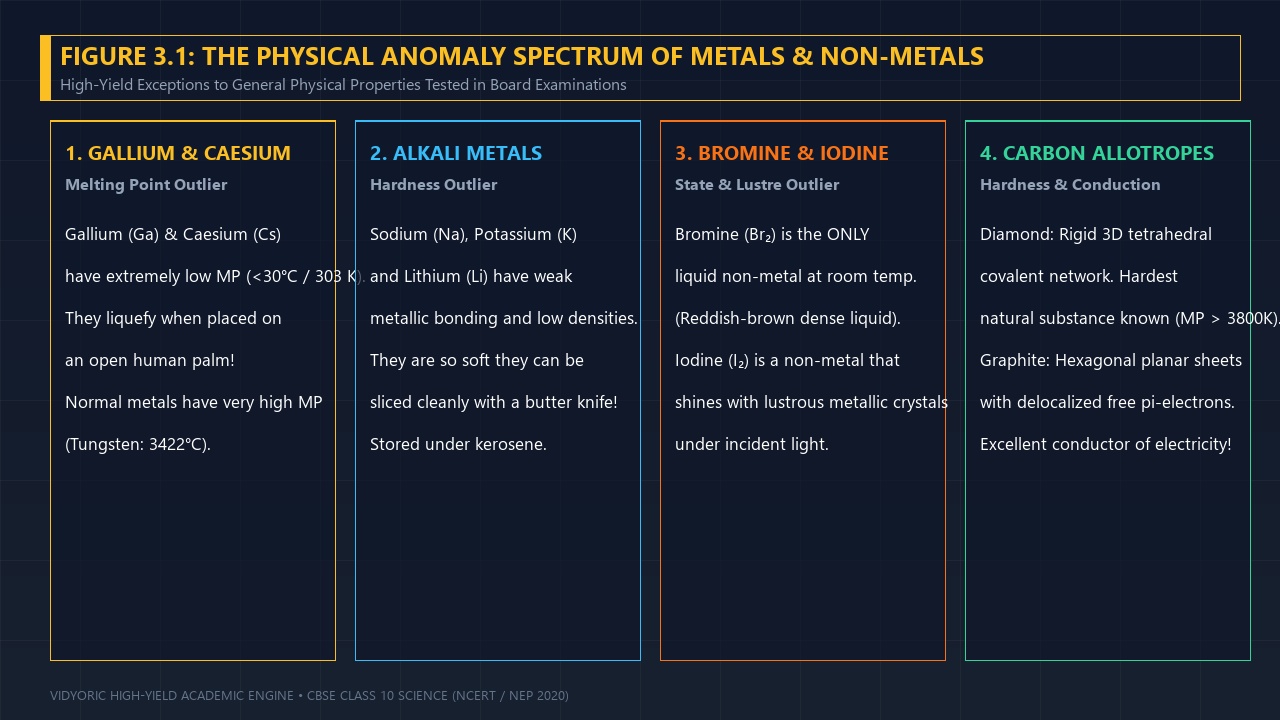
Figure 3.1: Physical Anomaly Spectrum

A. Metallic Properties & Outliers

  • Ductility: Gold is the most ductile metal known: a single gram of gold can be drawn into a wire $2\text{ km}$ long.
  • Malleability: Gold and silver can be beaten into leaves thinner than light wavelengths.
  • Conductivity: Silver ($Ag$) and Copper ($Cu$) are the best conductors of heat and electricity. Lead ($Pb$) and Mercury ($Hg$) are comparatively poor thermal conductors.
  • Melting Point Outliers: Gallium ($Ga$) and Caesium ($Cs$) have such low melting points that they liquefy when placed on the palm of your hand.
  • Hardness Outliers: Sodium ($Na$), Potassium ($K$), and Lithium ($Li$) have weak metallic bonds and can be sliced easily with an ordinary butter knife.

B. Non-Metallic Properties & Outliers

  • Liquid State: Bromine ($Br_2$) is the only non-metal that is a reddish-brown liquid at room temperature.
  • Lustre: Iodine ($I_2$) is a non-metal that forms brilliant, lustrous purple-black crystals.
  • Carbon Allotropes:
  • Diamond: Formed by a 3D rigid tetrahedral carbon network; it is the hardest naturally occurring substance known and has an exceptionally high melting point.
  • Graphite: Formed by hexagonal layers with delocalized pi-electrons that move freely between sheets, making graphite an excellent electrical conductor.
๐Ÿ“
Comprehensive High-Yield Mathematical Relations & Theorems

Complete step-by-step derivations, step traps, and LaTeX formula sheet breakdowns...

๐Ÿ”’

End of Free Notes Preview

Unlock the complete deck to access full LaTeX formula breakdowns, interactive diagrams, exam traps, and personal margin highlights!

๐Ÿ”‘ Sign In / Register Free
STEP 3 โ€ข CONCEPT NOTES โฑ๏ธ 8 min read
๐Ÿ“Œ 0 Notes

2. Amphoteric Oxides & The Water Reactivity Ladder

When metals react with oxygen and water, their chemical behaviours follow distinct thermodynamic hierarchies.

=============================================================================
                  AMPHOTERIC NATURE & WATER REACTIVITY
=============================================================================
                                     โ”‚
     โ”Œโ”€โ”€โ”€โ”€โ”€โ”€โ”€โ”€โ”€โ”€โ”€โ”€โ”€โ”€โ”€โ”€โ”€โ”€โ”€โ”€โ”€โ”€โ”€โ”€โ”€โ”€โ”€โ”€โ”€โ”€โ”€โ”ดโ”€โ”€โ”€โ”€โ”€โ”€โ”€โ”€โ”€โ”€โ”€โ”€โ”€โ”€โ”€โ”€โ”€โ”€โ”€โ”€โ”€โ”€โ”€โ”€โ”€โ”€โ”€โ”€โ”€โ”€โ”€โ”
     โ–ผ                                                               โ–ผ
[AMPHOTERIC OXIDES (Alโ‚‚Oโ‚ƒ & ZnO)]                           [WATER REACTIVITY LADDER]
  โ”œโ”€ Dual Character: React with BOTH Acids & Bases             โ”œโ”€ COLD WATER (Violent Ignition):
  โ”‚                                                            โ”‚   2K + 2Hโ‚‚O โ†’ 2KOH + Hโ‚‚โ†‘ (Lilac flame!)
  โ”œโ”€ Reaction with Acid (Acts as Base):                        โ”œโ”€ COLD WATER (Gentle Floating):
  โ”‚   Alโ‚‚Oโ‚ƒ + 6HCl โ†’ 2AlClโ‚ƒ + 3Hโ‚‚O                             โ”‚   Ca + 2Hโ‚‚O โ†’ Ca(OH)โ‚‚ + Hโ‚‚โ†‘ (Floats on bubbles)
  โ”‚                                                            โ”œโ”€ HOT WATER (Floats on bubbles):
  โ”œโ”€ Reaction with Base (Acts as Acid):                        โ”‚   Mg + 2Hโ‚‚O(hot) โ†’ Mg(OH)โ‚‚ + Hโ‚‚โ†‘
  โ”‚   Alโ‚‚Oโ‚ƒ + 2NaOH โ†’ 2NaAlOโ‚‚ (Sodium Aluminate) + Hโ‚‚O         โ”œโ”€ STEAM ONLY:
  โ”‚                                                            โ”‚   3Fe + 4Hโ‚‚O(steam) โ†’ Feโ‚ƒOโ‚„ + 4Hโ‚‚โ†‘
  โ””โ”€ Zinc Analogue:                                            โ””โ”€ ZERO REACTION (Completely Inert):
      ZnO + 2NaOH โ†’ Naโ‚‚ZnOโ‚‚ (Sodium Zincate) + Hโ‚‚O                 Pb, Cu, Ag, Au ignore water & steam!

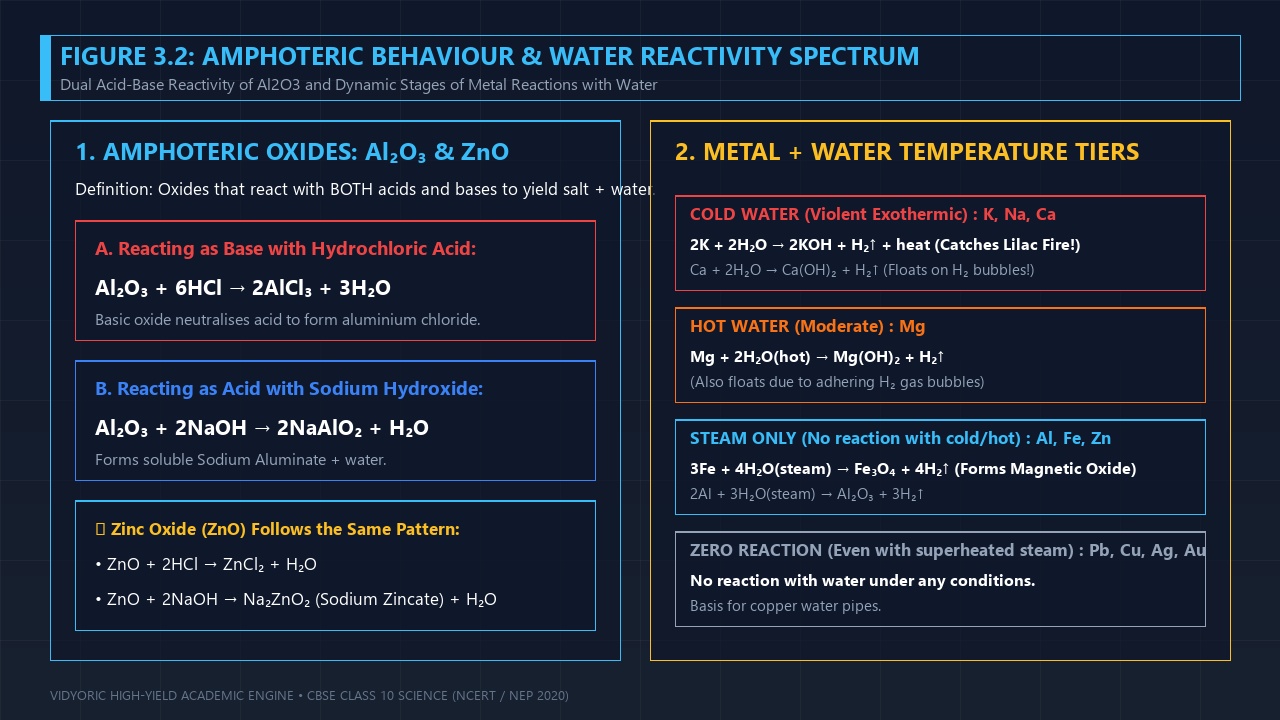
Figure 3.2: Amphoteric Nature and Water Reactivity

A. Amphoteric Oxides

Most metal oxides are basic, but Aluminium Oxide ($Al_2O_3$) and Zinc Oxide ($ZnO$) show amphoteric behaviour โ€” reacting with both acids and bases to produce salt and water:

  • With Acid:
$$Al_2O_3(s) + 6HCl(aq) \rightarrow 2AlCl_3(aq) + 3H_2O(l)$$
  • With Base:
$$Al_2O_3(s) + 2NaOH(aq) \rightarrow 2NaAlO_2(aq) \text{ (Sodium aluminate)} + H_2O(l)$$
  • Zinc Oxide with Base:
$$ZnO(s) + 2NaOH(aq) \rightarrow Na_2ZnO_2(aq) \text{ (Sodium zincate)} + H_2O(l)$$

B. The Water Reactivity Ladder

  1. Cold Water (Violent): Potassium ($K$) and Sodium ($Na$) react violently and exothermically; evolved $H_2$ gas immediately catches fire:
$$2K(s) + 2H_2O(l) \rightarrow 2KOH(aq) + H_2(g) \uparrow + \text{Heat}$$
  1. Cold Water (Buoyant Floating): Calcium ($Ca$) reacts less violently. The heat evolved is insufficient to ignite hydrogen. Bubbles of $H_2$ stick to calcium, causing the dense metal to float:
$$Ca(s) + 2H_2O(l) \rightarrow Ca(OH)_2(aq) + H_2(g) \uparrow$$
  1. Hot Water: Magnesium ($Mg$) does not react with cold water; it reacts with hot water to form $Mg(OH)_2$ and $H_2$, also floating due to adhering bubbles.
  2. Steam Only: Aluminium ($Al$), Iron ($Fe$), and Zinc ($Zn$) do not react with liquid water, but react with steam:
$$3Fe(s) + 4H_2O(g) \rightarrow Fe_3O_4(s) \text{ (Magnetic iron oxide)} + 4H_2(g) \uparrow$$
  1. Completely Inert: Lead ($Pb$), Copper ($Cu$), Silver ($Ag$), and Gold ($Au$) do not react with water or steam under any conditions.
๐Ÿ“
Comprehensive High-Yield Mathematical Relations & Theorems

Complete step-by-step derivations, step traps, and LaTeX formula sheet breakdowns...

๐Ÿ”’

End of Free Notes Preview

Unlock the complete deck to access full LaTeX formula breakdowns, interactive diagrams, exam traps, and personal margin highlights!

๐Ÿ”‘ Sign In / Register Free
STEP 4 โ€ข CONCEPT NOTES โฑ๏ธ 8 min read
๐Ÿ“Œ 0 Notes

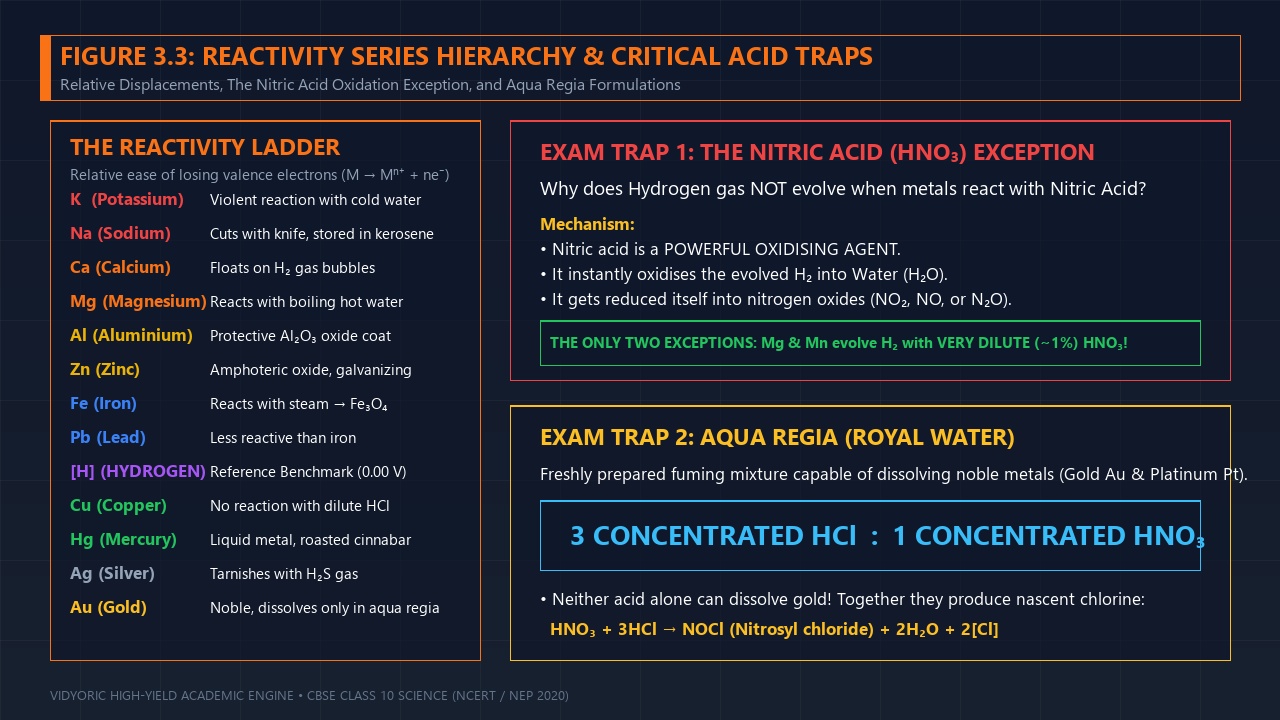
3. The Reactivity Hierarchy, The Nitric Acid Paradox & Aqua Regia

The activity series arranges metals in order of decreasing reactivity, governing single displacement reactions and acid dynamics.

=============================================================================
                  THE ACTIVITY LADDER & ACID DYNAMICS
=============================================================================
  K > Na > Ca > Mg > Al > Zn > Fe > Pb > [H] > Cu > Hg > Ag > Au
  โ–ฒ                                       โ–ฒ                     โ–ฒ
  Most Reactive                   Hydrogen Benchmark      Least Reactive
                                          โ”‚
     โ”Œโ”€โ”€โ”€โ”€โ”€โ”€โ”€โ”€โ”€โ”€โ”€โ”€โ”€โ”€โ”€โ”€โ”€โ”€โ”€โ”€โ”€โ”€โ”€โ”€โ”€โ”€โ”€โ”€โ”€โ”€โ”€โ”€โ”€โ”€โ”€โ”€โ”ดโ”€โ”€โ”€โ”€โ”€โ”€โ”€โ”€โ”€โ”€โ”€โ”€โ”€โ”€โ”€โ”€โ”€โ”€โ”€โ”€โ”€โ”€โ”€โ”€โ”€โ”€โ”€โ”€โ”€โ”€โ”€โ”€โ”€โ”€โ”€โ”€โ”
     โ–ผ                                                                         โ–ผ
[THE NITRIC ACID (HNOโ‚ƒ) PARADOX]                              [AQUA REGIA (ROYAL WATER)]
  โ”œโ”€ Rule: Metal + Dil. Acid โ†’ Salt + Hโ‚‚โ†‘                       โ”œโ”€ Composition:
  โ”œโ”€ The Trap: HNOโ‚ƒ does NOT evolve Hโ‚‚!                         โ”‚   3 Parts Conc. HCl : 1 Part Conc. HNOโ‚ƒ
  โ”‚   HNOโ‚ƒ is a powerful oxidizing agent that                   โ”‚   Volumetric Ratio = 3 : 1
  โ”‚   oxidizes Hโ‚‚ to Hโ‚‚O and reduces to NOโ‚‚/NO/Nโ‚‚O.             โ”œโ”€ Super-Solvent Power:
  โ””โ”€ Rare Exception: Only Mg & Mn react with                    โ”‚   Dissolves noble metals: Gold (Au)
      VERY DILUTE (~1%) HNOโ‚ƒ to evolve Hโ‚‚ gas!                  โ””โ”€  and Platinum (Pt)!

Figure 3.3: Reactivity Series and Acid Dynamics

A. The Electrochemical Reactivity Series

A metal higher in the reactivity series displaces a metal lower in the series from its aqueous salt solution:

$$Fe(s) + CuSO_4(aq) \text{ (Blue)} \rightarrow FeSO_4(aq) \text{ (Pale Green)} + Cu(s) \text{ (Red-brown)}$$

Conversely, dipping copper wire into ferrous sulphate solution produces no reaction because copper is less reactive than iron.

B. The Nitric Acid ($HNO_3$) Anomaly

When metals react with nitric acid, hydrogen gas is NOT evolved!

  • Reason: Nitric acid is a ferocious oxidizing agent. The moment nascent hydrogen atoms are formed, $HNO_3$ oxidizes them into water ($H_2O$) and reduces itself into nitrogen oxides ($NO_2, NO, \text{or } N_2O$).
  • The Board Exception: Only Magnesium ($Mg$) and Manganese ($Mn$) react with very dilute (~1%) nitric acid to liberate genuine $H_2$ gas:
$$Mg(s) + 2HNO_3(\text{very dil}) \rightarrow Mg(NO_3)_2(aq) + H_2(g) \uparrow$$

C. Aqua Regia (Royal Water)

Aqua Regia is a freshly prepared fuming mixture of:

$$\mathbf{3\text{ parts concentrated } HCl} : \mathbf{1\text{ part concentrated } HNO_3} \quad (\text{Molar ratio } 3:1)$$

Although neither acid can dissolve noble metals individually, Aqua Regia attacks and dissolves noble metals Gold ($Au$) and Platinum ($Pt$) by forming nascent chlorine and chloroauric acid ($HAuCl_4$).

๐Ÿ“
Comprehensive High-Yield Mathematical Relations & Theorems

Complete step-by-step derivations, step traps, and LaTeX formula sheet breakdowns...

๐Ÿ”’

End of Free Notes Preview

Unlock the complete deck to access full LaTeX formula breakdowns, interactive diagrams, exam traps, and personal margin highlights!

๐Ÿ”‘ Sign In / Register Free
STEP 5 โ€ข CONCEPT NOTES โฑ๏ธ 8 min read
๐Ÿ“Œ 0 Notes

4. Microscopic Architecture: Ionic Bonding & Crystal Lattices

When metals encounter non-metals, electropositive metals transfer valence electrons to electronegative non-metals, achieving stable noble gas configurations.

=============================================================================
                  IONIC LATTICE MECHANICS & PROPERTIES
=============================================================================
                                     โ”‚
     โ”Œโ”€โ”€โ”€โ”€โ”€โ”€โ”€โ”€โ”€โ”€โ”€โ”€โ”€โ”€โ”€โ”€โ”€โ”€โ”€โ”€โ”€โ”€โ”€โ”€โ”€โ”€โ”€โ”€โ”€โ”€โ”€โ”ผโ”€โ”€โ”€โ”€โ”€โ”€โ”€โ”€โ”€โ”€โ”€โ”€โ”€โ”€โ”€โ”€โ”€โ”€โ”€โ”€โ”€โ”€โ”€โ”€โ”€โ”€โ”€โ”€โ”€โ”€โ”€โ”
     โ–ผ                               โ–ผ                               โ–ผ
[ELECTRON TRANSFER]         [MECHANICAL BRITTLENESS]        [ELECTRICAL CONDUCTION]
  โ”œโ”€ Na(2,8,1) โ†’ Naโบ + eโป     โ”œโ”€ Solid crystal lattice        โ”œโ”€ Solid State:
  โ”‚   Cl(2,8,7) + eโป โ†’ Clโป    โ”‚   held by Coulombic bonds     โ”‚   Zero conductivity
  โ”‚   Naโบ + Clโป โ†’ NaCl        โ”œโ”€ Hammer Impact:               โ”‚   (Ions locked in lattice)
  โ”œโ”€ Mg(2,8,2) โ†’ Mgยฒโบ + 2eโป   โ”‚   Shears lattice planes by    โ””โ”€ Molten / Aqueous State:
  โ”‚   2Cl(2,8,7) + 2eโป โ†’ 2Clโป โ”‚   1 atomic unit โ†’             โ”‚   Free mobile ions migrate
  โ”‚   Mgยฒโบ + 2[Cl]โป โ†’ MgClโ‚‚   โ”‚   Like charges align โ†’        โ””โ”€  Conducts electricity
  โ””โ”€ Electrostatic Lattice    โ””โ”€  REPULSION SHATTERS CRYSTAL!     brightly!

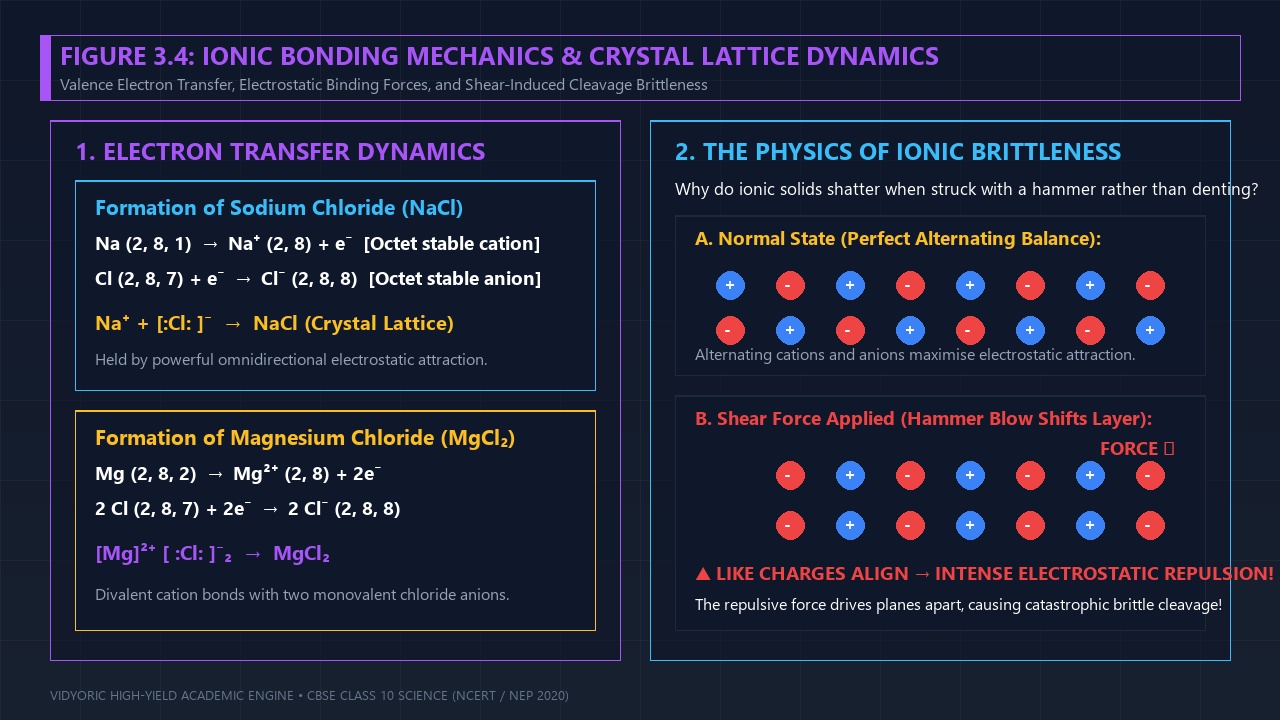
Figure 3.4: Ionic Bonding Dynamics

A. Formation of $NaCl$ and $MgCl_2$

  • Sodium Chloride ($NaCl$):
$$Na(2,8,1) \xrightarrow{-e^-} Na^+(2,8) \quad [\text{Neon configuration}]$$
$$Cl(2,8,7) \xrightarrow{+e^-} Cl^-(2,8,8) \quad [\text{Argon configuration}]$$
$$Na^+ + Cl^- \rightarrow NaCl$$
  • Magnesium Chloride ($MgCl_2$):
$$Mg(2,8,2) \xrightarrow{-2e^-} Mg^{2+}(2,8)$$
$$2Cl(2,8,7) \xrightarrow{+2e^-} 2Cl^-(2,8,8)$$
$$Mg^{2+} + 2[Cl]^- \rightarrow MgCl_2$$

B. Distinctive Physical Properties of Ionic Compounds

  1. Physical Nature & Brittleness: Crystalline solids held by omnidirectional electrostatic forces. Striking a crystal shifts atomic layers, aligning like charges next to one another ($+ \leftrightarrow +$ and $- \leftrightarrow -$), causing powerful repulsive forces that shatter the crystal.
  2. High Melting & Boiling Points: Breaking the rigid electrostatic network requires enormous thermal kinetic energy ($NaCl$ m.p. $1074\text{ K}$).
  3. Solubility: Highly soluble in polar solvents (like water, where polar dipoles hydrate and isolate ions); insoluble in non-polar organic solvents (kerosene, petrol).
  4. Electrical Conductivity:
  • In solid state: Ions cannot move from their fixed lattice positions $\implies$ Zero conductivity.
  • In molten or aqueous state: Ions are liberated from the lattice and migrate freely towards electrodes $\implies$ High conductivity.
๐Ÿ“
Comprehensive High-Yield Mathematical Relations & Theorems

Complete step-by-step derivations, step traps, and LaTeX formula sheet breakdowns...

๐Ÿ”’

End of Free Notes Preview

Unlock the complete deck to access full LaTeX formula breakdowns, interactive diagrams, exam traps, and personal margin highlights!

๐Ÿ”‘ Sign In / Register Free
๐Ÿ”’
Step 6 is Locked

CBSE Diagnostic Mastery Quiz: Metals & Non-Metals Board Check

This ๐Ÿ“ LaTeX Concept Notes is part of the full verified curriculum for Chapter 3: Metals and Non-Metals. Unlock the full deck to gain permanent access to all 13 interactive stages, active recall cards, and diagnostic checkpoints.

Deck Access Price
100% Free with Account
Instant Access
โœ“ UPI & Cards Supported
๐Ÿ”‘ Sign In / Register to Unlock Free →
๐Ÿ”’
Step 7 is Locked

CBSE Diagnostic Mastery Quiz: Metals & Non-Metals Board Check

This ๐Ÿ“ LaTeX Concept Notes is part of the full verified curriculum for Chapter 3: Metals and Non-Metals. Unlock the full deck to gain permanent access to all 13 interactive stages, active recall cards, and diagnostic checkpoints.

Deck Access Price
100% Free with Account
Instant Access
โœ“ UPI & Cards Supported
๐Ÿ”‘ Sign In / Register to Unlock Free →
๐Ÿ”’
Step 8 is Locked

CBSE Diagnostic Mastery Quiz: Metals & Non-Metals Board Check

This ๐Ÿ“ LaTeX Concept Notes is part of the full verified curriculum for Chapter 3: Metals and Non-Metals. Unlock the full deck to gain permanent access to all 13 interactive stages, active recall cards, and diagnostic checkpoints.

Deck Access Price
100% Free with Account
Instant Access
โœ“ UPI & Cards Supported
๐Ÿ”‘ Sign In / Register to Unlock Free →
๐Ÿ”’
Step 9 is Locked

CBSE Diagnostic Mastery Quiz: Metals & Non-Metals Board Check

This ๐Ÿ“ LaTeX Concept Notes is part of the full verified curriculum for Chapter 3: Metals and Non-Metals. Unlock the full deck to gain permanent access to all 13 interactive stages, active recall cards, and diagnostic checkpoints.

Deck Access Price
100% Free with Account
Instant Access
โœ“ UPI & Cards Supported
๐Ÿ”‘ Sign In / Register to Unlock Free →
๐Ÿ”’
Step 10 is Locked

CBSE Diagnostic Mastery Quiz: Metals & Non-Metals Board Check

This ๐Ÿ“ LaTeX Concept Notes is part of the full verified curriculum for Chapter 3: Metals and Non-Metals. Unlock the full deck to gain permanent access to all 13 interactive stages, active recall cards, and diagnostic checkpoints.

Deck Access Price
100% Free with Account
Instant Access
โœ“ UPI & Cards Supported
๐Ÿ”‘ Sign In / Register to Unlock Free →
๐Ÿ”’
Step 11 is Locked

CBSE Diagnostic Mastery Quiz: Metals & Non-Metals Board Check

This Microlearning Step is part of the full verified curriculum for Chapter 3: Metals and Non-Metals. Unlock the full deck to gain permanent access to all 13 interactive stages, active recall cards, and diagnostic checkpoints.

Deck Access Price
100% Free with Account
Instant Access
โœ“ UPI & Cards Supported
๐Ÿ”‘ Sign In / Register to Unlock Free →
๐Ÿ”’
Step 12 is Locked

CBSE Diagnostic Mastery Quiz: Metals & Non-Metals Board Check

This ๐Ÿง  Active Recall Flashcards is part of the full verified curriculum for Chapter 3: Metals and Non-Metals. Unlock the full deck to gain permanent access to all 13 interactive stages, active recall cards, and diagnostic checkpoints.

Deck Access Price
100% Free with Account
Instant Access
โœ“ UPI & Cards Supported
๐Ÿ”‘ Sign In / Register to Unlock Free →
๐Ÿ”’
Step 13 is Locked

CBSE Diagnostic Mastery Quiz: Metals & Non-Metals Board Check

This โšก Diagnostic Quiz is part of the full verified curriculum for Chapter 3: Metals and Non-Metals. Unlock the full deck to gain permanent access to all 13 interactive stages, active recall cards, and diagnostic checkpoints.

Deck Access Price
100% Free with Account
Instant Access
โœ“ UPI & Cards Supported
๐Ÿ”‘ Sign In / Register to Unlock Free →