📑 Interactive Chapter Bookmarks
0 chapters🎙️ Synchronized Transcript
**CBSE Class 10 Mathematics • Chapter 3: Pair of Linear Equations in Two Variables**
**Step 1 | Target Duration: 06:45 min | Educator: Prof. Arvind Swaminathan**
---
### [00:00 - 01:10] Hook: The Riddle of Two Unknowns
**Visual Scene**:
A high-tech digital chalkboard. Prof. Arvind Swaminathan stands beside a split-screen animation showing a stationery store on the left and a Cartesian coordinate grid on the right.
**Prof. Arvind Swaminathan**:
"Namaste students! Imagine walking into a stationery shop. The shopkeeper tells you: '2 pens and 3 notebooks cost ₹50.' Can you tell me the exact price of a single pen?
Take a moment. Think about it.
If a pen costs ₹10, then notebooks cost ₹10. But if a pen is ₹7, notebooks could be ₹12. There are literally infinite combinations that make ₹50! A single equation with two unknowns is an open road with infinite stops. On a graph, it forms a continuous, straight line stretching infinitely in both directions.
Now, what if another student walks in and buys 3 pens and 2 notebooks for ₹45? Suddenly, you have a second rule, a second straight line. And the moment two different straight lines cross each other in a flat plane, they meet at exactly ONE magical point! That single intersection point unlocks both prices simultaneously.
Welcome to the power of a **Pair of Linear Equations in Two Variables**. Today, we unlock the geometry of lines, consistency, and how three simple coefficient ratios tell you everything without plotting a single dot!"
---
### [01:10 - 02:45] The Algebraic Blueprint & The Three Destinies
**Visual Scene**:
The screen zooms into two algebraic formulas rendered in glowing typography:
$a_1 x + b_1 y + c_1 = 0$
$a_2 x + b_2 y + c_2 = 0$
Below them, three 2D coordinate planes appear side-by-side representing the three fundamental geometric possibilities.
**Prof. Arvind Swaminathan**:
"In algebra, we write any pair of linear equations as:
$a_1 x + b_1 y + c_1 = 0$ and $a_2 x + b_2 y + c_2 = 0$.
Here, $x$ and $y$ are our variables, while $a, b,$ and $c$ are real numbers. When you draw two straight lines on a sheet of paper, only three destinies can occur.
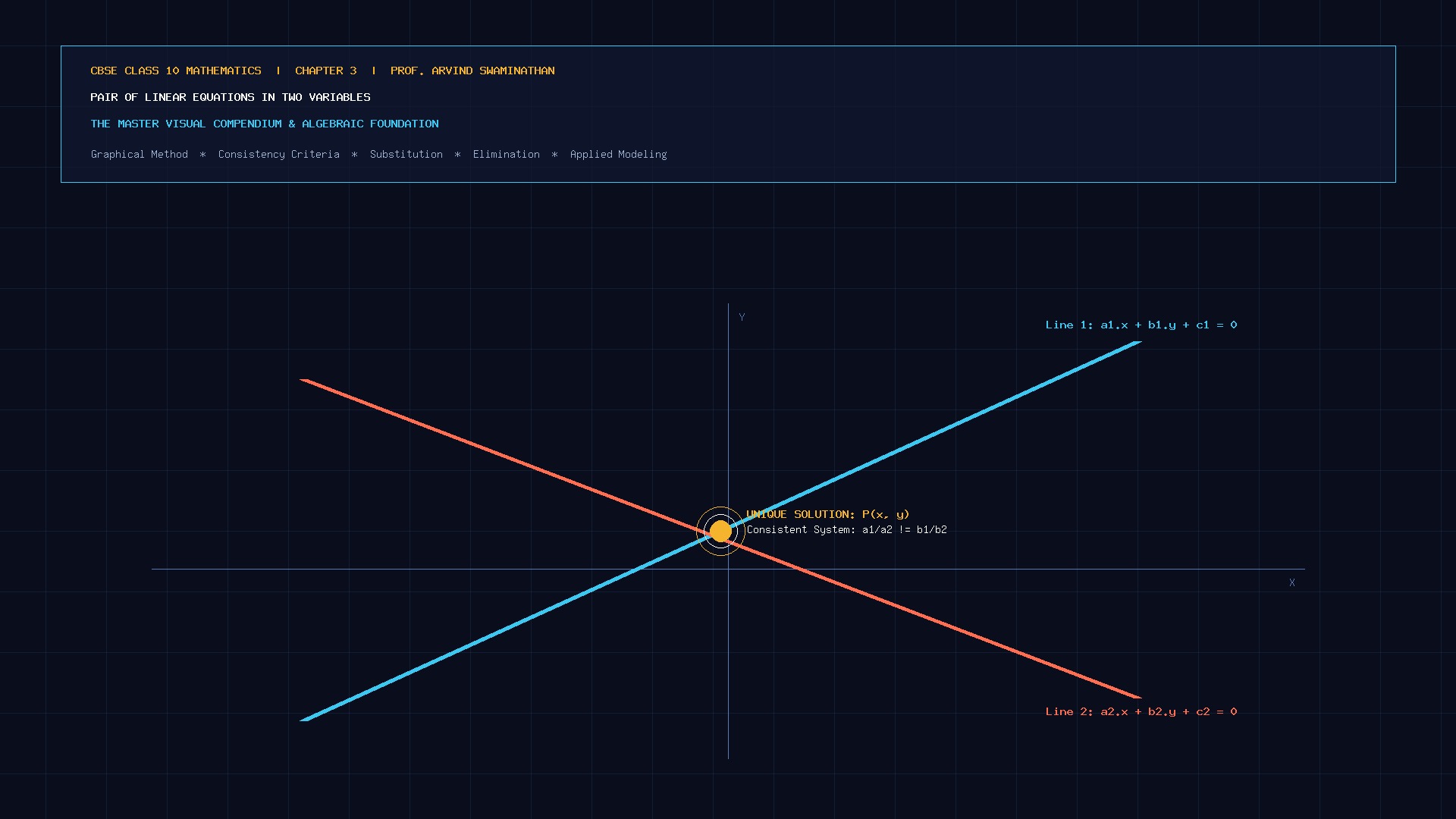
First destiny: The lines tilt at different angles and cross each other. They share **exactly one common point**. This gives us a **unique solution**, and we call such a system **Consistent**.
Second destiny: The two lines have identical slopes and identical positions—they lie completely on top of each other! Every single point on line 1 is also on line 2. This means **infinitely many solutions**. We call this a **Consistent and Dependent** system.
Third destiny: The lines run completely parallel, like train tracks, forever separated. They never meet, sharing zero points. Thus, there is **no solution**, and the system is **Inconsistent**."
---
### [02:45 - 04:30] The Secret Shortcut: The Master Ratio Test
**Visual Scene**:
Animated KaTeX equations animate across the screen with color-coded ratios ($\frac{a_1}{a_2}, \frac{b_1}{b_2}, \frac{c_1}{c_2}$). A dynamic slider shifts coefficients, demonstrating how the lines morph in real-time.
**Prof. Arvind Swaminathan**:
"Do you have to draw graph paper every time to check if a system has a solution? Absolutely not! You can predict the future in 5 seconds using the **Coefficient Ratio Test**.
Let's compare the ratio of $x$-coefficients, the ratio of $y$-coefficients, and the ratio of constant terms.
Rule number 1: If $\frac{a_1}{a_2} \ne \frac{b_1}{b_2}$, stop right there! The lines have different slopes. They are guaranteed to intersect at exactly one point. Unique solution! Consistent!
Rule number 2: If the $x$-ratio equals the $y$-ratio, the lines are either parallel or identical. To check which one, look at the constants!
If $\frac{a_1}{a_2} = \frac{b_1}{b_2} = \frac{c_1}{c_2}$, all three ratios are identical! Equation 2 is just a scaled twin of Equation 1. The lines are coincident, offering infinite solutions!
Rule number 3: If $\frac{a_1}{a_2} = \frac{b_1}{b_2} \ne \frac{c_1}{c_2}$, the lines have the exact same tilt but different starting levels. They are strictly parallel. No intersection, no solution, completely inconsistent!"
---
### [04:30 - 05:45] The Classic Examination Trap: Signs and Standard Form
**Visual Scene**:
A red warning banner flashes: "BOARD EXAM TRAP ALERT!". Prof. Arvind writes an equation with the constant term transposed to the right side: $2x + 3y = 7$ and $4x + 6y - 14 = 0$.
**Prof. Arvind Swaminathan**:
"Look closely at this classic board exam trap.
Equation 1 is $2x + 3y = 7$.
Equation 2 is $4x + 6y - 14 = 0$.
A hurried student says: $a_1/a_2 = 2/4 = 1/2$. $b_1/b_2 = 3/6 = 1/2$. And $c_1/c_2 = 7/(-14) = -1/2$. They conclude: 'Aha! $1/2 = 1/2 \ne -1/2$, so parallel lines!'
That is WRONG! Why?
Because in Equation 1, $7$ is on the right-hand side, but in Equation 2, $-14$ is on the left-hand side!
When you move $7$ to the left, it becomes $-7$. Then $c_1/c_2 = -7/(-14) = +1/2$!
All three ratios are equal to $1/2$. The lines are coincident!
Golden rule: Always bring both equations into standard form $ax + by + c = 0$ before you compare your ratios."
---
### [05:45 - 06:45] Roadmap Ahead & Practice Call
**Visual Scene**:
A sleek roadmap graphic displays the upcoming stages: Graphical Plotting, Substitution Method, Elimination Method, and Word Problem Archetypes.
**Prof. Arvind Swaminathan**:
"In the upcoming steps of this deck, you will master the two premier algebraic weapons: the **Substitution Method** (isolate and substitute) and the **Elimination Method** (match coefficients and obliterate). We will also tackle the 5 classic word problem archetypes: digit reversals, upstream-downstream boats, age puzzles, and taxi fares.
Scroll down, study the visual mind maps, test your intuition on the flashcards, and let's turn linear equations into pure scoring power. See you in Step 2!"
Diagnostic Quiz & Mastery MCQs: CBSE Class 10 Board Standards
This 📝 LaTeX Concept Notes is part of the full verified curriculum for Chapter 3: Pair of Linear Equations in Two Variables. Unlock the full deck to gain permanent access to all 13 interactive stages, active recall cards, and diagnostic checkpoints.
Movement 1: The Philosophical Elegance of Simultaneous Constraints
00:00Movement 2: The Ratio Test & The Three Geometric Destinies
00:00Movement 3: The Twin Engines: Substitution versus Elimination
00:00Movement 4: Word Problem Anatomy: Deconstructing Real-World Archetypes
00:00Movement 5: The Exam Hall Mental Checklist & Final Words
00:00**CBSE Class 10 Mathematics • Chapter 3: Pair of Linear Equations in Two Variables**
**Step 11 | Duration: 21:00 min (~5,300 characters) | Narrator: Prof. Arvind Swaminathan**
---
### [00:00 - 04:00] Movement 1: The Philosophical Elegance of Simultaneous Constraints
Namaste and welcome to this deep-dive audio masterclass on the Pair of Linear Equations in Two Variables. I am Prof. Arvind Swaminathan.
Take a deep breath and close your eyes. Picture an infinite, flat plane—the Cartesian coordinate system stretching endlessly across the four quadrants. Every straight line you draw on this plane is a physical manifestation of balance: an equation of the form $ax + by + c = 0$. A single line contains an infinity of coordinate points. If I tell you that $x + y = 10$, you could choose $(5, 5)$, $(0, 10)$, $(12, -2)$, or $(100, -90)$. Each point is a solitary truth, but none of them is uniquely destined.
Now, place a second straight line on the same paper. Instantly, the universe of possibilities shrinks dramatically. Two lines in a plane can interact in only three fundamental ways: they can cut across one another at a single unique vertex; they can run in strict parallelism like railway tracks across a desert, maintaining an unyielding distance; or they can collapse into unity, coalescing into the exact same trajectory.
In ancient India, the great mathematician Aryabhata explored this search for mutual balance in his work on the Kuṭṭaka—the pulverizer algorithm—breaking complex multi-variable constraints down into solvable steps. Today, that very same mathematical elegance powers everything from economic equilibrium models to GPS satellite navigation.
---
### [04:00 - 08:30] Movement 2: The Ratio Test & The Three Geometric Destinies
Let us analyze the three geometric destinies through the lens of algebra. Why do the ratios of coefficients tell us the entire story before we ever draw a line?
Consider two lines: $a_1 x + b_1 y + c_1 = 0$ and $a_2 x + b_2 y + c_2 = 0$.
The slope of any line in standard form is given by $-a/b$. If the ratio of $x$-coefficients differs from the ratio of $y$-coefficients—that is, $\frac{a_1}{a_2} \neq \frac{b_1}{b_2}$—it means their slopes are different. Lines with different slopes can never run parallel; on an infinite plane, they are mathematically destined to intersect at exactly one coordinate point $(\alpha, \beta)$. This single intersection guarantees a unique solution. We designate this system as **Consistent**.
Now, what if $\frac{a_1}{a_2} = \frac{b_1}{b_2}$? This means their slopes are identical! The lines tilt at the exact same angle. But where do they lie?
Here, we inspect the constant ratio $\frac{c_1}{c_2}$.
If the constant ratio also equals the coefficient ratios—$\frac{a_1}{a_2} = \frac{b_1}{b_2} = \frac{c_1}{c_2}$—then the two equations are not distinct at all! The second equation is simply the first equation multiplied by a constant scalar. Graphically, the two lines lie directly on top of each other. Every single point on one line is simultaneously on the other. Hence, we have infinitely many solutions, and the system is **Consistent and Dependent**.
Finally, if $\frac{a_1}{a_2} = \frac{b_1}{b_2} \neq \frac{c_1}{c_2}$, the lines share identical slopes but have different intercepts. They are parallel lines. No matter how far you extend them, they will never intersect. They share zero points. The system has no solution, and we designate it as **Inconsistent**.
---
### [08:30 - 13:00] Movement 3: The Twin Engines: Substitution versus Elimination
When solving a system analytically, you have two premier engines: Substitution and Elimination.
The Substitution Method is the strategy of isolation. You inspect both equations, locate the variable with the simplest coefficient—ideally $1$ or $-1$—and isolate it. If you have $x + 2y = 3$, you write $x = 3 - 2y$. You then take this package and insert it into the second equation in place of $x$. Suddenly, the second equation transforms from a two-variable dilemma into a single-variable equation in $y$. Once you solve for $y$, you back-substitute into your expression to obtain $x$.
The Elimination Method, on the other hand, is the strategy of harmonization and cancellation. You choose one variable to eliminate. You calculate the least common multiple of its coefficients across both equations, multiply each equation by an appropriate scalar, and align the coefficients. If their signs are opposite, you add the equations; if their signs are identical, you subtract them. The target variable is obliterated, leaving you with a single-step equation. Elimination is universally favored by mathematicians for its speed, cleanliness, and resistance to algebraic fraction clutter.
---
### [13:00 - 17:30] Movement 4: Word Problem Anatomy: Deconstructing Real-World Archetypes
Let us decode the five classic word problem archetypes that appear in board examinations.
The first archetype is the **Two-Digit Number Problem**. Never forget place value: a two-digit number with tens digit $x$ and units digit $y$ is not $xy$, but $10x + y$. When the digits are reversed, the number becomes $10y + x$. When a problem states that reversing digits changes the value by a certain amount, setting up $(10x + y)$ against $(10y + x)$ immediately reduces to a clean linear relationship in $(x - y)$ or $(x + y)$.
The second archetype is the **Age Puzzle**. Always define the present age as your baseline: let father's age be $x$ and son's age be $y$. When moving into the past by $t$ years, both individuals age backward: $(x - t)$ and $(y - t)$. When moving into the future, both age forward: $(x + t)$ and $(y + t)$. The most common student blunder is aging only one person while leaving the other at their present age!
The third archetype is **Fixed and Variable Cost**. In taxi fares, hostel boarding, or library books, the total cost always equals a fixed base charge $x$ plus $y$ times the variable units: $\text{Cost} = x + n \cdot y$. Subtracting two such equations eliminates the fixed charge $x$ effortlessly, revealing the unit rate $y$ in seconds.
The fourth archetype is **Upstream and Downstream**. When a boat moves downstream, the river current assists the boat: speed becomes $(u + v)$. When moving upstream against the current, the river resists the boat: speed becomes $(u - v)$. Since time equals distance divided by speed, setting up $\frac{D_{\text{up}}}{u - v} + \frac{D_{\text{down}}}{u + v} = T$ creates a symmetric system easily solvable by substituting dummy variables $X = \frac{1}{u-v}$ and $Y = \frac{1}{u+v}$.
---
### [17:30 - 21:00] Movement 5: The Exam Hall Mental Checklist & Final Words
As we conclude this masterclass, fix these three golden safeguards into your memory:
First: Before testing coefficient ratios, transpose every term into strict standard form $ax + by + c = 0$. Ensure both constant terms are on the same side of the equal sign.
Second: When subtracting algebraic equations in the elimination method, draw parentheses around the entire second equation and change every single sign systematically. Negatives multiplying negatives turn into positives!
Third: Always verify your solution! Take your calculated values of $x$ and $y$ and plug them back into the original word problem statements. If the prices, ages, or speeds do not make physical sense—such as negative ages or speeds—you have caught an error before the examiner does.
Linear equations are not just dry algebra; they are the geometric language of intersections, balance, and harmony. Trust the ratios, master the elimination protocol, and you will walk into your examination with unshakable confidence. Keep practicing, and I will see you in Chapter 4!
Diagnostic Quiz & Mastery MCQs: CBSE Class 10 Board Standards
This 🧠 Active Recall Flashcards is part of the full verified curriculum for Chapter 3: Pair of Linear Equations in Two Variables. Unlock the full deck to gain permanent access to all 13 interactive stages, active recall cards, and diagnostic checkpoints.
Diagnostic Quiz & Mastery MCQs: CBSE Class 10 Board Standards
This ⚡ Diagnostic Quiz is part of the full verified curriculum for Chapter 3: Pair of Linear Equations in Two Variables. Unlock the full deck to gain permanent access to all 13 interactive stages, active recall cards, and diagnostic checkpoints.