📑 Interactive Chapter Bookmarks
0 chapters🎙️ Synchronized Transcript
**CBSE Class 10 Mathematics • Chapter 4: Quadratic Equations**
**Step 1 | Target Duration: 06:45 min | Educator: Prof. Arvind Swaminathan**
---
### [00:00 - 01:15] Hook: When Lines Begin to Curve
**Visual Scene**:
Prof. Arvind Swaminathan stands on a virtual studio stage. An animated projectile arches across the screen behind him, tracing a luminous golden parabolic curve against a dark coordinate grid. Beside it, an expanding square morphs into a rectangle of area $x(x + 5) = 150$.
**Prof. Arvind Swaminathan**:
"Namaste students! Think back to when you first learned algebra. You solved equations like $2x + 3 = 11$. Everything was straight, predictable, linear. If you walked at constant speed, your distance grew in a straight line.
Now imagine kicking a football into the air. Does it travel in a straight line forever?
Of course not! Gravity pulls on it continuously. The height at any instant isn't just proportional to time $t$; it depends on time squared: $t^2$!
Or imagine a farmer who has a square plot of land of side $x$. If he increases one side by 5 meters, the area becomes $x(x + 5) = 150$. Suddenly, $x$ multiplies by itself, creating $x^2$!
The moment an unknown quantity interacts with itself, linear flatlands disappear. We enter the world of curves, arches, and parabolas governed by **Quadratic Equations**.
Today, we take that quantum leap. Welcome to Chapter 4!"
---
### [01:15 - 02:40] The Universal Standard Form: $ax^2 + bx + c = 0$
**Visual Scene**:
The equation $ax^2 + bx + c = 0$ illuminates in glowing neon blue on the board. The term $ax^2$ is highlighted in gold with the label "Quadratic Term ($a \neq 0$)". The term $bx$ is cyan ("Linear Term"), and $c$ is coral ("Constant Term").
**Prof. Arvind Swaminathan**:
"Any quadratic equation in a single variable $x$ can be expressed in the universal standard form:
$$ax^2 + bx + c = 0$$
Where $a, b,$ and $c$ are real numbers. But look at the most crucial condition: **$a$ can NEVER be zero!**
Why? Because if $a = 0$, the $x^2$ term is extinguished, and you are left with $bx + c = 0$—which is just an ordinary linear equation!
The highest power of $x$—the degree—must be strictly equal to 2.
Now let me warn you: examiners love setting traps where equations *look* quadratic, or *look* cubic, but aren't! You can never judge an equation by its cover until you expand every bracket and bring all terms to one side."
---
### [02:40 - 04:15] The Disguise Trap: Expanding to Reveal Truth
**Visual Scene**:
Two mathematical expressions appear. Prof. Arvind expands both on the chalkboard step-by-step with red warning checkmarks.
**Prof. Arvind Swaminathan**:
"Look at this equation:
$x(x + 1) + 8 = (x + 2)(x - 2)$
A student looks at $x \times x$ on the left and says: 'Ah, $x^2$, it is quadratic!'
Hold on! Let's expand both sides.
On the left, $x^2 + x + 8$.
On the right, $(x + 2)(x - 2)$ expands to $x^2 - 4$.
Now, subtract $x^2$ from both sides! The $x^2$ terms cancel out completely!
What remains? $x + 12 = 0$. That is a LINEAR equation, not quadratic!
Now look at this one:
$(x + 2)^3 = 2x(x^2 - 1)$
You see cubes on both sides. On the left: $x^3 + 6x^2 + 12x + 8$.
On the right: $2x^3 - 2x$.
Subtracting gives $x^3 - 6x^2 - 14x - 8 = 0$. Because the $x^3$ term survives, this is a CUBIC equation, not quadratic!
Golden rule: Always expand completely into $ax^2 + bx + c = 0$ before you classify!"
---
### [04:15 - 05:40] Roots: The Secret Crossings on the $x$-Axis
**Visual Scene**:
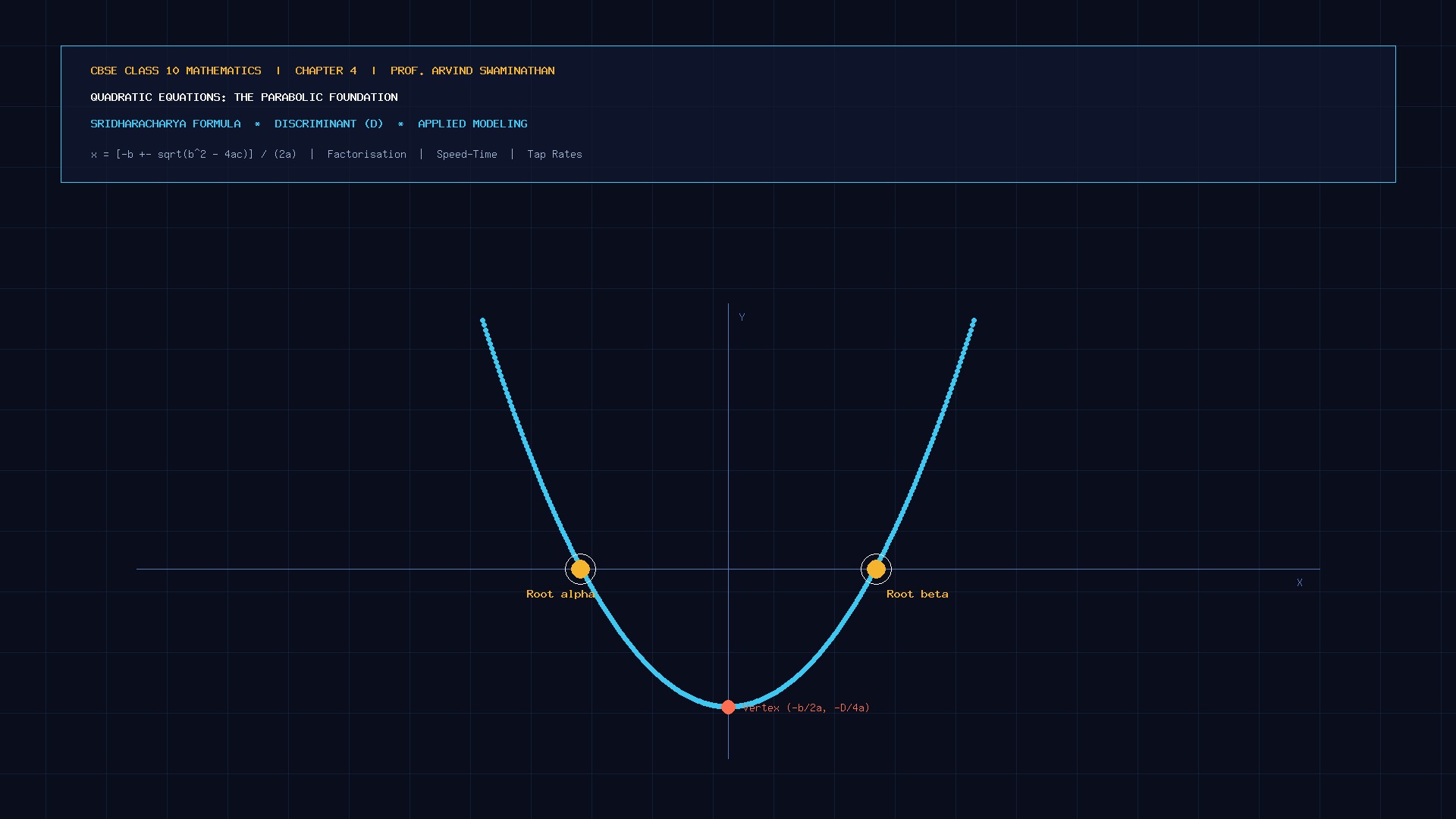
A parabola $y = ax^2 + bx + c$ plots dynamically across the screen. Two glowing points on the $x$-axis pulse with light: $\alpha$ and $\beta$.
**Prof. Arvind Swaminathan**:
"What is a root of a quadratic equation?
A real number $\alpha$ is called a root of $ax^2 + bx + c = 0$ if substituting $x = \alpha$ makes the equation true: $a\alpha^2 + b\alpha + c = 0$.
Geometrically, if you graph the curve $y = ax^2 + bx + c$, the roots are simply the points where the parabola crosses or touches the $x$-axis.
And because a parabola is a simple U-shaped curve, it can cross the $x$-axis at most twice. Therefore, a quadratic equation can have at most **two real roots**."
---
### [05:40 - 06:45] The Road to Mastery Ahead
**Visual Scene**:
A diagrammatic flowchart displays the upcoming stages: Factorisation (Splitting the Middle Term), Sridharacharya Quadratic Formula, Discriminant Analysis, and Real-World Word Problems.
**Prof. Arvind Swaminathan**:
"Over the next steps, we will master two premier problem-solving engines: **Factorisation by splitting the middle term**, and the thousand-year-old Indian breakthrough—the **Sridharacharya Quadratic Formula**, along with its diagnostic powerhouse, the **Discriminant $D = b^2 - 4ac$**.
We will also tackle the 4 big real-world application families: rectangular plots, consecutive integers, uniform speed trains, and water tap rates.
Let's conquer Chapter 4 together. I will see you in Step 2!"
Diagnostic Quiz & Mastery MCQs: CBSE Class 10 Board Standards
This 📝 LaTeX Concept Notes is part of the full verified curriculum for Chapter 4: Quadratic Equations. Unlock the full deck to gain permanent access to all 13 interactive stages, active recall cards, and diagnostic checkpoints.
Diagnostic Quiz & Mastery MCQs: CBSE Class 10 Board Standards
This 📝 LaTeX Concept Notes is part of the full verified curriculum for Chapter 4: Quadratic Equations. Unlock the full deck to gain permanent access to all 13 interactive stages, active recall cards, and diagnostic checkpoints.
Diagnostic Quiz & Mastery MCQs: CBSE Class 10 Board Standards
This 📝 LaTeX Concept Notes is part of the full verified curriculum for Chapter 4: Quadratic Equations. Unlock the full deck to gain permanent access to all 13 interactive stages, active recall cards, and diagnostic checkpoints.
Diagnostic Quiz & Mastery MCQs: CBSE Class 10 Board Standards
This 📝 LaTeX Concept Notes is part of the full verified curriculum for Chapter 4: Quadratic Equations. Unlock the full deck to gain permanent access to all 13 interactive stages, active recall cards, and diagnostic checkpoints.
Diagnostic Quiz & Mastery MCQs: CBSE Class 10 Board Standards
This 📝 LaTeX Concept Notes is part of the full verified curriculum for Chapter 4: Quadratic Equations. Unlock the full deck to gain permanent access to all 13 interactive stages, active recall cards, and diagnostic checkpoints.
Diagnostic Quiz & Mastery MCQs: CBSE Class 10 Board Standards
This 📝 LaTeX Concept Notes is part of the full verified curriculum for Chapter 4: Quadratic Equations. Unlock the full deck to gain permanent access to all 13 interactive stages, active recall cards, and diagnostic checkpoints.
Diagnostic Quiz & Mastery MCQs: CBSE Class 10 Board Standards
This 📝 LaTeX Concept Notes is part of the full verified curriculum for Chapter 4: Quadratic Equations. Unlock the full deck to gain permanent access to all 13 interactive stages, active recall cards, and diagnostic checkpoints.
Diagnostic Quiz & Mastery MCQs: CBSE Class 10 Board Standards
This 📝 LaTeX Concept Notes is part of the full verified curriculum for Chapter 4: Quadratic Equations. Unlock the full deck to gain permanent access to all 13 interactive stages, active recall cards, and diagnostic checkpoints.
Diagnostic Quiz & Mastery MCQs: CBSE Class 10 Board Standards
This 📝 LaTeX Concept Notes is part of the full verified curriculum for Chapter 4: Quadratic Equations. Unlock the full deck to gain permanent access to all 13 interactive stages, active recall cards, and diagnostic checkpoints.
Movement 1: The Cosmic Geometry of Quadratic Relationships
00:00Movement 2: The Two Solving Engines: Factorisation vs The Formula
00:00Movement 3: The Discriminant: The Diagnostic Probe of Reality
00:00Movement 4: Deconstructing Real-World Applied Archetypes
00:00Movement 5: The Exam Hall Master Checklist
00:00**CBSE Class 10 Mathematics • Chapter 4: Quadratic Equations**
**Step 11 | Duration: 21:00 min (~5,300 characters) | Narrator: Prof. Arvind Swaminathan**
---
### [00:00 - 04:00] Movement 1: The Cosmic Geometry of Quadratic Relationships
Namaste and welcome to this deep-dive audio masterclass on Quadratic Equations. I am Prof. Arvind Swaminathan.
Close your eyes and visualize motion. When light shines from a flashlight, its reflector is shaped as a parabola. When a fountain jets water high into the evening air, the glistening stream bends gracefully along a parabolic trajectory. When a planet orbits the sun or a satellite broadcasts signals across continents, the mathematics underlying their curves is fundamentally quadratic: $ax^2 + bx + c = 0$.
In linear algebra, everything grows uniformly. If one pen costs ₹5, two pens cost ₹10. But in the physical universe, quantities often multiply by themselves. Gravitational fall accelerates with time squared. Kinetic energy increases with velocity squared. The surface area of any biological organism scales with the square of its linear dimensions.
Over a millennium ago in ancient India, mathematicians like Brahmagupta and Sridharacharya recognized that quadratic relationships were not mere puzzles, but universal patterns. Sridharacharya formulated the celebrated rule of completing the square, giving humanity a universal key to unlock any quadratic equation in closed algebraic form. Today, we stand on the shoulders of these mathematical giants to master this foundation for your board examinations.
---
### [04:00 - 08:30] Movement 2: The Two Solving Engines: Factorisation vs The Formula
Let us compare the two great analytical engines you possess: Factorisation by splitting the middle term, and the Sridharacharya Quadratic Formula.
When you factorise $ax^2 + bx + c = 0$, you are looking for two numbers that multiply to give $a \cdot c$ and add together to give $b$. When those numbers are clean integers, factorisation is exceptionally swift. But factorisation relies on pattern matching. What happens when the roots are irrational, like $\frac{3 \pm \sqrt{5}}{2}$? Your intuition cannot easily guess numbers that multiply to $-1$ and add to $3$.
That is where the Sridharacharya Quadratic Formula proves its absolute supremacy:
$$x = \frac{-b \pm \sqrt{b^2 - 4ac}}{2a}$$
This formula works unconditionally on every single quadratic equation ever written. Whether the coefficients are integers, fractions, or radicals like $\sqrt{3}x^2 + 10x + 7\sqrt{3} = 0$, the formula delivers exact roots with mechanical certainty.
Notice how the formula was forged: we multiplied the standard equation by $4a$, transformed the $x^2$ and $x$ terms into a perfect square $(2ax + b)^2$, balanced the equation with $b^2 - 4ac$ on the right side, took the square root, and isolated $x$. It is a masterclass in algebraic harmony.
---
### [08:30 - 13:00] Movement 3: The Discriminant: The Diagnostic Probe of Reality
Inside the square root of the quadratic formula lies the most powerful diagnostic expression in secondary algebra:
$$D = b^2 - 4ac$$
We call it the **Discriminant** because it discriminates between the three physical realities of roots without requiring you to solve the equation.
When $D$ is strictly positive ($D > 0$), the square root of $D$ is a real, positive number. The $\pm$ sign branches into two distinct paths: $-b + \sqrt{D}$ and $-b - \sqrt{D}$. This produces **two distinct real roots**. Geometrically, the parabola plunges down, crosses the $x$-axis at $\alpha$, curves below, and ascends back up across the $x$-axis at $\beta$.
When $D$ is exactly zero ($D = 0$), the square root of zero is zero. The $\pm$ branch collapses into nothingness! The two roots merge into one repeated value: $x = -\frac{b}{2a}$. Geometrically, the vertex of the parabola touches the $x$-axis at exactly one point of tangency before turning around.
When $D$ is negative ($D < 0$), you are faced with the square root of a negative number. In the realm of real numbers, no real number squared can equal a negative quantity. Therefore, the equation has **no real roots**. Geometrically, the parabola floats entirely above the $x$-axis (if $a > 0$) or sits entirely below it (if $a < 0$), never touching the axis at any point.
In board exams, remember: whenever a question says *"Find the value of $k$ for which the equation has equal real roots"*, write down $D = b^2 - 4ac = 0$ immediately. It is an instant guarantee of marks.
---
### [13:00 - 17:30] Movement 4: Deconstructing Real-World Applied Archetypes
Now, let us examine how real-world stories transform into quadratic equations.
The first archetype is the **Speed, Distance, and Time Problem**. A train travels $360\text{ km}$. If it travels $5\text{ km/h}$ faster, it saves $1\text{ hour}$.
Remember: Time equals distance divided by speed. The slower journey takes more time than the faster journey. Therefore, write:
$$\frac{360}{v} - \frac{360}{v + 5} = 1$$
Always subtract the smaller time (faster speed) from the larger time (slower speed). Cross-multiplying leads directly to $v^2 + 5v - 1800 = 0$, giving $v = 40\text{ km/h}$.
The second archetype is the **Reciprocal Work Rate Problem**, such as two water taps filling a swimming pool or cistern. If a smaller tap takes $x$ hours, its rate of filling per hour is $\frac{1}{x}$. If the larger tap takes $10$ hours less, its rate is $\frac{1}{x - 10}$. Their combined rate is the reciprocal of the total time. You set up:
$$\frac{1}{x} + \frac{1}{x - 10} = \frac{1}{T_{\text{total}}}$$
When you solve the resulting quadratic equation, you will often find two mathematical solutions—for instance, $x = 25$ and $x = 3.75$. But look closely: if $x = 3.75$, the larger tap would take $3.75 - 10 = -6.25$ hours! Time cannot be negative. You must explicitly discard the extraneous root and state your final physical answer clearly.
---
### [17:30 - 21:00] Movement 5: The Exam Hall Master Checklist
Before you conclude this masterclass, burn these three golden examination rules into your mental compass:
Rule 1: Always check for standard form first. Expand every bracket, transpose all terms to the left-hand side so that zero is isolated on the right, and clearly write down your identified values of $a$, $b$, and $c$.
Rule 2: When calculating $b^2 - 4ac$, watch the sign of $c$! If $c$ is negative, $-4ac$ becomes $-4(a)(-c) = +4ac$! Adding a positive number increases the discriminant. A huge number of students lose marks by turning this into a subtraction.
Rule 3: In the quadratic formula, do not forget the factor of $2a$ in the denominator! Writing $x = \frac{-b \pm \sqrt{D}}{2}$ instead of $2a$ is a devastating blunder whenever $a \neq 1$.
Quadratics are the bridge between straight lines and the curved beauty of the physical cosmos. Master the discriminant, trust the formula, and you will achieve absolute perfection in this chapter. Keep practicing, and I will meet you in Chapter 5!
Diagnostic Quiz & Mastery MCQs: CBSE Class 10 Board Standards
This 🧠 Active Recall Flashcards is part of the full verified curriculum for Chapter 4: Quadratic Equations. Unlock the full deck to gain permanent access to all 13 interactive stages, active recall cards, and diagnostic checkpoints.
Diagnostic Quiz & Mastery MCQs: CBSE Class 10 Board Standards
This ⚡ Diagnostic Quiz is part of the full verified curriculum for Chapter 4: Quadratic Equations. Unlock the full deck to gain permanent access to all 13 interactive stages, active recall cards, and diagnostic checkpoints.