The Canonical 3D Solid Primitives & Metrics
Lead Educator: Prof. Arvind Swaminathan (Senior NCERT Mathematics Faculty)
? Visual Concept Diagrams & Figures
1. The Building Blocks of Three-Dimensional Geometry
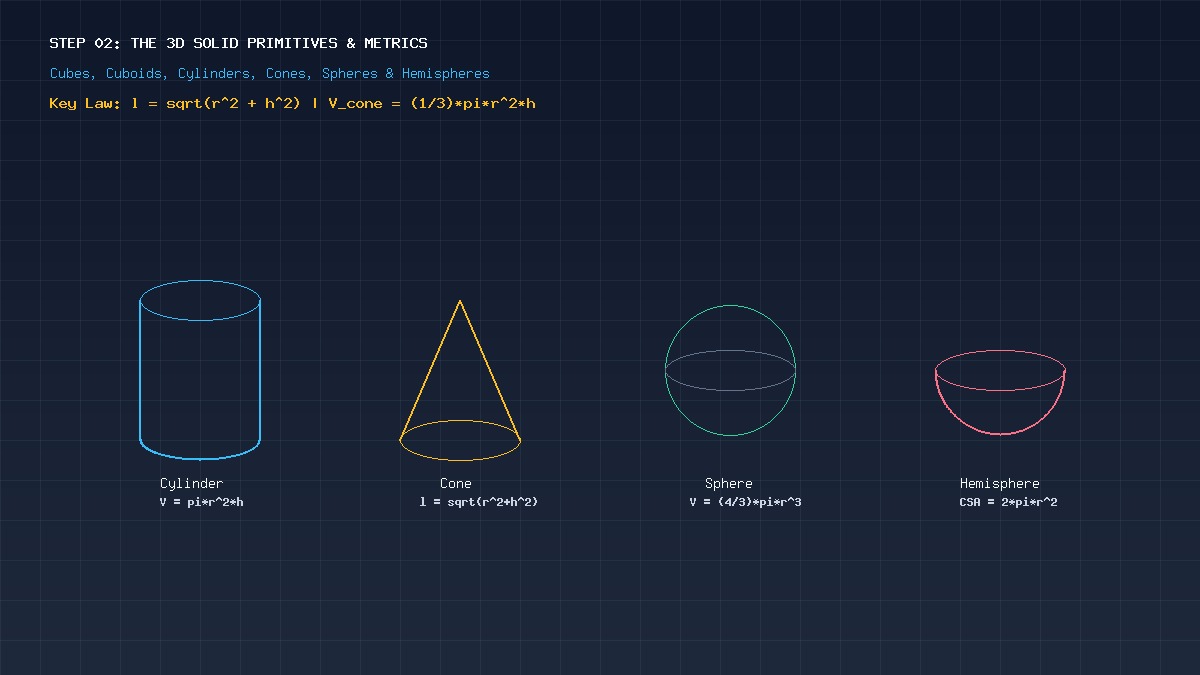
Every composite structure in engineering is an assembly or excavation of the 6 fundamental solid primitives:
- Cube (Edge $a$):
- Lateral Surface Area (LSA) $= 4a^2$
- Total Surface Area (TSA) $= 6a^2$
- Volume ($V$) $= a^3$
- Space Diagonal $= \sqrt{3}a$
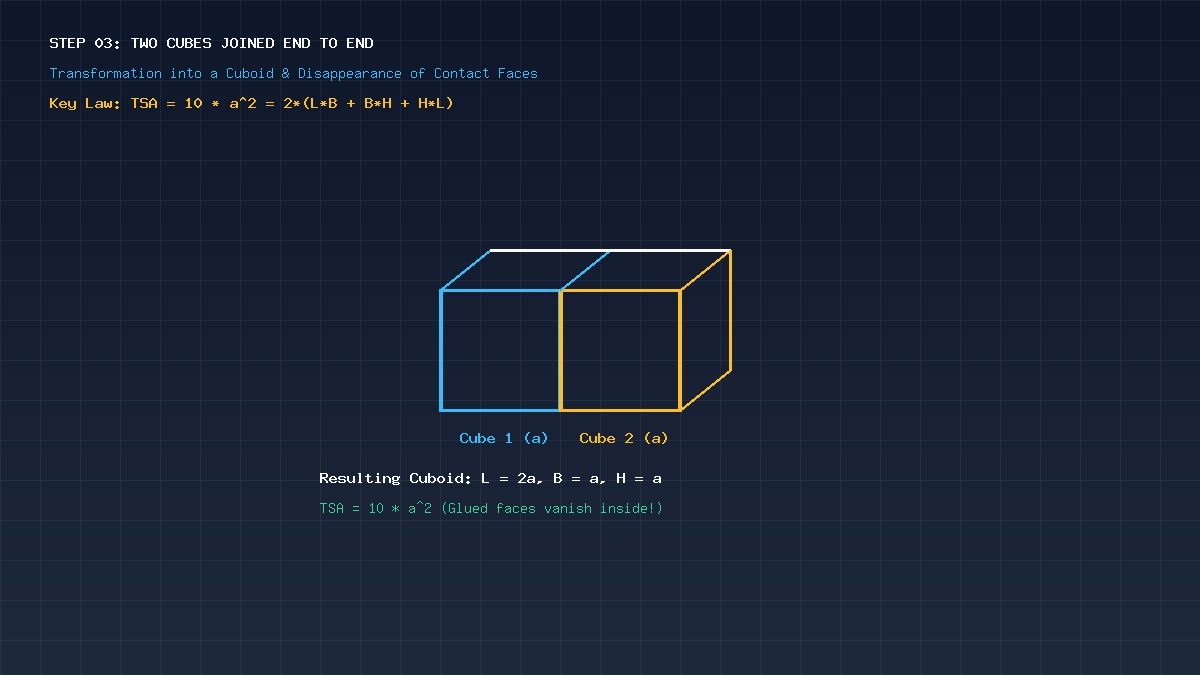
- Cuboid (Dimensions $l, b, h$):
- Lateral Surface Area $= 2h(l + b)$
- Total Surface Area $= 2(lb + bh + hl)$
- Volume $= l \times b \times h$
- Space Diagonal $= \sqrt{l^2 + b^2 + h^2}$
- Right Circular Cylinder (Radius $r$, Height $h$):
- Curved Surface Area (CSA) $= 2\pi rh$
- Total Surface Area $= 2\pi r(r + h)$
- Volume $= \pi r^2 h$
- Right Circular Cone (Radius $r$, Height $h$, Slant Height $l$):
- Slant Height Formula: $\mathbf{l = \sqrt{r^2 + h^2}}$
- Curved Surface Area $= \pi r l$
- Total Surface Area $= \pi r(r + l)$
- Volume $= \frac{1}{3}\pi r^2 h$
- Sphere (Radius $r$):
- Surface Area (CSA $=$ TSA) $= 4\pi r^2$
- Volume $= \frac{4}{3}\pi r^3$
- Hemisphere (Radius $r$):
- Curved Surface Area $= 2\pi r^2$
- Total Surface Area (including flat circular base) $= 3\pi r^2$
- Volume $= \frac{2}{3}\pi r^3$