📑 Interactive Chapter Bookmarks
0 chapters🎙️ Synchronized Transcript
**CBSE Class 10 Mathematics • Chapter 6: Triangles**
**Step 1 | Target Duration: 06:45 min | Educator: Prof. Arvind Swaminathan**
---
### [00:00 - 01:15] Hook: Measuring the Immeasurable
**Visual Scene**:
Prof. Arvind Swaminathan stands before an immersive panoramic projection of the Great Pyramid of Giza. In the foreground, an ancient Greek scholar holds a vertical staff in the sand as the afternoon sun casts two parallel shadows.
**Prof. Arvind Swaminathan**:
"Namaste students! Over two thousand five hundred years ago, the Greek philosopher and mathematician Thales stood in the scorching sands of Egypt. The Egyptian Pharaohs challenged visitors: *'Can anyone measure the exact height of the Great Pyramid of Giza?'*
Think about it: how do you measure something taller than a 40-story skyscraper without climbing it? You cannot drop a measuring tape through solid stone!
Thales smiled. He placed a wooden stick vertically into the sand. He waited until the length of the stick's shadow was exactly equal to the height of the stick. At that exact moment, he said: *'Measure the shadow of the pyramid! Its shadow is equal to its height!'*
And even when the shadow wasn't equal, Thales discovered something far greater: the ratio of height to shadow is ALWAYS identical for any two objects under the same sun!
Welcome to the revolutionary world of **Similar Triangles**. Today, we unlock the secret geometry of scaling, proportions, and the famous **Basic Proportionality Theorem**!"
---
### [01:15 - 02:40] Congruence vs. Similarity: Shape vs. Size
**Visual Scene**:
A graphic split-screen displays a standard passport photo on the left, an identical passport photocopy in the center, and a massive 20-foot outdoor billboard of the exact same photograph on the right.
**Prof. Arvind Swaminathan**:
"In Class 9, you studied **Congruence**.
Two figures are congruent if they have the exact same shape AND the exact same size. Think of two ₹10 coins from the same minting batch: you can lay one directly on top of the other, and they match point-for-point.
In Class 10, we graduate to **Similarity**.
Two figures are similar if they have the **exact same shape**, even if their sizes are vastly different!
When you take a picture on your smartphone and pinch-to-zoom, does your face get distorted? No! The nose, eyes, and chin expand in exact, uniform proportion.
For triangles, similarity requires two mathematical conditions:
1. Every corresponding angle must be identical!
2. Every pair of corresponding sides must share the exact same scaling ratio!
If both conditions are met, the triangles are similar: $\Delta ABC \sim \Delta DEF$."
---
### [02:40 - 04:30] The Basic Proportionality Theorem (Thales Theorem)
**Visual Scene**:
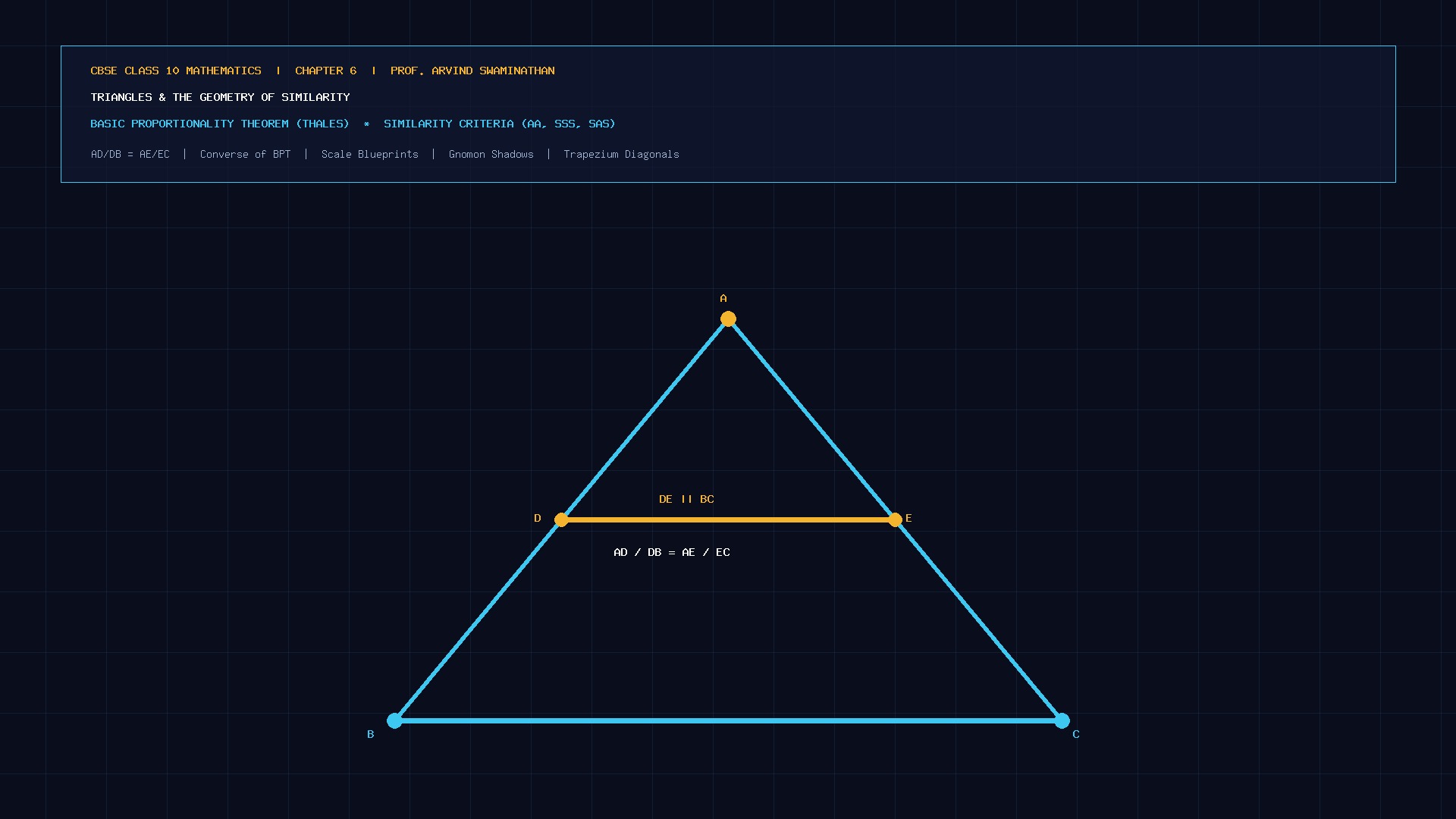
A large triangle $\Delta ABC$ appears on the virtual board. A glowing horizontal line $DE$ cuts across sides $AB$ and $AC$, strictly parallel to the base $BC$. Fractions $\frac{AD}{DB}$ and $\frac{AE}{EC}$ highlight in bright cyan and gold.
**Prof. Arvind Swaminathan**:
"Now look at the master theorem of this entire chapter: the **Basic Proportionality Theorem**, or **BPT**.
Take any triangle $ABC$. Draw a line $DE$ parallel to the base $BC$.
The moment you draw this parallel line, it slices the two sides into pieces. And Thales proved that the ratio of the segments on the left side is EQUAL to the ratio of the segments on the right side!
$$\frac{AD}{DB} = \frac{AE}{EC}$$
Why? We prove it by comparing triangle areas!
The area of $\Delta ADE$ compared to $\Delta BDE$ gives $\frac{AD}{DB}$.
The area of $\Delta ADE$ compared to $\Delta CDE$ gives $\frac{AE}{EC}$.
And because triangles $BDE$ and $CDE$ sit on the exact same base $DE$ between the same parallel lines, their areas are identical!
This proves BPT with crystalline perfection. It is a guaranteed 5-mark theorem in your board exams!"
---
### [04:30 - 05:45] The Big Trap: BPT vs. Similarity of the Base
**Visual Scene**:
A flashing red warning sign: "EXAM TRAP ALERT!". An arrow points to the segment $DE$ and the base $BC$.
**Prof. Arvind Swaminathan**:
"Here is where thousands of students lose marks. Listen carefully!
BPT tells you: $\frac{AD}{DB} = \frac{AE}{EC}$.
Can you say: $\frac{DE}{BC} = \frac{AD}{DB}$?
NO! Absolutely NOT!
$DE$ and $BC$ are sides of the triangles $\Delta ADE$ and $\Delta ABC$. To compare $DE$ to $BC$, you must compare the small triangle to the ENTIRE large triangle!
$$\frac{DE}{BC} = \frac{AD}{AB} = \frac{AE}{AC}$$
Remember: $\frac{AD}{AB}$ uses the full side $AB$, NOT just the small bottom piece $DB$! Never confuse BPT ratios with full triangle similarity ratios."
---
### [05:45 - 06:45] The Road to Mastery Ahead
**Visual Scene**:
A roadmap displays the 3 criteria (AA, SSS, SAS) and applied real-world models: measuring lamp-post shadows and trapezium diagonals.
**Prof. Arvind Swaminathan**:
"Over the next steps of this deck, you will master the three similarity criteria—**AA**, **SSS**, and **SAS**—and learn how to solve real-world problems like tracking the shadow of a girl walking away from a street lamp.
Study the step-by-step visual diagrams, test your intuition with the flashcards, and let's turn triangle geometry into pure scoring power. See you in Step 2!"
Diagnostic Quiz & Mastery MCQs: CBSE Class 10 Board Standards
This 📝 LaTeX Concept Notes is part of the full verified curriculum for Chapter 6: Triangles. Unlock the full deck to gain permanent access to all 13 interactive stages, active recall cards, and diagnostic checkpoints.
Diagnostic Quiz & Mastery MCQs: CBSE Class 10 Board Standards
This 📝 LaTeX Concept Notes is part of the full verified curriculum for Chapter 6: Triangles. Unlock the full deck to gain permanent access to all 13 interactive stages, active recall cards, and diagnostic checkpoints.
Diagnostic Quiz & Mastery MCQs: CBSE Class 10 Board Standards
This 📝 LaTeX Concept Notes is part of the full verified curriculum for Chapter 6: Triangles. Unlock the full deck to gain permanent access to all 13 interactive stages, active recall cards, and diagnostic checkpoints.
Diagnostic Quiz & Mastery MCQs: CBSE Class 10 Board Standards
This 📝 LaTeX Concept Notes is part of the full verified curriculum for Chapter 6: Triangles. Unlock the full deck to gain permanent access to all 13 interactive stages, active recall cards, and diagnostic checkpoints.
Diagnostic Quiz & Mastery MCQs: CBSE Class 10 Board Standards
This 📝 LaTeX Concept Notes is part of the full verified curriculum for Chapter 6: Triangles. Unlock the full deck to gain permanent access to all 13 interactive stages, active recall cards, and diagnostic checkpoints.
Diagnostic Quiz & Mastery MCQs: CBSE Class 10 Board Standards
This 📝 LaTeX Concept Notes is part of the full verified curriculum for Chapter 6: Triangles. Unlock the full deck to gain permanent access to all 13 interactive stages, active recall cards, and diagnostic checkpoints.
Diagnostic Quiz & Mastery MCQs: CBSE Class 10 Board Standards
This 📝 LaTeX Concept Notes is part of the full verified curriculum for Chapter 6: Triangles. Unlock the full deck to gain permanent access to all 13 interactive stages, active recall cards, and diagnostic checkpoints.
Diagnostic Quiz & Mastery MCQs: CBSE Class 10 Board Standards
This 📝 LaTeX Concept Notes is part of the full verified curriculum for Chapter 6: Triangles. Unlock the full deck to gain permanent access to all 13 interactive stages, active recall cards, and diagnostic checkpoints.
Diagnostic Quiz & Mastery MCQs: CBSE Class 10 Board Standards
This 📝 LaTeX Concept Notes is part of the full verified curriculum for Chapter 6: Triangles. Unlock the full deck to gain permanent access to all 13 interactive stages, active recall cards, and diagnostic checkpoints.
Movement 1: The Philosophical Elegance of Scale
00:00Movement 2: Thales, Area Ratios & The Master Proof of BPT
00:00Movement 3: The Three Similarity Engines: AA, SSS & SAS
00:00Movement 4: The Art of Symbolic Correspondence & Real-World Shadows
00:00Movement 5: The Exam Hall Master Checklist
00:00**CBSE Class 10 Mathematics • Chapter 6: Triangles**
**Step 11 | Duration: 21:00 min (~5,300 characters) | Narrator: Prof. Arvind Swaminathan**
---
### [00:00 - 04:00] Movement 1: The Philosophical Elegance of Scale
Namaste and welcome to this deep-dive audio masterclass on Triangles and the Geometry of Similarity. I am Prof. Arvind Swaminathan.
Look around the room where you are sitting. Everything that humans have built—the screen in front of you, the house enclosing you, the roads outside—began as a scaled drawing. An architect does not construct a skyscraper by sketching on a thousand-foot sheet of paper. They draw a blueprint on a small desk surface, where one centimeter represents ten meters. When the construction crew pours concrete, every wall, arch, and doorway expands uniformly according to that exact mathematical scale.
In nature, scaling is equally fundamental. When an eagle soars high in the sky, its shadow expands across the valley below. When light rays pass through the lens of your eye, a vast mountain landscape shrinks down to focus onto a tiny patch of retina measuring only a few millimeters. The physical world retains its angular integrity across billions of magnitude scales.
In ancient India, the *Sulba Sutras* laid down rigorous geometric rules for altar construction, demanding that fire altars of different surface areas maintain the exact same shape and proportional proportions. Today, that geometry of scaling is formalized through the concept of **Similar Triangles**.
---
### [04:00 - 08:30] Movement 2: Thales, Area Ratios & The Master Proof of BPT
Let us examine the foundational theorem of proportional geometry: the **Basic Proportionality Theorem**, or Thales Theorem.
Picture any triangle $ABC$. Draw a straight line $DE$ that cuts through side $AB$ at $D$ and side $AC$ at $E$, such that $DE$ runs strictly parallel to the third side $BC$.
The theorem asserts that $\frac{AD}{DB} = \frac{AE}{EC}$.
Why is this true? The beauty of the proof lies in using area ratios as a measuring tool.
Recall that the area of any triangle is half base times height. If you look at $\Delta ADE$ and $\Delta BDE$, they share the exact same vertex $E$. Therefore, the perpendicular dropped from $E$ down to the line $AB$ serves as the altitude for BOTH triangles! When you compute the ratio of their areas, the factor of one-half and the altitude cancel completely, leaving only the ratio of their bases: $\frac{AD}{DB}$.
Now turn your eyes to the other side: $\Delta ADE$ and $\Delta CDE$. Taking their bases along $AC$ with an altitude from $D$, the ratio of their areas simplifies to $\frac{AE}{EC}$.
Here is the masterstroke: look at the two triangles in the denominator—$\Delta BDE$ and $\Delta CDE$. Both of them rest on the very same base segment $DE$. Both of them stretch between the exact same parallel lines $DE$ and $BC$! From Class 9 geometry, two triangles on the same base and between the same parallels have identical areas. Because their numerators are identical and their denominators are equal, their area ratios must be equal: $\frac{AD}{DB} = \frac{AE}{EC}$.
It is one of the most elegant proofs in all of classical geometry.
---
### [08:30 - 13:00] Movement 3: The Three Similarity Engines: AA, SSS & SAS
Now, how do we prove that two separate triangles in space are similar? You do not need to measure all three angles and all three sides. You only need one of the three master criteria.
The first and most powerful criterion is **AA (Angle-Angle)**.
If you know that two angles of triangle 1 are equal to two angles of triangle 2, you are done! Why? Because the three angles of any triangle always add up to $180^\circ$. If two angles match, the third angle has no choice: it must match as well. Thus, AAA automatically collapses into AA. In board exams, AA is the workhorse: whenever lines are parallel, look for alternate interior angles or corresponding angles to prove AA similarity in two lines!
The second criterion is **SSS (Side-Side-Side)**.
If the ratio of all three pairs of corresponding sides is identical—$\frac{AB}{DE} = \frac{BC}{EF} = \frac{AC}{DF}$—then the shapes are guaranteed to be similar, and all their corresponding angles will automatically match.
The third criterion is **SAS (Side-Angle-Side)**.
Here is the examination trap: one angle must be equal ($\angle A = \angle D$), and the two sides flanking that angle must be proportional ($\frac{AB}{DE} = \frac{AC}{DF}$). If the given angle is not strictly sandwiched between the proportional sides, SAS fails!
---
### [13:00 - 17:30] Movement 4: The Art of Symbolic Correspondence & Real-World Shadows
Let us discuss the language of similarity: **Symbolic Correspondence**.
When you write $\Delta ABC \sim \Delta DEF$, you are signing a strict geometric contract. The order of letters specifies every vertex pairing: $A$ corresponds to $D$, $B$ corresponds to $E$, and $C$ corresponds to $F$.
If $\angle A = 50^\circ$ and in the second triangle $\angle E = 50^\circ$, you must NOT write $\Delta ABC \sim \Delta DEF$; you must write $\Delta ABC \sim \Delta EFD$! Examiners deduct marks instantly if the letter ordering does not match corresponding vertices.
Now consider real-world shadow problems. Imagine a girl of height $90\text{ cm}$ walking away from a street lamp of height $3.6\text{ meters}$.
Both the girl and the lamp stand perpendicular to the flat ground, creating right angles ($90^\circ$). The light rays from the lamp cast a shadow on the ground, creating a small right triangle for the girl and a large right triangle for the lamp post. Because they share the same tip angle where the shadow ends, the two triangles are similar by AA!
By setting the ratio of heights equal to the ratio of bases—$\frac{3.6}{0.9} = \frac{\text{Distance} + \text{Shadow}}{\text{Shadow}}$—the equation collapses into linear simplicity, giving the shadow length in seconds.
---
### [17:30 - 21:00] Movement 5: The Exam Hall Master Checklist
As we conclude this masterclass, fix these three golden guidelines into your mental checklist:
Rule 1: Always distinguish BPT from full triangle similarity. In $\Delta ABC$ with $DE \parallel BC$, BPT gives $\frac{AD}{DB} = \frac{AE}{EC}$. But when comparing the parallel segment $DE$ to base $BC$, you must compare $\Delta ADE$ to $\Delta ABC$: $\frac{DE}{BC} = \frac{AD}{AB}$, which uses the full side $AB$, NOT the segment $DB$!
Rule 2: In shadow problems, always ensure uniform units! If height is given in centimeters ($90\text{ cm}$) and lamp height is in meters ($3.6\text{ m}$), convert $90\text{ cm}$ to $0.9\text{ m}$ immediately before writing proportions.
Rule 3: In trapezium problems, draw the diagonals! Diagonals of a trapezium with $AB \parallel CD$ intersect at $O$ to form vertically opposite angles and alternate interior angles, giving $\Delta AOB \sim \Delta COD$ by AA similarity and proving $\frac{AO}{OC} = \frac{BO}{OD}$ with effortless speed.
Similar triangles are the lenses through which we measure the universe. Master the correspondence, trust BPT, and you will achieve absolute perfection in this chapter. Keep practicing, and I will see you in Chapter 7!
Diagnostic Quiz & Mastery MCQs: CBSE Class 10 Board Standards
This 🧠 Active Recall Flashcards is part of the full verified curriculum for Chapter 6: Triangles. Unlock the full deck to gain permanent access to all 13 interactive stages, active recall cards, and diagnostic checkpoints.
Diagnostic Quiz & Mastery MCQs: CBSE Class 10 Board Standards
This ⚡ Diagnostic Quiz is part of the full verified curriculum for Chapter 6: Triangles. Unlock the full deck to gain permanent access to all 13 interactive stages, active recall cards, and diagnostic checkpoints.